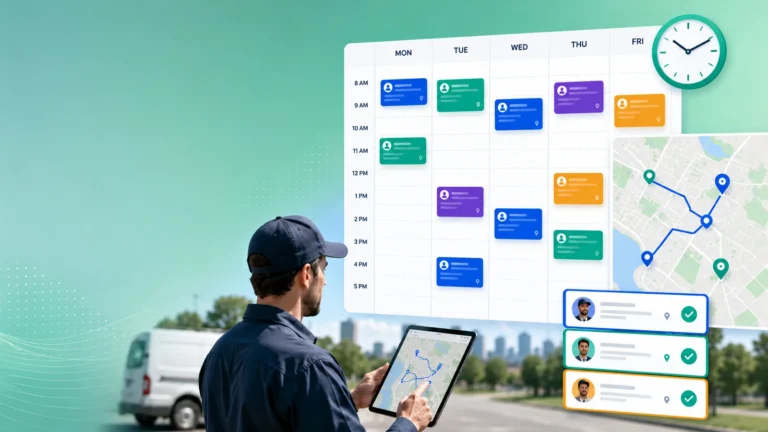
Carbon-aware scheduling cuts service emissions by reducing unnecessary journeys, assigning nearby technicians, grouping jobs geographically, and avoiding visits that are unlikely to resolve the problem. It adds environmental impact to the factors already used when planning field work.
A normal schedule may focus on skills, availability, urgency, service-level agreements, and appointment windows. A carbon-aware schedule still respects those requirements, but it also considers how much travel each assignment creates.
The goal is not to delay urgent repairs or send an unsuitable technician simply because they are closer. It is to remove avoidable travel while maintaining service quality.
Emissions Are Often Built Into the Schedule
A large share of field service travel is decided before a technician starts the vehicle. It is created when dispatch assigns the job, selects the appointment time, and decides where that work fits within the rest of the day.
A schedule can look full and productive while sending technicians back and forth across the same area. One technician may pass close to a customer in the morning, only for another technician to travel there later that afternoon.
Individual detours may seem small. Across dozens of technicians and hundreds of weekly appointments, they create additional mileage, fuel use, working time, and vehicle wear.
Carbon-aware scheduling looks at the complete movement plan rather than treating each job as an isolated appointment. It asks whether nearby work can be grouped, whether the most suitable local technician is available, and whether a different time slot would prevent a long return journey.
This connects closely with better routing in field service. Routing does more than find the fastest road between two addresses. It determines whether the entire service day follows a sensible geographical flow.
The cleanest schedule is not always the schedule with the fewest miles on paper. A shorter route has little value if it sends the wrong technician, misses an SLA, or creates a repeat visit.
Carbon reduction therefore needs to work alongside operational priorities rather than replacing them.
Better Decisions Before Dispatch Prevent Waste
The most effective way to reduce travel emissions is often to prevent unnecessary travel completely. That requires better decisions before the job enters the field schedule.
A vague service request can lead to a visit that was never properly qualified. The technician may arrive and discover that the issue could have been resolved remotely, the site is inaccessible, or the required part is not available.
That first journey creates emissions without delivering a complete outcome. A second visit then adds more travel because the initial response was poorly prepared.
Remote checks can help determine whether a visit is necessary and what the technician will need. Error codes, connected-asset data, customer photos, video support, and guided troubleshooting can provide useful context before dispatch.
Using remote diagnostics to reduce unnecessary truck rolls does not mean avoiding on-site service when it is needed. It means making sure the visit has a clear purpose and a realistic chance of resolving the issue.
Job timing also matters. A low-priority inspection may be moved to a day when several technicians are already working nearby, rather than creating a separate journey across the region.
This does not mean repeatedly delaying the customer for environmental reasons. The customer should still receive confirmation, a clear appointment window, and an explanation of what will happen next.
Carbon-aware scheduling works best when it reduces waste without making service less reliable.
A Real Schedule Shows the Difference
Consider a company that maintains commercial heating systems across a city and its surrounding towns. On Monday morning, a customer reports that one office floor is not heating correctly.
The issue is uncomfortable but not an emergency because the rest of the building is operating normally. The customer wants confirmation that the request has been received, an appointment window, and advice on whether the affected area can remain in use.
The nearest technician has general heating experience but is not certified for that particular control system. Another qualified technician is scheduled to work near the customer the following morning.
A distance-only system might assign the closest person immediately. That technician could travel to the site, identify a control fault, and then leave because the repair requires a specialist.
The customer would need a second appointment. Two technicians would travel to the same building, and the service team would use two schedule slots for one issue.
A carbon-aware system considers skills, location, urgency, likely duration, and the probability of completing the work. It schedules the qualified technician for the next morning when that person will already be working nearby.
Before confirming the appointment, the dispatcher asks the customer to share the controller error code. The likely replacement component is then reserved and added to the technician’s stock.
The customer receives a confirmed morning window and temporary operating guidance. The technician completes the repair in one visit while travelling only a short distance from the previous job.
The lower-emission choice is also the better service choice. It avoids an unproductive journey, protects technician time, and gives the customer a more reliable resolution.
Carbon Awareness Must Work With Live Conditions
A schedule created at 7:00 a.m. may no longer be practical by midday. Jobs run long, emergency calls arrive, customers cancel, technicians report vehicle problems, and traffic conditions change.
Carbon-aware scheduling must therefore be dynamic. It should reconsider the route when the day changes rather than protecting the original plan at all costs.
Suppose an urgent refrigeration failure appears near a technician who is finishing another job. Reassigning that technician may prevent someone from travelling across the city, but only when the technician has the right skills and parts.
The system also needs to understand the cost of disruption. Moving one appointment may shorten a route but cause another customer to miss a promised window.
Good scheduling weighs these effects together. It may recommend a lower-emission option while allowing the dispatcher to see its impact on SLAs, customer commitments, overtime, and technician workload.
This is where AI-supported field service scheduling can help. Scheduling systems can compare more combinations than a dispatcher can reasonably assess during a busy service day.
Human judgment still matters. A dispatcher may know that a particular site has restricted access, a customer has already experienced two delays, or a technician is finishing a physically demanding job and should not receive another complex assignment.
Carbon awareness should improve the dispatcher’s options, not hide operational realities behind an automated score.
Service Teams Need Practical Measures
A business cannot improve carbon-aware scheduling if it only tracks the total fuel bill. That number may rise or fall because of fuel prices, fleet changes, service demand, or regional growth.
More useful measures connect emissions to service activity. Teams can monitor travel distance per completed job, repeat journeys, unnecessary truck rolls, technician idle travel, jobs completed within local territories, and visits grouped into the same area.
First-time fix rate also matters. A shorter initial journey is not a success if incomplete preparation creates another visit two days later.
Managers should review customer outcomes alongside environmental measures. Arrival-window reliability, response time, completion rate, and customer communication should remain visible.
The best improvement may come from simple operational changes. Better job intake can prevent incorrect dispatches, stronger territory planning can reduce cross-region travel, and improved parts readiness can avoid repeat visits.
Electric vehicles can reduce tailpipe emissions, but they do not make poor scheduling efficient. An electric van still uses energy, technician time, and road capacity when it is sent on an unnecessary journey.
Carbon-aware scheduling addresses the decision behind the journey. It helps the business determine whether the visit is needed, who should complete it, when it should happen, and how it fits with nearby work.
That is how service teams cut emissions without treating sustainability as a separate project. They build it into the same scheduling decisions that already shape cost, capacity, technician workload, and customer experience.