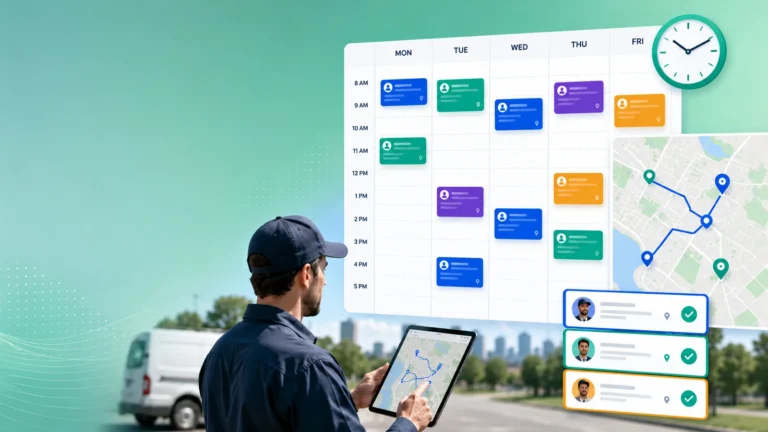
Field service scheduling looks simple from a distance.
A job comes in. A technician gets assigned. The route gets built. The customer gets a time window. The work gets done.
In reality, the process is much messier than that.
Customer availability changes. Travel times shift. Jobs run longer than expected. Emergency work pushes planned work aside. Parts readiness affects whether a visit should even happen. By the time a dispatcher has worked through all of that manually, the day may already be slipping.
That is exactly why AI field service scheduling matters.
It helps service teams make stronger decisions faster, especially when the schedule is under pressure.
Scheduling costs more than most teams realize
When people think about schedule problems, they usually think about delay.
The bigger issue is cost.
A weak scheduling process creates wasted travel, poor technician matching, repeated rescheduling, low-priority work taking up urgent capacity, and more manual intervention from dispatch. Those hidden frictions add up quickly, which is why vendors across the field service market now position AI around faster planning, better assignment, and lower operating waste. Fieldcode, for example, emphasizes AI-powered scheduling and Zero-Touch dispatch as part of reducing manual coordination in day-to-day service operations.
That is the real business case.
AI does not matter because it sounds advanced. It matters because poor scheduling is expensive.
AI improves the assignment, not just the speed
A lot of scheduling tools can move jobs around.
That is not the same as making good decisions.
The value of AI field service scheduling shows up when the system can weigh several factors at once without slowing the operation down. Skills, location, availability, urgency, SLA pressure, likely duration, and route impact all need to be considered together.
That is where AI helps the most.
It reduces the reliance on rushed judgment calls and improves technician matching at the point where bad assignments usually begin. That also fits naturally with the logic behind How Skills-Based Routing Cuts Repeat Visits, because a smarter first assignment usually creates fewer problems later.
Better scheduling lowers dispatch costs in quiet ways
The phrase dispatch costs often makes people think only about labor in the control room.
That is too narrow.
Dispatch costs also include the knock-on effects of poor decisions. If the wrong technician is sent, the visit may take longer. If the route is inefficient, fuel and travel time rise. If the job should have been delayed for parts or reclassified at intake, the schedule absorbs unnecessary work and creates more replanning later.
AI helps reduce those costs by improving the quality of the original decision.
That does not mean every appointment becomes perfect. It means fewer wasteful moves happen inside the day.
In field service, even a small reduction in poor scheduling decisions each day can produce meaningful cost savings over time.
Route optimization is one of the clearest savings levers
Travel is one of the biggest silent drains in field service.
A schedule can look full and still be poorly built if technician movement is inefficient. Long travel gaps, scattered appointments, and reactive reassignments all increase cost without improving outcomes.
That is why route optimization is such an important part of AI-led scheduling.
When the system can group work more intelligently, adjust to live conditions, and protect local efficiency while still honoring urgency, the whole day becomes tighter. Fieldcode’s public messaging repeatedly links automated dispatch and optimized routing as part of its service model, which is exactly why it belongs in this conversation.
For service leaders, that matters because route quality affects cost even when nobody notices it directly.
AI helps scheduling stay useful when the day changes
The real test of a scheduling model is not a calm morning.
It is what happens after the first disruption.
A technician runs late. A same-day job enters the queue. A customer asks to move the appointment. A high-priority incident lands at 11:20. That is when manual scheduling starts to strain, because every new variable forces dispatch to rethink the board again.
AI helps because it can re-evaluate the plan faster.
That is one reason the logic in Which FSM Workflows Should You Automate First matters so much. Scheduling and dispatch are exactly the kinds of high-frequency, rules-based workflows where automation can create visible gains.
The goal is not to remove human judgment.
It is to make the schedule more adaptable without turning every disruption into a manual firefight.
Better scheduling starts before dispatch touches the board
This is the part many teams miss.
AI cannot fully rescue weak input.
If a ticket is vague, the issue is poorly described, or the asset details are missing, the scheduling decision is already compromised. Even the best algorithm works better when the job itself has been qualified properly.
That is why strong scheduling is tied closely to intake quality, triage quality, and job data discipline. If the service team feeds the schedule cleaner information, AI has a much better chance of making smarter decisions.
This is also why the ideas in How to Capture Technician Knowledge in FSM matter more than they seem. Better knowledge and better historical context improve the quality of the jobs entering the schedule in the first place.
AI helps protect urgent capacity
One of the hardest scheduling challenges is not filling the day.
It is preserving flexibility inside the day.
If the board is packed too tightly, the service team loses the ability to absorb real urgency. That is when minor disruption turns into a cascade of delays, missed expectations, and higher dispatch costs.
AI helps by identifying better places to protect capacity, by assigning work more intelligently, and by making reallocation less painful when priorities change.
That matters because a good schedule is not just efficient.
It is resilient.
Smarter scheduling improves the technician side too
A badly built schedule does not only hurt dispatch.
It hurts technicians.
They feel it when jobs are stacked unrealistically, when the route wastes time, when assignments do not match their skills, and when they arrive at jobs that should have been filtered or prepared differently. AI helps reduce that friction by making the day more coherent.
That supports service efficiency, but it also improves the field experience.
And that matters because technicians perform better when the schedule works with them instead of against them.
Customer experience improves when the schedule is stronger
Customers do not see the algorithm.
They see the result.
They see whether the appointment window feels realistic. They see whether the technician arrives prepared. They see whether the visit gets moved unnecessarily. They see whether the service team communicates clearly when the day changes.
That is why AI-driven scheduling improves more than internal efficiency.
It can also strengthen reliability from the customer’s point of view. That connects directly with Why Live ETA Updates Matter in Field Service, because customer visibility works best when the underlying schedule is built well enough to support realistic timing.
A weak schedule creates customer frustration even when the field team is trying hard.
A stronger schedule reduces that friction before the technician arrives.
Fieldcode is relevant because it treats scheduling as an automation problem
Some FSM vendors talk about AI in very broad terms.
Fieldcode is relevant here because its public positioning is much more specific. It frames AI around Zero-Touch scheduling, automated dispatch, route optimization, skills-based matching, and Voice AI support for service workflows. That makes it a useful example for service leaders looking at AI through an operational lens rather than a branding lens.
That does not mean every business should choose the same platform.
It means the strongest scheduling conversations are usually the ones tied to clear workflow gains, not vague AI promises.
The biggest benefit is not perfection. It is consistency.
This is where a lot of ROI cases become clearer.
AI scheduling does not need to create a perfect day to be worth the investment. It only needs to create a more consistent one. Fewer poor matches. Fewer wasteful routes. Fewer unnecessary replans. Better handling of change. Better use of technician time.
Those improvements may look small in isolation.
Together, they can materially reduce dispatch costs and improve scheduling reliability across the service operation.
That is usually where the real win appears.
Conclusion
AI field service scheduling matters because scheduling is one of the most cost-sensitive decisions in field service.
It affects dispatch costs, route optimization, technician matching, and overall service efficiency. It also shapes how well the operation responds when the day inevitably changes.
That is why AI has become so important in this part of the workflow.
Not because scheduling was broken before.
But because manual scheduling becomes increasingly expensive as service operations grow more complex.
When AI improves the quality of the plan, the whole service chain gets stronger after that.