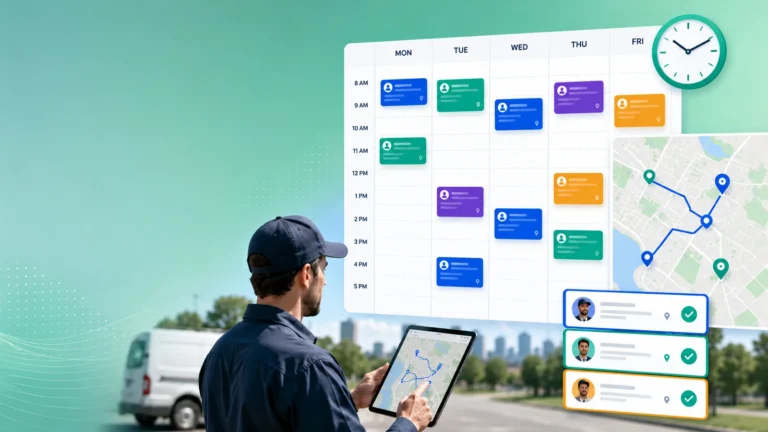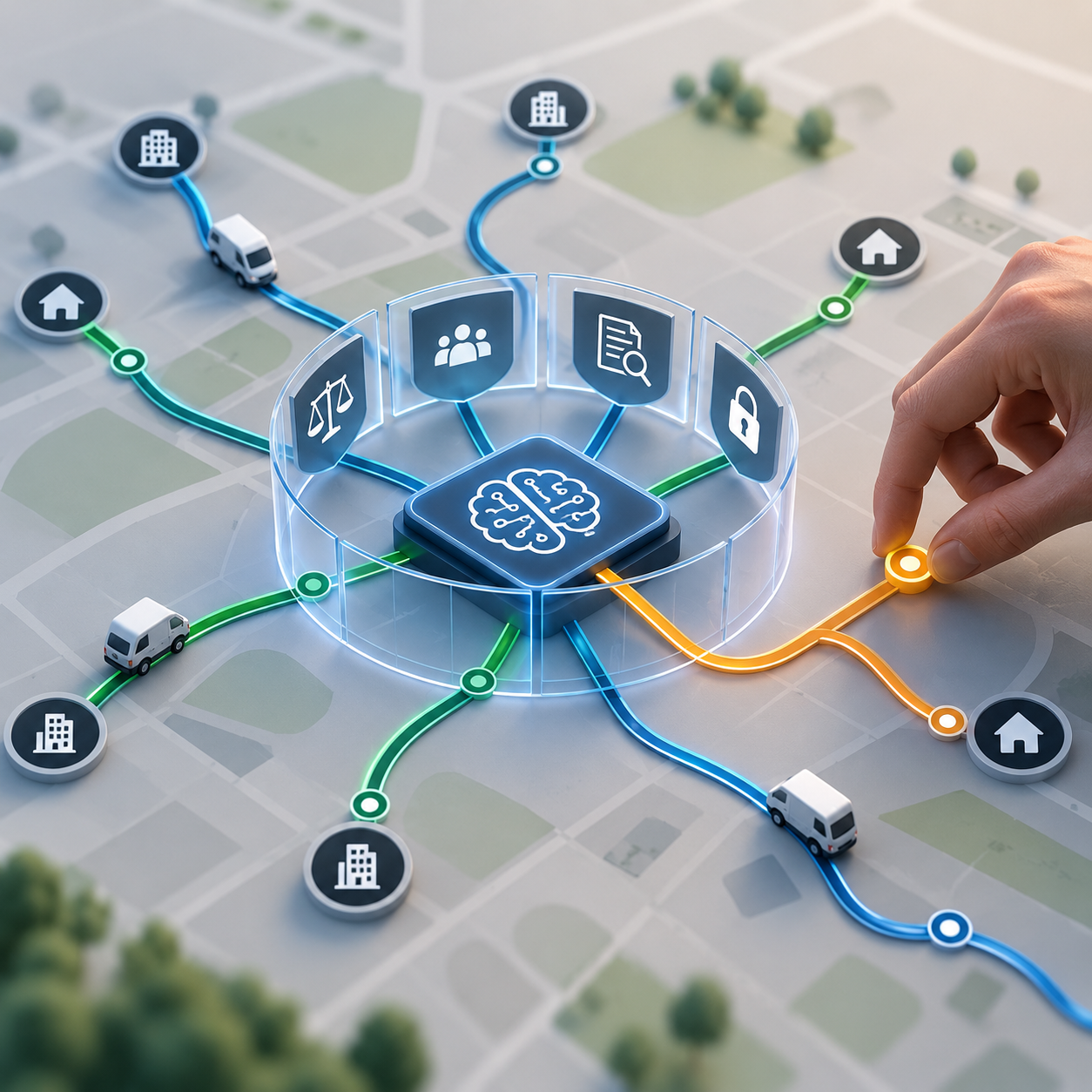
AI is showing up in dispatch and scheduling in very practical ways. It can recommend the best technician for a job, predict likely parts needs, detect appointment risk, and help contact centers triage service requests faster. Done well, these tools reduce repeat visits, stabilize schedules, and improve customer experience.
But dispatch is also a high-impact decision point. It determines who gets work, which customers get served first, and how service outcomes are distributed across regions, asset types, and technician groups. When AI influences those decisions, leaders inherit a new responsibility: governance that prevents hidden bias, avoids unsafe automation, and makes outcomes explainable to customers, technicians, and auditors.
The goal is not to slow innovation. It is to ensure AI improves service performance without creating preventable operational or reputational risk.
Why dispatch AI needs governance, not just tuning
Many organizations treat AI in dispatch like another optimization feature: you trial it, measure KPIs, and keep what works. That is necessary, but it is not sufficient.
The reason is simple. Dispatch AI is a socio-technical system. It relies on data about people and assets, it learns from historical outcomes, and it influences real-world decisions. If historical data includes uneven service quality across neighborhoods, different call handling behaviors by agents, or inconsistent documentation by region, AI can quietly reinforce those patterns instead of fixing them.
This risk is especially high when the model is not transparent. A dispatcher may receive a “recommended technician” without understanding the rationale, and technicians may feel that assignments are arbitrary. Over time, that undermines trust and creates resistance, even if performance improves on paper.
Governance gives you a way to answer three questions consistently:
How does the system make recommendations?
What risks could it introduce?
How do we detect and correct problems before they scale?
Step 1: Define what AI is allowed to decide
The first governance step is scoping. Not every decision should be automated, and not every recommendation should be accepted without review.
A practical approach is to separate dispatch decisions into three tiers.
In the first tier, AI can suggest low-risk improvements such as grouping stops, estimating travel time, or flagging appointment conflicts. In the second tier, AI can recommend assignments and schedules, but a human approves them. In the third tier, AI-driven decisions may run automatically, but only when conditions are tightly controlled, such as within a single territory, for a narrow set of job types, or during low-severity scenarios.
This is not about fear. It is about matching automation to risk. A missed appointment is one kind of failure. A safety incident from an incorrect assignment is another. Governance begins by defining the boundaries.
If you have already been mapping your service journey toward automation, it helps to formalize those boundaries in the same way you would define a “zero-touch” workflow. For context, zero-touch service breaks down how automated decisions can work end-to-end when the handoffs and controls are designed intentionally.
Step 2: Make fairness measurable in field service terms
“Fairness” often sounds abstract, but in dispatch it can be made concrete.
Fairness questions in field service usually look like this:
Are high-value jobs consistently routed to a small subset of technicians?
Are certain neighborhoods or customer groups waiting longer for service?
Are overtime and undesirable shifts concentrated in certain teams?
Are new technicians being under-assigned in a way that slows skill growth?
Are repeat visits being over-attributed to specific technicians because of bad job scoping?
To measure this, you do not need a philosophical framework. You need a handful of distribution checks. Compare assignment quality and workload outcomes across groups, territories, and customer segments. Look for persistent gaps in arrival times, completion rates, or schedule stability.
Crucially, measure outcomes, not just activity. If your organization is shifting from utilization-led management to outcome-led KPIs, use the same lens here. A useful pairing is to track “who gets assigned what” alongside the outcome metrics you already care about, such as repeat dispatch rate, SLA compliance, and first-time completion. This connects governance to operational performance, not theory.
Step 3: Audit the data that feeds the model
Dispatch AI is only as “ethical” as the data it learns from and the signals it is given.
Three data issues cause most governance failures.
The first is missing or inconsistent job classification. If work orders are vague, the model learns from noise. That can lead to wrong technician matching and parts predictions that do not hold up on the road.
The second is biased historical outcomes. If certain regions historically had longer response times because of staffing shortages, the model may treat those patterns as “normal,” then plan around them rather than improving them.
The third is proxy variables. Sometimes a model uses signals that appear harmless but correlate with sensitive patterns, such as location, service tier, or customer channel. Even without “sensitive data,” proxies can create unequal outcomes.
A practical control is a data audit checklist, reviewed quarterly, that tests for completeness, consistency, and drift. If your job types, assets, or workforce structure changes, the data feeding dispatch logic changes too.
Step 4: Require explainability that dispatchers can use
Explainability is not a compliance box. It is an adoption requirement.
Dispatch teams need to understand why the system suggested a technician or route. The explanation does not need to expose model internals. It needs to provide operational reasons, such as skills match, proximity, parts coverage, SLA risk, or customer constraints.
If the system can’t explain itself in dispatcher language, dispatchers will either ignore it or follow it blindly. Both outcomes are risky.
Explainability also matters for technicians. When technicians see consistent patterns, such as a certain type of job always going to a certain person, they will assume favoritism or unfairness unless there is transparency. Providing basic explanation and visible routing criteria reduces that friction.
Step 5: Keep humans in the loop, but make overrides visible
Human oversight is essential, but it must be structured.
If dispatchers override AI recommendations, capture the override reason. Over time, those reasons become your improvement roadmap. High override rates might indicate that the model is wrong, but they can also reveal that job intake is weak, parts data is incomplete, or the routing constraints are unrealistic.
The same principle applies to voice-driven triage. If a voice agent collects initial information, but humans frequently need to re-ask the same questions, your intake design is failing. The “first minutes” of a case, as explored in this analysis of voice AI agents, shape downstream scheduling quality. Governance should treat that early intake as part of the same system, because dispatch recommendations depend on the quality of that first capture.
Step 6: Monitor for drift and unintended consequences
Models drift. So do operations.
New products appear. Technician skills evolve. Service territories change. Customer demand shifts seasonally. If the model is not monitored, it can degrade quietly. Worse, it can create unintended behavior.
Two examples show up frequently.
The first is “metric gaming by proxy.” If the model is rewarded for reducing travel time, it may optimize for proximity even when it increases repeat visits. If it is rewarded for maximizing utilization, it may overload certain technicians and increase burnout risk.
The second is brittle performance under stress. The model may work well under normal demand but fail during storms, outages, or major incident spikes when priorities change quickly.
The fix is regular monitoring with a small number of guardrail metrics. These should include not only efficiency, but also outcome quality and distribution. If completion quality drops or customer wait times widen unevenly across regions, that is a governance signal.
Step 7: Use a recognized risk framework to structure the program
Governance is easier when it follows a common language and structure.
NIST’s AI Risk Management Framework emphasizes managing AI risks across the lifecycle and highlights characteristics of trustworthy AI such as validity, reliability, accountability, transparency, and fairness. (NIST) In practical terms for field service, this supports the idea that dispatch AI should be evaluated not only on “does it optimize,” but on “does it behave reliably, explainably, and safely when conditions change.”
Similarly, the OECD AI Principles emphasize trustworthy AI that respects human rights and democratic values, including transparency, robustness, and accountability. (OECD) You do not need to treat these as legal requirements to benefit from them. They provide a structure for program design, documentation, and stakeholder alignment.
What “good” looks like in an ethical dispatch program
A mature program does not mean perfect automation. It means predictable control.
Good governance in dispatch AI looks like this:
The model’s decision boundaries are clear.
Fairness is measured in field service terms, not slogans.
Data quality is audited, and drift is monitored.
Recommendations are explainable in dispatcher language.
Overrides are tracked and used as feedback.
Performance monitoring includes outcomes and distribution, not just efficiency.
The program is documented using a recognized risk framework.
When those elements are in place, AI becomes a dependable operational partner, not a black box that creates new uncertainty.