IFS used its Unleashed 2026 conference in Orlando (12–16 October) to launch IFS Intelligence, a new AI layer for industrial operations, and the Industrial AI Harness that governs it. More than 3,000 attendees from over 100 countries heard the same message repeatedly: AI in field service should augment technicians, not replace them, and it has to run inside the rules of the business.
For service leaders, the news is less about one new feature and more about a change in how AI is meant to work in service operations. IFS is betting on governed “digital workers” that act on live asset, work order and schedule data, with people approving the actions that matter. This article covers what was announced, what field service customers reported, and what it means for your own AI roadmap.
Key takeaways
- IFS Intelligence launched on 13 October 2026 with three components (Cowork, Loops and Runway). It is available now on supported IFS Cloud versions under a universal enterprise-wide license, with no feature-gating or tiering.
- The Industrial AI Harness sets six layers of control around AI agents. IFS says the AI can only see or do what the signed-in user is authorized to, and that no raw data is sent to external AI providers.
- Field service customers shared early results: Eight Group cut job documentation from 25 minutes to one minute, and Kodiak Gas Services reported an 85% efficiency gain from a parts replenishment agent.
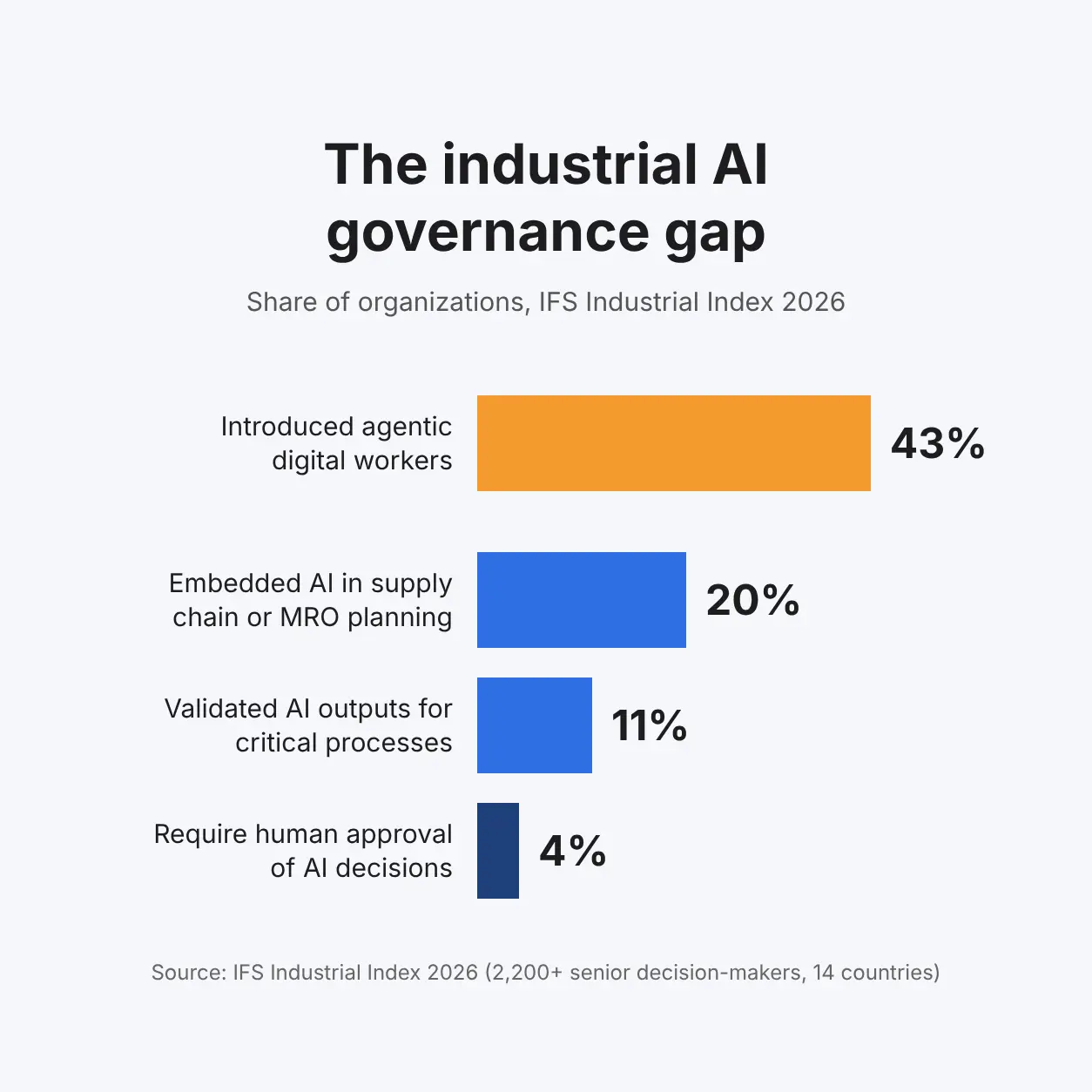
- Governance is lagging adoption: in the IFS Industrial Index 2026, 43% of frontline teams have introduced agentic digital workers, but only 11% have validated AI outputs for mission-critical processes.
What IFS announced at Unleashed 2026
IFS Intelligence: Cowork, Loops and Runway
According to IFS’s launch announcement, IFS Intelligence pulls together data from assets, systems and processes and turns it into action inside the systems that run physical operations. It works with live data from IFS and third-party systems and only acts within rules the business sets.
| Component | What it does | Where it could show up in field service |
|---|---|---|
| Cowork | Plain-language questions and investigations. Actions are prepared but only run after a person approves them. Answers can become live “Lens” views, and repeatable work can be saved as “Skills.” | A dispatcher or service manager asking why first-time fix dropped in a region, then approving a suggested change. |
| Loops | Background workflows run by digital workers that escalate when judgment or approval is needed. Teams can build their own workers in Studio. | Parts replenishment, follow-up scheduling or warranty checks running without manual hand-offs. |
| Runway | Uses plain-language requirements to speed up migration, configuration and extension of IFS. | Faster rollout of new service processes, forms or territories. |
Commercially, IFS is selling Intelligence as a single license that unlocks capabilities across all in-scope IFS software a customer already has. Customers get an “AI Executions” entitlement, which IFS describes as a fair-usage cap rather than a credit model.
The Industrial AI Harness
The Industrial AI Harness is the control layer underneath IFS Intelligence. It inherits permissions from IFS Cloud and is built from six components, each meant to stop a specific kind of failure:
- Planning and orchestration – breaks goals into steps and coordinates agents and tools.
- Skills and connectors – defines and validates which systems agents can use.
- Memory and context – tracks progress and supplies only task-relevant information.
- Guardrails and permissions – enforces identity, approvals and limits on risky actions.
- Verification and escalation – checks work for correctness and policy, and escalates when unsure.
- Observability and auditability – logs decisions and actions so they can be traced later.
IFS also describes “staged autonomy”: AI moves from copilot assistance, to recommendations, to autonomous action, and escalates whenever it is uncertain. The Harness is designed to work across multiple AI models, and customers can shape deployment, for example where data is processed.
Why it matters for field service operations
IFS CEO Mark Moffat framed the launch around lost potential. “We often see industrial organizations operating at around 60% of their potential,” he said. In his keynote, reported by Constellation Research, he cited an estimate that the 500 largest companies lose $1.4 trillion a year to unplanned downtime, and pointed to the loss of technicians and know-how as a major pressure.
The technician gap came up again and again. Moffat noted that in the US, around 500 aircraft are sitting idle without a technician to repair them. That is the same problem many service organizations face: too few experienced people, too much knowledge locked in their heads, and customers expecting faster first-time fixes. We covered this trend in more detail in AI Adoption in Field Service: Closing the Technician Gap.
IFS’s answer is to put AI where the work happens. The launch materials name missed first-time fixes on service plans as one of the losses it wants to cut, and describe people “in the field, on the plant floor, or on a rig” using one conversational interface to get answers.
What field service customers reported
The most useful evidence came from customers on stage. In her Unleashed highlights for Future of Field Service, Sarah Nicastro collected several examples:
- Eight Group: Using IFS’s Resolve app with image analysis, job documentation time dropped from 25 minutes to one minute. CIO Mo Dawood also explained why the company did not build its own agents: “We’re a field service business, not a software business.”
- Kodiak Gas Services: Its first IFS Loops agent is a material replenisher. It helps technicians identify the right part, find it in inventory and handle procurement, and improved that process’s efficiency by 85%. CIO Pedro Buhigas said people are a scarce resource and agents help the business scale.
- William Grant & Sons: An experienced engineer said of the Resolve app that he does not need it to do his job, but can see how it brings others up to his level. That is a practical case for capturing tribal knowledge for newer technicians.
- Sims Crane & Equipment: Chief Business Operations Officer Curtis Taylor said that “out of the box, all the data in our systems can be surfaced to our people.”
These are vendor-hosted customer stories, so results will vary. Still, the pattern is consistent: the quickest wins are in documentation, parts and knowledge access, not in replacing the technician.
The governance gap behind the headlines
IFS also released its Industrial Index 2026, a survey of more than 2,200 senior decision-makers in 14 countries. Frontline teams, including service leads and engineers, are moving fast:
- 93% reported improved first-time-right performance and 90% reported higher asset availability.
- 43% have trained and introduced agentic digital workers into daily operations in the last 12 months.
Controls have not kept pace:
- Only 11% have validated AI outputs for safety-, quality- or mission-critical processes.
- Only 11% have control mechanisms for sensitive or export-controlled data.
- Only 4% require mandatory human oversight or approval for AI-supported decisions.
- Only 20% have embedded industrial AI in supply chain or maintenance planning.
Research from The Futurum Group, cited by IFS, points the same way: 66% of enterprises plan to invest in digital workers within 12 months, but only 5.7% trust AI to act fully autonomously. For more data on where AI in service stands, see AI in Field Service Statistics 2026: What Four New Reports Reveal.
What service leaders should take from Unleashed 2026
- Start with the technician’s admin load. Documentation, parts lookup and job history are where customers reported the clearest time savings.
- Treat governance as a requirement, not an add-on. Before agents act on work orders or inventory, decide who approves what, and make sure every action is logged.
- Use staged autonomy. Let AI recommend first, measure the results, then automate the steps that prove reliable.
- Capture expert knowledge now. Tools that turn senior technicians’ know-how into guidance for new hires address the skills gap directly.
- Check the commercial model. Enterprise-wide licenses and usage caps differ from per-user or credit-based AI pricing. Compare total cost before you scale. Our comparison of field service management software is a useful starting point.
Frequently Asked Questions
What is IFS Intelligence?
IFS Intelligence is an AI product IFS launched on 13 October 2026 at IFS Unleashed. It has three parts: Cowork for plain-language questions and approved actions, Loops for background digital workers, and Runway for faster configuration and migration. It runs on live data from IFS and third-party systems.
What is the IFS Industrial AI Harness?
It is the governance layer under IFS Intelligence. Its six components cover planning, connectors, memory, guardrails, verification and audit logging. IFS says AI only sees and does what the signed-in user is permitted to, and that raw data is not sent to external AI providers.
Is IFS Intelligence available now?
Yes. IFS says it is available now on supported versions of IFS Cloud as a universal enterprise-wide license, with an AI Executions entitlement that works as a fair-usage cap.
How are field service companies using it?
Customers on stage included Eight Group, which cut documentation time from 25 minutes to one minute, and Kodiak Gas Services, which reported an 85% efficiency gain from a parts replenishment agent built with IFS Loops.
Will AI agents replace field technicians?
Not according to the speakers at Unleashed. The consistent message was that AI should take on admin, lookup and knowledge tasks so scarce technicians can spend more time on skilled work, with humans approving critical actions.
Conclusion
IFS Unleashed 2026 shows where enterprise field service software is heading: governed AI agents that act on live operational data, with people staying in control. The early customer results are strongest in documentation, parts and knowledge transfer. The bigger challenge for most service organizations is the governance gap, since adoption is moving much faster than validation and oversight. Leaders who set those rules now will be in a better position to scale AI safely. Follow FSM News for more coverage of AI in field service.