The latest AI in field service statistics come from four studies published in 2026. Together they find that almost every service organization now uses AI in some form, and that leaders expect it to change how their teams resolve incidents by 2028.
But the same studies also show a gap: deployment is moving faster than measurement, workforce readiness and data quality. Below are the key figures from ISG, Salesforce, Aquant and Geotab, and what they mean for service operations.
Key takeaways
- 95% of field service organizations have deployed some form of AI, according to Salesforce (2026).
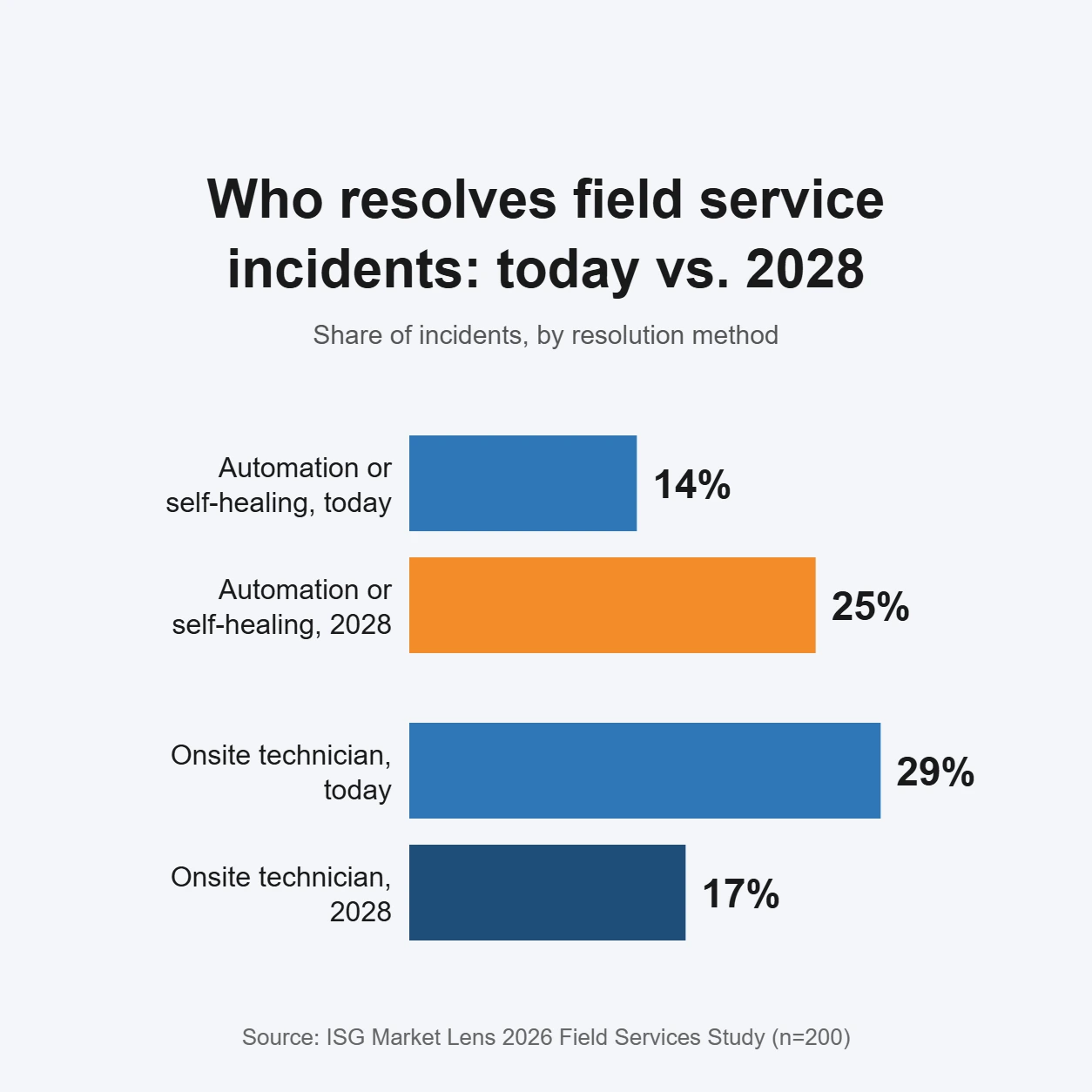
- Companies expect automation to resolve 25% of field service incidents by year-end 2028, up from 14% today, according to ISG (2026).
- ISG expects two-thirds of enterprises to use AI to coordinate field service teams by 2028.
- The first-time fix gap between top and bottom performers is 28 points, according to Aquant (2026).
- 75% of organizations are only “somewhat confident” in their workforce’s AI readiness, according to Geotab (2026).
Adoption: Almost Every Service Organization Is Using AI
Most service teams have already made the adoption decision. Salesforce’s State of Field Service report surveyed 2,317 field service professionals in nine countries and found that 95% of organizations have deployed some form of AI. 85% also plan to increase AI investment over the next one to two years.
How far that adoption goes varies, though. In Geotab’s 2026 State of AI in Field Service report, 98% of respondents said they are taking action on AI. Only 29% have fully deployed it across multiple service areas, while 39% use it for specific use cases and 30% are still running pilots.
The most common uses sit close to the customer and the technician. For example, Salesforce (2026) reports that 54% use AI-driven tools for customer communication and 51% use AI to assist employees in the field. For a closer look at the technician side, see our article on AI adoption in field service and the technician gap.
Automation: Where Field Service Work Is Heading by 2028
The newest data comes from the ISG Market Lens 2026 Field Services Study, which ISG released in October 2026. ISG surveyed 200 field services decision-makers at Global 2000 companies in the Americas and Europe, and 74% of them hold C-level roles.
Respondents expect automation or self-healing to handle 25% of incidents by year-end 2028, up from 14% today. Over the same period, they expect the share that needs onsite technician work to fall from 29% to 17%.
Fewer onsite visits do not mean less demand for field services. 56% of respondents expect AI infrastructure and AI-enabled devices to significantly drive field services demand through 2028. 39% also cite data center, network or connectivity expansion as a significant driver. “AI is changing the game for field services,” said Michael Dornan, principal analyst and study co-author.
If those expectations hold, technicians will handle fewer routine jobs and spend more of their time on problems that automation and remote tools cannot solve.
Software: How ISG Rates the Platforms Behind AI in Field Service
ISG also looked at the software side. In February 2026, it released its 2026 Buyers Guides for Field Service Management, which evaluate 37 software providers across four guides. ISG expects that by 2028, two-thirds of enterprises will use AI to coordinate field service teams. It also expects most technicians to have AI-boosted knowledge on site by 2027.
In the Field Service Emerging Providers guide, ISG rated Fieldcode Exemplary, alongside Dusk Mobile, KloudGin and ServicePower. ISG also included Fieldcode among the 17 providers in its Healthcare Field Service guide.
“Field service operations tend to break down when coordination becomes manual and fragmented,” said Matthias Luebko, CEO of Fieldcode.
Performance: The Gap AI Is Expected to Close
Aquant’s 2026 Field Service Benchmark analyzed data from 161 service organizations, covering nearly 30 million service events and $8.3 billion in service costs.
The industry first-time fix benchmark is 77%. Top performers reach 88%, while bottom performers reach 60%. Mean time to resolution follows the same pattern: 2.5 days for top performers and 10 days for bottom performers, against a 4.5-day benchmark. Our guide to MTTR in field service explains how to calculate that metric.
Failed visits are the costliest part of the gap. At the median, they make up 25% of total service cost. For bottom performers that rises to 44%, compared with 14% for top performers. Aquant (2026) also estimates that teams could resolve about 1 in 5 cases remotely.
Triage, guided troubleshooting and remote resolution tools are aimed at exactly these visits: the ones that should not happen, and the ones that take more than one trip.
ROI: Results Are Real, but Measurement Is Uneven
Salesforce (2026) found that 85% of leaders say they have measured the ROI of their AI investment. The reported gains include higher mobile worker productivity (43%), improved customer satisfaction (40%) and fewer safety incidents (34%).
Scheduling and dispatch stand out. Among organizations using AI-powered scheduling and dispatch, 57% see higher revenue per job, 57% report higher mobile worker productivity and 49% report lower labor costs. Our article on how AI is changing field service dispatch looks at this area in more detail.
Yet 40% of the same respondents say they struggle to measure whether AI is working. Part of the reason is data. Only 16% say their field and back-office technology runs on a single platform, so many teams track outcomes across disconnected systems.
Workforce: Readiness Lags Behind Deployment
Workforce readiness is the weakest point in the data. Geotab (2026) found that 75% of organizations are only “somewhat confident” about their workforce’s AI readiness. Meanwhile, 45% cite cybersecurity and data privacy concerns as the most significant barrier to AI implementation.
Salesforce (2026) points to a retention problem. 66% of leaders report that mobile worker turnover has risen over the past two years. The top driver is insufficient training or support when companies introduce new technology. 61% also say mobile workers have limited access to the customer data they need.
Retention is tied to performance. According to Aquant (2026), top-performing companies retain 87% of employees, compared with 66% for underperforming companies.
What These AI in Field Service Statistics Mean for Service Leaders
- Measure at the outcome level. Track first-time fix, repeat visits and MTTR before and after each AI use case, not only usage or licenses.
- Start where failed visits cost the most. Triage and remote resolution target the 25% of service cost that failed visits represent at the median.
- Fix the data path. With only 16% running a unified platform, connecting field and back-office data is often the first step to proving ROI.
- Plan for a different visit mix. If automation takes over routine incidents, technician scheduling and skills planning need to reflect more complex jobs.
- Train before rollout, not after. Training gaps are the top driver of rising turnover, so enablement belongs in every AI project plan.
A Short Example From the Field
Consider a regional equipment service provider with a 74% first-time fix rate. Its team adds AI-based triage that checks asset history and error codes before dispatch.
Within a quarter, the team closes a share of low-complexity cases remotely. The remaining visits arrive with better part predictions and clearer notes. The team then measures repeat visits each month and expands the use case only after the numbers improve.
Frequently Asked Questions
What are the most important AI in field service statistics for 2026?
Salesforce (2026) reports that 95% of field service organizations have deployed some form of AI. ISG (2026) expects automation to resolve 25% of incidents by 2028, and Aquant (2026) puts the first-time fix benchmark at 77%.
How many field service organizations use AI in 2026?
According to Salesforce (2026), 95% of field service organizations have deployed some form of AI. However, Geotab (2026) found that only 29% have fully deployed it across multiple service areas.
How much field service work will AI automate by 2028?
ISG (2026) found that companies expect automation to resolve 25% of incidents without human intervention by year-end 2028, up from 14% today.
Which field service software providers did ISG rate Exemplary in 2026?
ISG’s 2026 Buyers Guides for Field Service Management evaluated 37 providers. In the Emerging Providers guide, ISG rated Fieldcode, Dusk Mobile, KloudGin and ServicePower Exemplary.
Does AI in field service deliver ROI?
85% of leaders say they have measured ROI, according to Salesforce (2026). At the same time, 40% say they struggle to measure whether AI is working.
What is the biggest barrier to AI in field service?
Geotab (2026) found that 45% cite cybersecurity and data privacy concerns as the most significant barrier. Workforce readiness and fragmented data also come up as obstacles.
Conclusion
The 2026 AI in field service statistics show near-universal adoption, an expected rise in automated resolution to 25% of incidents by 2028, and a wide gap between top and bottom performers. Measurement, connected data and technician training are where most organizations still have work to do.