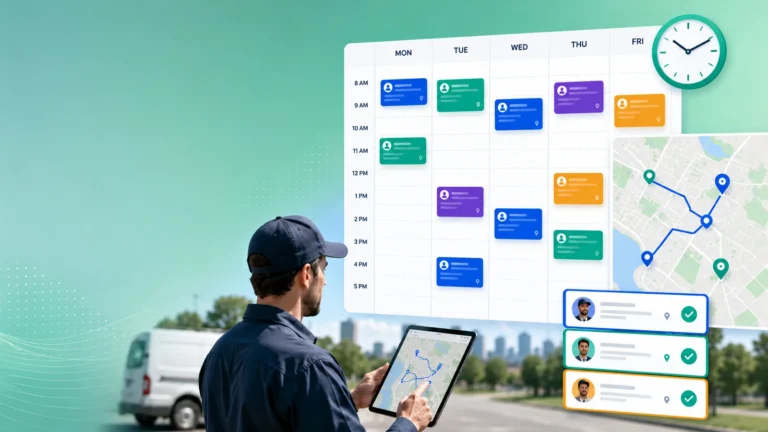
A field service schedule can look fine on paper and still waste a lot of time on the road.
That is the problem with routing.
When people think about service efficiency, they often focus on job count, technician availability, and appointment volume. But a big part of daily performance comes down to how work is arranged geographically. If the route is weak, the whole day becomes heavier. Technicians lose time travelling, the schedule becomes harder to protect, and customers feel the knock-on effect when visits start slipping.
That is why better routing matters so much.
It does not just make the map look cleaner.
It makes the entire service day easier to execute.
Routing affects more than travel time
It is easy to think of routing as a transport issue.
It is much bigger than that.
A poor route increases travel, but it also weakens appointment timing, makes schedule changes harder to manage, and puts more strain on technicians throughout the day. One badly placed job can create wasted movement before and after it. Several badly placed jobs can make the whole schedule feel unstable.
That is why field efficiency depends on routing more than many teams realize.
The route is part of the workflow, not something separate from it.
Better routing reduces hidden waste
A lot of waste in field service is not dramatic.
It shows up quietly.
Ten extra minutes here. Fifteen there. A technician crossing back into an area that should have been handled earlier. A midday reassignment that creates unnecessary travel in both directions. None of those choices may look serious alone, but together they can drain hours from the day.
This is why better routing creates such meaningful gains.
It removes wasted movement that often gets accepted as normal.
And once that waste starts coming out of the schedule, the rest of the operation usually feels less pressured too.
Route quality shapes the schedule
A schedule is not just a list of time slots.
It is a movement plan.
That is why service scheduling and routing are so closely connected. A weak route can make a reasonable appointment plan fail in practice. A strong route can make the day feel more controlled even when demand is high. This is also part of the wider logic explored in What Makes Smart Scheduling Work in Field Service: the goal is not just to fill time, but to build a plan that still works once the day begins to move. When routing improves, the schedule becomes easier to trust.
Technicians feel weak routing immediately
Office teams may not always notice poor routing right away.
Technicians do.
They feel it when the day starts with an avoidable long drive. They feel it when the next job is far from the last one for no good reason. They feel it when a late-day appointment could have fit much more cleanly somewhere else. That repeated inefficiency drains time, focus, and energy.
That is why technician productivity is tied closely to route quality.
A stronger route does not just save miles.
It makes the day feel more manageable for the person doing the work.
Better routing supports more realistic customer timing
Customers usually do not care how the route was built.
They care whether the technician gets there when expected.
That is why route quality affects customer experience too. If the route is scattered, timing becomes harder to predict. Delays are more likely to build. Arrival windows become wider or less reliable. The customer may never hear the phrase route optimization, but they definitely feel the result when a schedule seems to drift through the day.
This fits naturally with Why Live ETA Updates Matter in Field Service, because better timing confidence usually starts with a better route underneath it.
Better routing makes change easier to absorb
The real test of routing is not a perfect morning.
It is what happens after the first disruption.
A same-day request appears. A technician runs long. A customer needs to move the visit. A high-priority job enters the queue. When the route is already inefficient, every new change becomes harder to absorb. When the route is stronger, the service team has more flexibility to adjust without breaking the rest of the day.
That is one reason route optimization matters beyond simple distance reduction.
It gives the operation more room to respond when the day stops behaving exactly as planned.
Routing works best when job data is strong
There is one important point here.
Routing is only as smart as the information feeding it.
If job duration is underestimated, the route will look better than it really is. If urgency is unclear, the wrong jobs may get priority. If the request lacks context, work can be scheduled poorly throughout the day. That is why routing depends heavily on job quality and workflow clarity.
This is also why better job data matters in the routing conversation, as explored in How Better Job Data Improves Dispatch Decisions. Better information leads to better decisions, and routing is one of the first places where weak information becomes expensive.
Routing and dispatch should support each other
A common mistake is treating routing and dispatch as separate concerns.
They are not.
Dispatch decides who gets the work. Routing affects whether that decision actually makes sense in practice. If those two things are disconnected, the business may assign jobs quickly but still create inefficient movement across the day.
That is why better routing should be seen as part of stronger dispatch logic, not just a map feature.
This also aligns with How AI Is Changing Field Service Dispatch, because better assignment quality often depends on combining timing, skills, and geography more intelligently.
Better routing improves capacity without adding headcount
This is one of the most practical benefits.
When route waste drops, technician time opens up.
That does not always mean fitting several extra jobs into the day. Sometimes it means protecting service quality, reducing late arrivals, or giving the team more breathing room for real urgency. But the result is still valuable because the business gets more usable capacity from the same workforce.
That is why field efficiency is not only about speed.
It is also about how intelligently the available time gets used.
Fieldcode is one example of how routing is being treated differently
One example of this wider market shift is Fieldcode, which has positioned itself around automated dispatch, AI-supported scheduling, and stronger route logic as part of day-to-day service execution. It is relevant here as an example of how routing is increasingly being treated as a core operational issue rather than a simple planning add-on.
That matters because the market is moving beyond static routes.
More providers are treating routing as something that should actively support service performance throughout the day.
The goal is not just shorter routes
This is worth saying clearly.
The goal of better routing is not only to reduce mileage.
The real goal is to create a more workable day. Less wasted movement. Better appointment reliability. Stronger technician flow. Better schedule protection. Easier response to change. When routing helps create those outcomes, it becomes much more than a travel tool.
It becomes part of how the service operation holds together.
Conclusion
Better routing matters because it improves more than distance.
It strengthens field efficiency, supports smarter route optimization, improves technician productivity, and makes service scheduling more reliable across the day.
That is the real value.
A stronger route does not just move technicians around more neatly.
It helps the whole service operation work with less waste and more control.