Fieldcode has introduced new controls for service organizations that divide field operations across multiple dispatch groups but still need dispatchers to work across those boundaries.
The update combines multi-group operational visibility with more granular user administration, allowing organizations to broaden what dispatchers can see without automatically extending the same level of administrative access.
Key takeaways
- Dispatchers can select multiple dispatch groups and view their engineers and scheduled work together.
- The functionality is available within Fieldcode’s scheduling Timeline.
- Existing dispatch-group structures remain in place rather than being replaced by a new organizational model.
- New user administration controls determine which users individual roles are permitted to edit.
- Fieldcode positions the changes as particularly relevant to distributed IT and telecom service operations.
One operational view across multiple dispatch groups
Field service organizations commonly separate work into operational groups based on geography, customers, service territories or internal units. That structure can simplify responsibility and access, but it can also create additional navigation for dispatchers whose remit covers several groups.
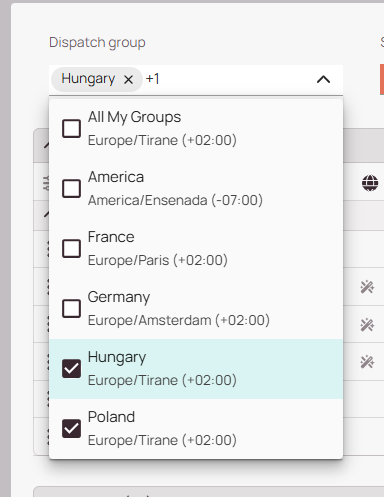
Fieldcode’s new multi-select functionality allows those dispatchers to select several dispatch groups simultaneously. Within the Timeline, engineers belonging to the selected groups and their scheduled work are shown together.
Importantly, the change does not remove Fieldcode’s existing dispatch-group structure. Organizations can continue separating operations as they do today while giving selected users visibility across multiple groups where required.
Administrative permissions remain separate
The second part of the update concerns user administration.
Fieldcode now allows organizations to define which users a specific role is permitted to edit. The intention is to separate the operational scope someone needs to oversee from the administrative authority that person requires.
For example, a dispatcher may need visibility into work across several regions or service units without also needing organization-wide permissions to modify users.
“Service organizations often need broader visibility across regions or service units without giving every role the same level of administrative control,” said Matthias Lübko, CEO of Fieldcode. “These changes allow organizations to widen the operational view available to dispatchers while keeping administrative responsibilities aligned with how their service operations are structured.”
Why this matters for field service
As field service operations become more distributed, the structure used to organize technicians does not always match the scope from which dispatchers need to make day-to-day decisions.
A service organization might separate technicians by customer account, geography or specialist team while central dispatchers still coordinate work across several of those units. Requiring dispatchers to move repeatedly between isolated views can make cross-team coordination more cumbersome.
At the same time, broader operational visibility does not necessarily justify broader administrative permissions.
Fieldcode’s update addresses those two requirements separately: expanding the operational view available to dispatchers while retaining tighter control over who can administer individual users.
Relevance for IT and telecom field operations
Fieldcode specifically identifies IT services and telecommunications as environments where the model may be useful.
These operations can be divided across multiple customer accounts, regions, technical teams or service partners. A dispatcher responsible for several such groups may therefore need a combined view of engineers and scheduled work while administrative responsibilities remain limited to a particular organizational scope.
The same principle can apply more broadly to distributed service organizations using dispatch groups to separate operational responsibilities.
FSM News perspective
This update is primarily about operational governance rather than introducing a new scheduling or optimization capability.
The distinction is relevant. As FSM platforms support larger and more distributed organizations, controlling who can see operational activity and who can administer users becomes a separate design problem from determining how work itself is scheduled.
Fieldcode’s approach retains existing dispatch groups as the organizational layer while allowing selected users to work across several of them. For organizations evaluating the change, the practical question will be how closely those group and role structures reflect the way dispatch responsibilities are divided internally.
FAQs
What are multi-select dispatch groups in Fieldcode?
They allow a dispatcher to select several dispatch groups at the same time and view the engineers and scheduled work associated with those groups together in the Timeline.
Does the update replace existing dispatch groups?
No. Fieldcode says the functionality builds on its existing dispatch-group structure. Organizations can continue separating operations using their current groups.
What changed in user administration?
Organizations can define which users a particular role is permitted to edit, helping separate operational visibility from administrative access.