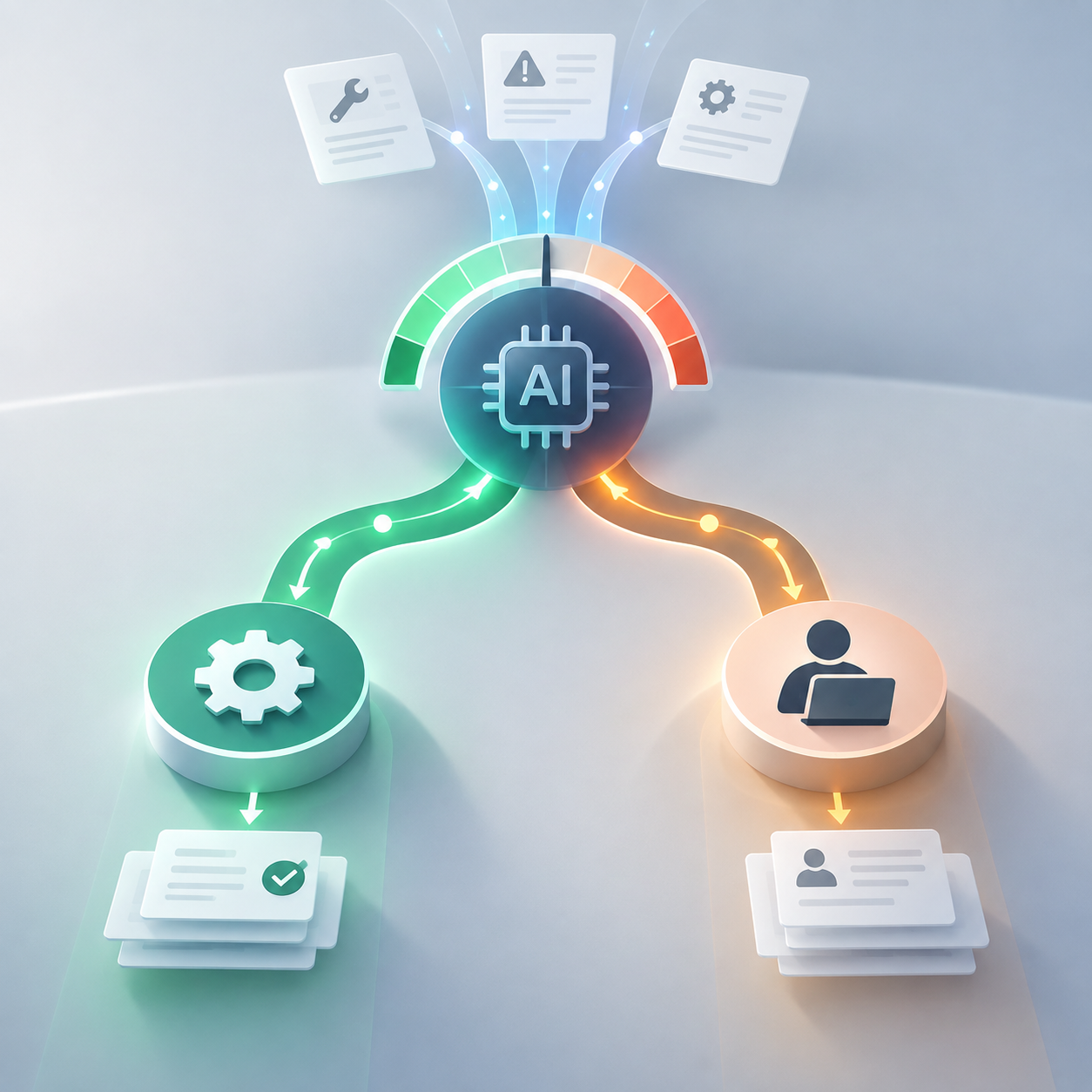
AI confidence scores can improve service triage by indicating how strongly an AI system supports a recommendation. However, the score should not automatically be treated as the probability that the recommendation is correct; that interpretation depends on how the model produces, calibrates, and validates its confidence scores. Instead of simply labelling a job as urgent, remotely fixable, or ready for dispatch, the system indicates how strongly the available information supports that decision.
This helps service teams decide when automation can move the job forward and when a dispatcher or technical expert should take a closer look. A high-confidence recommendation may trigger a standard workflow, while a low-confidence result can be escalated before the wrong promise is made to the customer.
The score does not replace human judgment. It gives people a clearer view of where judgment is most needed.
A Recommendation Is More Useful When Uncertainty Is Visible
AI can support triage by reviewing the customer’s description, asset history, error codes, previous repairs, sensor data, contract details, and similar past cases. It may then recommend remote troubleshooting, an emergency response, a specialist technician, or a standard appointment.
The problem is that not every recommendation is equally reliable. A decision based on a confirmed asset number, clear fault code, and complete repair history should carry more weight than one based on a short note saying, “machine not working.”
AI confidence scores make that difference visible. For example, the system may assign a 92% confidence score to the recommendation that a reported issue can be resolved remotely, but only a 48% score to the prediction that a particular component has failed.
Those two recommendations should not be treated in the same way. The first may be suitable for an automated troubleshooting workflow, while the second needs more information before parts are reserved or a technician is assigned.
This is why better job data remains essential. A confidence score can help explain uncertainty, but it cannot create reliable context when the original service request is incomplete.
Confidence Scores Help Choose the Next Action
The value of a confidence score comes from what the service team does with it. A number on a dashboard means very little unless it is connected to a clear operational response.
A high-confidence, low-risk case may move directly into an automated process. The customer could receive guided troubleshooting steps, an appointment option, or confirmation that the request has been passed to the right team.
A medium-confidence case may require one more question. The system might ask the customer to confirm the asset model, share a photograph, describe the sound being made, or read an error code from the display.
A low-confidence result should usually bring a person into the decision. The job may involve conflicting information, an unfamiliar asset, an unusual failure, or a possible safety risk that the AI cannot classify reliably.
This approach helps avoid two common mistakes. The first is automating every decision because the system produced an answer, and the second is sending every case to a dispatcher because the business does not trust automation at all.
AI confidence scores create a practical middle ground. Routine cases can move quickly, while uncertain or higher-risk cases receive more attention.
That also makes voice AI service intake more useful. An AI agent can collect the initial details, assess the quality of the information, and ask targeted follow-up questions when its confidence remains too low.
A Real Service Request Shows the Difference
Imagine a restaurant manager reports that a walk-in freezer is becoming warmer. The manager wants immediate confirmation that the request has been received, advice on protecting the stored food, and a clear estimate of when help will arrive.
The system identifies the freezer from the customer account and reviews its recent service history. A temperature sensor was replaced four months earlier, and the current alert pattern resembles previous cases involving a door-seal problem.
The AI assigns an 86% confidence score to the hypothesis that the issue is linked to the door not closing properly, but only a 55% score to the prediction that no mechanical repair will be required. It should not tell the customer that a technician is unnecessary.
Instead, the triage workflow asks the manager to check whether the door is fully closed and submit a photograph of the seal. It also provides immediate guidance on reducing door openings and monitoring product temperatures.
The photograph shows that the seal has partly detached, but the temperature continues to rise after the door is secured. The confidence in a simple remote resolution falls, and the job is escalated for urgent dispatch.
The system recommends a refrigeration technician carrying the correct seal and common fan components. The dispatcher can review that recommendation alongside travel time, skills, parts availability, and the restaurant’s service agreement.
The customer receives confirmation of the appointment window and clear instructions for protecting stock until the technician arrives. The technician then finds a damaged seal and a failing evaporator fan, completing both repairs during the visit.
Without visible confidence levels, the system might have treated the first likely cause as a final diagnosis. That could have delayed the visit and placed the customer’s stock at greater risk.
Dispatchers Need Reasons, Not Just Percentages
A confidence score should never appear as a mysterious number. Dispatchers need to understand which information increased or reduced the score.
The system might explain that confidence is high because the asset is confirmed, the fault code is specific, and the pattern matches 120 previous repairs. It may also warn that confidence is limited because the asset has no recent service history or the customer’s description conflicts with sensor data.
This context helps the dispatcher judge whether the recommendation makes sense. It also allows the team to spot data problems that the AI cannot correct on its own.
For example, a low score may not mean the failure is unusually complex. It may mean the customer account contains two similar assets and the request does not identify which one has failed.
A quick clarification could increase confidence enough to support a reliable dispatch decision. This is one way AI can strengthen field service dispatch without taking control away from experienced coordinators.
Thresholds should also reflect the risk of the decision. A routine appointment change may be automated at a lower confidence level than a recommendation to delay an emergency visit.
The acceptable threshold may also vary by industry. A possible safety issue involving medical, electrical, gas, or industrial equipment needs more cautious handling than a low-risk cosmetic repair.
Service Teams Must Measure the Result
Confidence scores should be tested against real outcomes. If the system regularly shows high confidence but produces poor triage decisions, the score is not helping the operation.
Teams should compare recommendations with what actually happened. Was the issue resolved remotely? Was the urgency correct? Did the assigned technician have the right skills? Was another visit required?
They should also review low-confidence cases. Some may reveal genuinely unusual situations, while others may expose repeated gaps in service intake, asset records, or technician notes.
This feedback can improve both the AI and the surrounding workflow. If uncertainty repeatedly comes from missing serial numbers, the intake process can make that field mandatory or provide an easier way for the customer to scan it.
Service leaders should also watch for overconfidence. A model may appear certain because it has seen many similar cases, but a new product version, recent software update, or unusual installation may make the historical pattern less useful.
That is why exception management remains important. The system needs a clear path for cases that do not fit the normal workflow, even when the initial recommendation appears strong.
The goal is not to produce the highest possible confidence score for every ticket. It is to make uncertainty useful.
When confidence is visible, service teams can automate routine decisions, ask better follow-up questions, and direct human attention toward the cases that genuinely need it. Customers receive clearer next steps, dispatchers make decisions with better context, and technicians are less likely to arrive at jobs that were misunderstood from the beginning.