Field service gets more complicated long before most teams admit it.
At first, the workflow may still feel manageable. Jobs come in, coordinators assign work, technicians move through the day, and customers get updates when needed. But as volume grows, the weak points start showing. More manual follow-up is needed. More schedule adjustments happen during the day. More time gets spent fixing preventable issues instead of moving the work forward. That is exactly why field service workflow automation matters so much in modern operations.
It is not only about saving time.
It is about preventing the workflow from becoming heavier every time the business grows.
Manual coordination becomes expensive very quickly
A lot of service businesses do not notice the cost of manual work at first.
That is because the work is spread across small actions. Someone updates a ticket. Someone checks technician availability. Someone re-enters information from a call. Someone reschedules a visit after a delay. Someone follows up with a customer because the status is still unclear. Each task seems minor on its own, but together they create a lot of drag.
That is where automation starts to matter.
It reduces the need for repeated handling in places where the workflow should already be structured. This is also why Which FSM Workflows Should You Automate First remains such an important question. Not every process needs automation at the same time, but some workflows become expensive to leave manual for too long.
Automation improves workflow consistency
One of the biggest problems with manual service operations is inconsistency.
Two people may classify the same issue differently. One coordinator may collect strong details while another logs only the basics. One dispatcher may follow up quickly while another gets delayed by a crowded board. The result is that the workflow becomes dependent on individual habits instead of a stronger operating model.
That is why workflow consistency is one of the clearest benefits of automation.
Automation does not make every service case identical. It makes the routine parts of the workflow more predictable, which helps the business scale with more control.
Better automation improves scheduling quality
Scheduling is one of the first places where the limits of manual work become obvious.
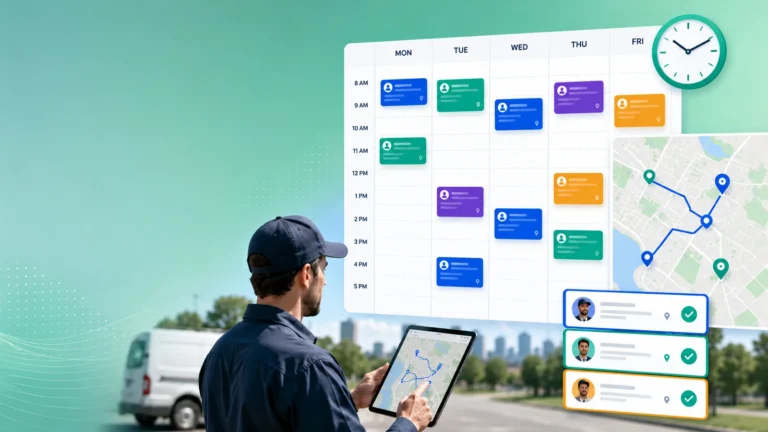
A growing service operation has to weigh skills, timing, urgency, travel, customer availability, and route logic at the same time. When all of that depends heavily on manual coordination, the board becomes harder to manage and easier to destabilize.
That is where automation becomes practical, not theoretical.
A stronger scheduling workflow reduces repeated decision-making in the obvious places and gives the team more space to focus on real exceptions. This is part of the same logic explored in What Makes Smart Scheduling Work in Field Service, where the real goal is not just filling time slots, but building a schedule that still works once the day starts moving.
Automation reduces hidden delays
Some service delays come from major problems.
A lot of them come from smaller manual gaps.
The request was not qualified well enough. The ticket needed more clarification. The update did not reach the customer soon enough. The dispatch change was made late. The technician did not receive the cleanest version of the job context. None of those issues may look dramatic alone, but together they slow the workflow down in ways that are easy to underestimate.
This is why service efficiency often improves when businesses automate the routine friction points.
The workflow stops losing time in places where time never needed to be lost.
It helps the team focus on exceptions that matter
One of the biggest mistakes in service operations is using skilled people for repetitive coordination all day.
The team ends up spending too much time on work that could be handled more consistently by the system itself. That includes intake steps, status handling, routine notifications, structured scheduling actions, and repetitive follow-up tasks.
Good automation does not remove people from the operation.
It helps them spend less time on predictable work and more time on the difficult situations that genuinely need judgment. That is one reason manual coordination becomes such an important issue in growing field operations. The more complex the day becomes, the more costly it is to waste skilled attention on low-value repetition.
Better workflows create better technician experiences
Automation is not only an office benefit.
It affects the field team too.
Technicians feel the difference when the job notes are clearer, when the schedule is more stable, when updates are more reliable, and when the workflow around them is less chaotic. A badly structured service process creates extra effort for technicians even when the problem began elsewhere.
That is one reason Why Technician Experience Matters in Modern FSM belongs in this conversation. Better workflow design often improves the technician side of service without needing to put more pressure on the people doing the work.
Customer experience improves when workflows are cleaner
Customers may not see the workflow directly, but they feel the outcome of it.
They feel it when updates are consistent. They feel it when the appointment process is clearer. They feel it when the technician arrives with better context. They feel it when delays are managed with more control instead of visible confusion.
That is why automation has a customer-facing effect even when the feature itself looks operational.
A smoother workflow usually creates a smoother experience.
And in field service, the customer often notices workflow weakness before the business fully does.
Automation supports growth without adding the same level of overhead
As service teams grow, the real challenge is not only handling more jobs.
It is handling more jobs without letting coordination costs rise at the same pace. A business that doubles its workload does not want to double the amount of manual checking, chasing, and administrative repair needed to keep the day functioning.
That is where field service workflow automation becomes essential.
It helps the business grow with more structure instead of simply adding more pressure to the same weak process.
Better automation depends on better workflow design
There is one important warning here.
Automation does not fix a broken process just because software is added to it.
If the workflow itself is unclear, inconsistent, or badly designed, automation may only make the confusion move faster. That is why service leaders need to understand what the workflow is supposed to do before deciding how to automate it.
This is the part many teams skip.
They focus on features before fixing the process logic underneath them.
The better approach is to identify where the workflow is repetitive, rules-based, and creating avoidable delay. Those are usually the best automation targets.
Fieldcode is one example of this shift
One example of this broader market movement is Fieldcode, which has positioned itself around Zero-Touch workflows, automated dispatch, and AI-supported service execution. It is a useful example because it reflects how automation in field service is increasingly being tied to the movement of work itself rather than only to reporting or analytics.
That matters because the market is changing.
Automation is no longer being treated as an extra layer. It is being treated as part of how the service workflow is supposed to function.
The biggest benefit is control
This may be the clearest reason automation matters.
It gives the business more control over the routine parts of service without forcing every step to depend on memory, manual follow-up, or individual workarounds. That control improves scheduling, coordination, updates, and consistency across the workflow.
And once that control improves, the whole operation becomes easier to manage.
That is usually where the real value appears.
Not in one dramatic feature, but in the steady removal of friction from the service day.
Conclusion
Field service workflow automation matters because manual service operations become expensive, inconsistent, and harder to scale over time.
It improves dispatch automation, supports better service efficiency, reduces unnecessary manual coordination, and strengthens workflow consistency across the service chain.
That is why automation keeps showing up as a central theme in modern field service.
It is not only about speed.
It is about building a workflow that can keep performing even as the business gets busier.