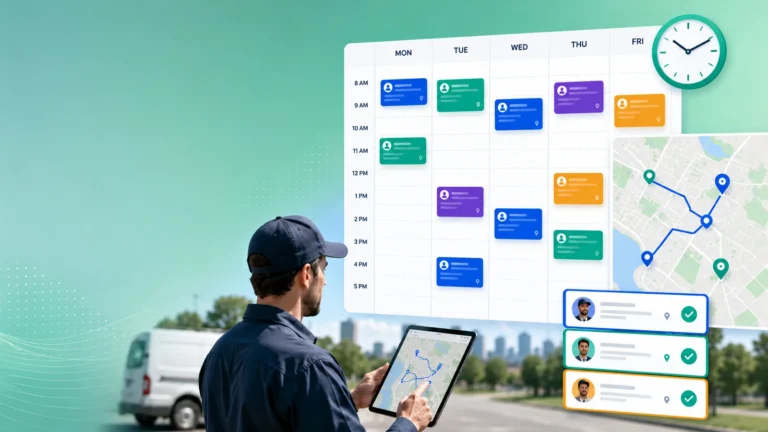
Running field service in one area is hard enough.
Running it across multiple regions is a different level of complexity.
You are not just managing more technicians. You are managing different territories, different demand patterns, different travel realities, different customer expectations, and sometimes different operating habits too.
That is why multi-region service teams need more than a larger scheduling board.
They need a system that helps the whole service operation stay aligned without forcing every region to work in exactly the same way.
Growth usually creates complexity before it creates control
A lot of service businesses expand region by region.
At first, that feels like momentum.
Then the strain begins to show. One region uses one process. Another handles dispatch differently. One team documents jobs well. Another team relies on shortcuts. Reporting becomes harder to trust. Leadership loses confidence in what is really happening across the business.
That is where FSM platforms start to matter more.
They create structure across distributed operations, which is exactly what growing multi-region service teams need most.
Visibility becomes harder as regions increase
In a smaller service operation, leaders can often stay close to the work.
They know who is overloaded. They know which territory is struggling. They know which local manager is keeping things under control.
That gets much harder once the business spreads across several regions.
The real challenge is not just handling more activity. It is maintaining field service visibility across different areas without drowning in fragmented updates.
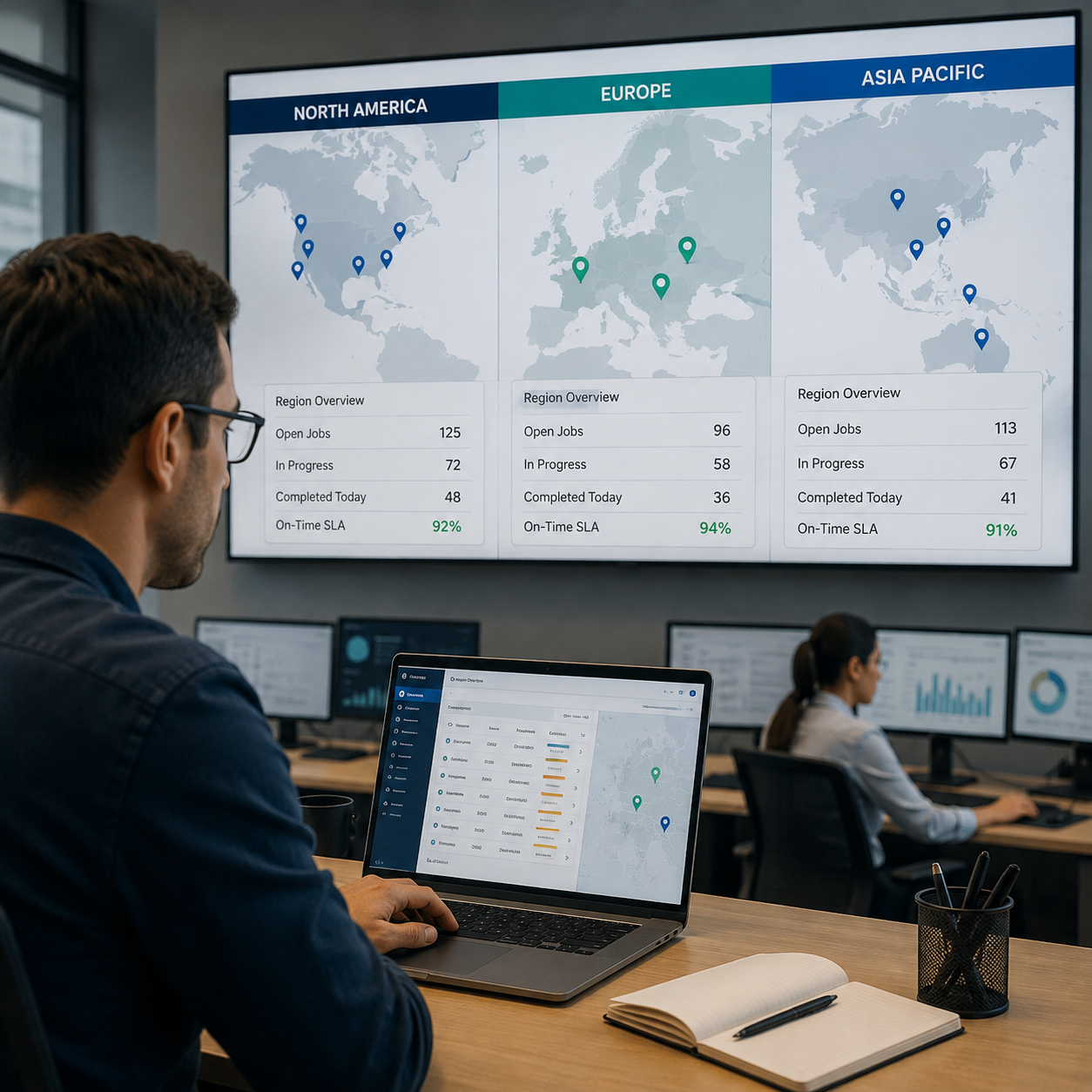
A strong FSM platform helps by creating one operational picture. Leaders can see job flow, technician activity, delays, backlog pressure, and workload distribution across the broader network instead of relying on disconnected local views.
That kind of visibility matters because multi-region problems often hide in the gaps between teams.
Standardization matters, but so does local flexibility
This is one of the hardest balances to get right.
A business with multi-region service teams needs common standards. It needs consistent data, reporting, status definitions, and service rules. Otherwise every region becomes its own version of field service, and comparison becomes almost meaningless.
But pure centralization is not the answer either.
Regions often have different realities. Travel density changes. Customer demand shifts. Job mix varies. Some areas may need tighter same-day capacity. Others may need a different scheduling model because of geography or technician distribution.
That is why good FSM support is not just about enforcing rules.
It is about creating standardized workflows where they matter most while still allowing regional flexibility where the work actually demands it.
Scheduling gets more complicated when regions behave differently
Scheduling is difficult even in a single operating area.
In a multi-region setup, it becomes more layered.
Each region may have different technician density, different average travel times, different peak demand periods, and different SLA pressure. A central team may want consistency, but the scheduling logic still has to reflect local reality.
That is why regional scheduling is such an important part of multi-region field service.
A strong FSM platform helps local teams schedule intelligently while still giving leadership confidence that the underlying process is aligned. That might mean shared rules around priorities, skills, and job statuses, but with enough flexibility for each region to manage the practical details well.
Multi-region teams need cleaner data than single-region teams
In a smaller operation, people can sometimes work around weak data.
Someone knows the customer.
Someone remembers the asset.
Someone can quickly explain what the ticket really means.
That becomes much harder across multiple regions.
When the business expands, clean data stops being nice to have. It becomes operationally necessary. Shared asset history, clear job notes, consistent issue categories, and reliable status updates all matter more when different teams need to understand the same work without local memory filling the gaps.
That is why field service visibility depends so heavily on data discipline.
Weak information creates much larger problems when more teams depend on it.
Service consistency is harder to protect across regions
Customers do not judge your business by region.
They judge it as one brand.
That is why service consistency matters so much for multi-region service teams. The customer expects a similar level of professionalism, communication, and reliability regardless of which local team handles the work.
Without strong platform support, that consistency can slip.
One region may update customers well. Another may be slower. One may close jobs cleanly. Another may leave too much ambiguity in the workflow. The service experience starts to feel uneven, even if leadership believes the business is following the same model everywhere.
FSM platforms help reduce that inconsistency by building shared operational habits into the workflow itself.
Multi-region operations benefit from stronger skills visibility
Technician skills are already a major factor in assignment quality.
In a multi-region business, the challenge gets bigger.
Leaders need to know not only who is available, but where the strongest expertise sits, where skill gaps are developing, and which regions are too dependent on a small number of experienced people. That kind of visibility is much harder to maintain through spreadsheets, local knowledge, or disconnected planning tools.
A stronger platform helps service leaders understand skills across the full network.
That makes it easier to plan coverage, spot training needs, and avoid situations where one region becomes fragile because too much operational knowledge sits with too few people.
Reporting becomes more useful when regions are comparable
One hidden benefit of good FSM support is better comparison.
A lot of businesses collect plenty of service data, but the reporting becomes difficult to trust because each region enters and manages work differently. That creates noisy metrics. One area may appear faster simply because it closes jobs differently. Another may appear less efficient because it documents more accurately.
That makes leadership less certain about where the real problems are.
Good FSM platforms improve reporting by creating more consistent workflows and status logic. Once that happens, leaders can compare regional performance with more confidence.
That is when reporting starts helping the business improve, not just describe activity.
Multi-region support also reduces dependence on individual managers
Many expanding service businesses rely heavily on strong local managers.
That can work well for a while.
But it also creates risk. If too much operational consistency depends on one regional leader’s habits, the business becomes harder to scale cleanly. Performance may stay strong in one region and drift in another based on management style rather than system design.
FSM platforms reduce some of that dependence.
They do not replace good local leadership. But they make the operation less fragile by embedding more consistency into the workflow itself.
That is one of the quiet strengths of a mature service platform. It helps the business scale beyond personalities.
Customer communication matters more at regional scale too
As the service network grows, communication gaps become more expensive.
One region may handle ETA updates well. Another may leave customers chasing for information. One team may manage expectations clearly. Another may create avoidable frustration through silence or vague timing.
Those differences become more visible as the business grows.
A stronger platform helps standardize the customer communication side of service across regions, which makes the experience feel more unified. That matters because regional scale often exposes where communication was too informal to begin with.
Multi-region service needs both control and trust
There is an important mindset shift here.
Supporting multi-region service teams is not about controlling every local decision from the center. That usually creates frustration and slows the operation down.
It is about creating enough structure that leadership can trust the network without micromanaging it.
That means standard rules where consistency matters.
It means local flexibility where regional reality matters.
And it means giving everyone access to the same operational truth, even if they are managing different markets.
That is where FSM platforms create real value.
Conclusion
Multi-region service teams need more than a larger headcount and more dispatchers.
They need stronger field service visibility, more reliable standardized workflows, smarter regional scheduling, and better service consistency across the whole operation.
That is what FSM platforms help deliver.
As service businesses grow, the real challenge is not only handling more work.
It is keeping the operation aligned while the footprint gets wider.
The teams that do that well are the ones that scale with more control, not more confusion.