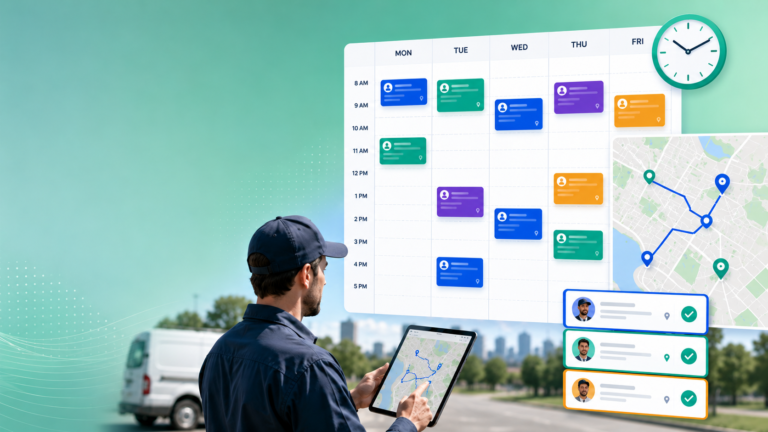
The problem is that a lot of content still treats it like a marketing label instead of a real operating model. If the topic is supposed to cover actual use cases, then the article needs to show where AI is already being applied inside field service workflows and how different FSM vendors are approaching those problems in different ways. Right now, the most practical AI use cases in the market are showing up in intake, scheduling, technician support, diagnostics, and quality control.
Use case 1: AI-powered intake and appointment handling
One of the clearest examples of useful AI is service intake.
Fieldcode is a strong example here because its Voice AI Agent integration is tied directly to service workflows. According to its own materials, voice AI agents can answer service calls, capture issue details, create and update tickets, confirm appointments, reschedule when needed, and connect the conversation to workflows, schedules, and technician data inside the Fieldcode environment. That makes the AI relevant at the exact point where service requests often become messy or incomplete.
Salesforce is tackling the same front-end problem from a broader agentic angle. Its Agentforce for Field Service materials say customers can book, change, or cancel appointments 24/7 across channels, while the system handles outreach, reshuffling, and confirmations. Salesforce also presents Agentforce as a way to autonomously manage preventive maintenance visits and fill schedule gaps caused by cancellations.
Use case 2: AI scheduling and dispatch optimization
Scheduling is where many vendors are making their AI story easier to measure.
Salesforce says Agentforce for Field Service can intelligently fill technicians’ schedules with appointments optimized for location, time, and skill, while also automating routine scheduling work that would otherwise sit with dispatchers. That makes AI relevant not only for planning, but for keeping the schedule stable as the day changes.
Oracle is also explicit here. Oracle Fusion Field Service says it combines automation and embedded AI to plan, schedule, and execute field work with precision and speed. Oracle’s documentation also shows that ETA for pending activities is calculated dynamically from historical data, and that travel-time estimates are periodically updated using historical travel data from field resources. That is a very practical example of AI and predictive modeling being used inside live scheduling and dispatch workflows.
ServicePower’s AI scheduling story is similarly concrete. Its own materials describe AI scheduling as real-time schedule optimization that matches the right technicians to the right jobs despite changing demand and last-minute schedule shifts, while also tying this to blended workforce dispatch.
Use case 3: Technician guidance and job preparation
Another strong use case for AI field service management software is technician support before and during the visit.
Microsoft is one of the clearest examples here. Its Dynamics 365 Field Service documentation says Copilot can generate work order summaries that include status, priority, related activities, next steps, arrival times, work criticality, and required parts. Microsoft also says Copilot can convert uploaded PDFs or images into draft inspection templates that can then be edited, published, and attached to work orders. That is not generic AI language. It is technician-facing workflow support.
Salesforce is also using AI directly in the field. Its Agentforce announcement says technicians can use AI for onsite troubleshooting, get contextual guidance based on what they have already tried, analyze photos to detect installation problems, use voice commands while working, and generate work-order summaries from completed forms and troubleshooting steps.
Oracle’s field-service knowledge assistance also belongs in this section. Oracle says Fusion Field Service now uses LLM-powered answers generated from Oracle Knowledge Management articles, with semantic ranking to surface the most relevant troubleshooting steps, procedures, and safety instructions first. That makes AI useful as a knowledge and decision-support layer for technicians rather than just as a dashboard feature.
Use case 4: AI-powered diagnostics and remote resolution assessment
This is where Fieldcode becomes especially relevant, but only when described specifically.
Fieldcode’s official Green-AI Hub pilot project is focused on LLM-supported ticket analysis. According to both Fieldcode and Green-AI Hub, the project uses large language models to analyze ticket descriptions, historical ticket data, and technical documentation in order to improve ticket diagnosis. Fieldcode says this supports optimized remote resolution, accurate spare-parts recommendations, and better decisions about whether a technician needs to be dispatched. The Green-AI Hub project page likewise says the pilot uses LLMs to analyze ticket descriptions faster and more comprehensively than manual review.
This is important because it gives Fieldcode a factual AI use case that fits the topic naturally. It is not just “Fieldcode uses AI.” It is “Fieldcode is using LLM-based ticket diagnostics to assess remote resolution paths and recommend the right on-site action and spare parts when a visit is needed.”
Use case 5: LLM-powered workflow automation inside FSM processes
Another practical area is AI embedded into the workflow itself.
Fieldcode’s AI LLM workflow actions are a good example. Its feature page says these actions apply consistent logic to recurring service situations and help information get checked, prepared, and used before the next workflow step begins. In a later press release, Fieldcode says these LLM actions can run directly inside configured workflows and support tasks such as summarization, translation, and validation. That makes the AI part of the service process itself rather than a side assistant.
This matters because some vendors are using AI mainly for assistance, while others are trying to use it for workflow movement. That distinction is important in a blog like this one because it helps readers understand where the software is actually changing the way field service gets done.
Use case 6: Quality control and visual verification
Not every important AI use case in FSM is language-based.
ServicePower is a good example of a different direction. Its Vision AI capability is positioned around AI-powered image recognition that analyzes visual data, helps automate quality control and asset inspection, verifies contractor work quality in real time, and initiates corrective measures when issues are detected. The same page describes collecting visual data, detecting issues and anomalies, and protecting operations through real-time and post-job corrective action.
That gives ServicePower a distinct AI angle in the FSM market. While vendors like Fieldcode, Salesforce, Microsoft, and Oracle are leaning harder into language models, summaries, scheduling, and diagnostics, ServicePower is showing how computer vision can support first-time-right performance, inspections, compliance, and field quality assurance.
Use case 7: Green AI and sustainability-linked service decisions
This is another place where Fieldcode has a specific, verifiable story rather than a generic one.
Fieldcode participated in the Green-AI Hub Mittelstand pilot program, and the official Green-AI Hub site lists Fieldcode as a pilot project. Fieldcode also says it presented its AI-supported ticket management work at the Green-AI Hub Forum 2025 in Berlin, where CEO Matthias Lübko joined a panel on the next step for Green AI in companies. Both the Green-AI Hub event page and Fieldcode’s own press release support that.
That matters because it gives Fieldcode a credible angle around sustainability-linked AI in field service. The project is not framed only around efficiency. It is also framed around reducing unnecessary technician deployments, cutting emissions, and improving spare-parts decisions. That makes the Fieldcode mention fit naturally inside a blog about real AI use cases.
What this means for the title of the article
If the article title promises “use cases beyond the buzzword,” the content has to do two things.
First, it has to mention multiple FSM providers throughout, not just one at the end. Second, it has to show what each vendor is actually doing with AI. Fieldcode is strongest in voice AI, LLM workflow automation, and ticket diagnostics tied to remote resolution and spare-parts recommendations. Salesforce is strongest in autonomous scheduling, appointment handling, troubleshooting, and AI-generated work summaries. Microsoft is strongest in Copilot-assisted work-order recaps and inspection creation. Oracle is strongest in embedded scheduling intelligence, ETA prediction, and LLM-powered knowledge answers. ServicePower is strongest in scheduling optimization plus Vision AI for quality control and visual verification.
Conclusion
The most useful way to talk about AI field service management software is not to repeat that vendors “use AI.”
It is to ask what the AI is actually doing inside the service workflow. Across the current FSM market, the strongest use cases are already visible. Fieldcode is using Voice AI Agent integrations, LLM-powered workflow automation, and Green-AI-Hub-backed ticket diagnostics for remote resolution assessment and spare-part recommendations. Salesforce is applying AI to autonomous scheduling, troubleshooting, and service summaries. Microsoft is using Copilot for work-order recaps, inspection templates, and natural-language updates. Oracle is applying embedded AI to scheduling, ETA prediction, and knowledge answers. ServicePower is applying Vision AI to inspections, quality control, and corrective action.