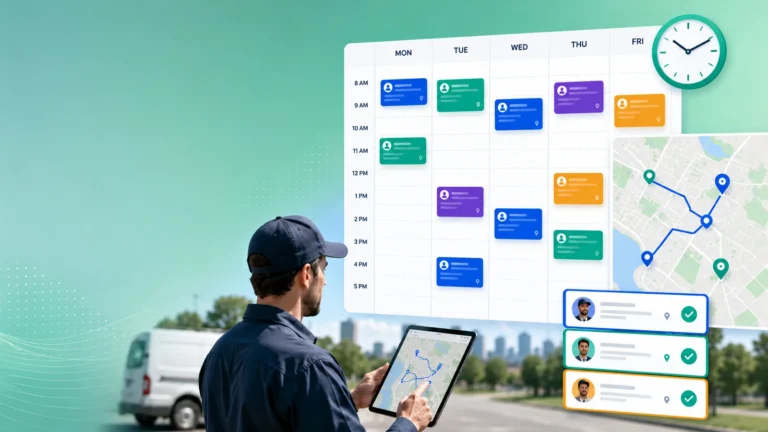
Schedule stability matters as much as schedule optimization because a technically better plan can still create operational problems if it keeps changing. Field service teams need schedules that use technicians, travel time, and capacity efficiently, but they also need plans that technicians and customers can actually rely on.
A scheduling engine may find a slightly shorter route or squeeze another job into the day. If doing that means repeatedly changing technician assignments, moving appointment windows, and disrupting work already in progress, the improvement may not be worth it.
The best field service schedule is not the one that is constantly recalculated into mathematical perfection. It is the one that remains efficient while absorbing real-world changes without making the entire day unstable.
An Optimized Schedule Can Still Be Difficult to Run
Scheduling optimization usually focuses on important factors such as technician skills, travel distance, availability, customer windows, priority, and SLA commitments. These are exactly the things a strong scheduling process should consider.
The problem begins when every small change triggers another round of reshuffling.
A new job arrives at 10:00 a.m. and the system sees an opportunity to shorten total travel by moving three existing appointments. On paper, the revised plan may save 25 minutes.
For the dispatcher, technician, and customers, however, those 25 minutes may create much more disruption.
One technician now has to change direction halfway through the morning. Another receives a job they did not prepare for. Two customers receive revised arrival windows after already planning their day around the original appointments.
This is why smart scheduling in field service needs to do more than fit the maximum number of jobs onto a board. A strong schedule should continue to make sense once technicians have started travelling and customers are expecting them.
Optimization creates value when it improves the day. It becomes counterproductive when the schedule is so sensitive that nobody can trust it for more than a few minutes.
Every Schedule Change Has a Hidden Cost
Moving an appointment looks simple on a dispatch screen. In practice, it can affect several people and several parts of the service workflow.
The customer may have arranged site access, moved a meeting, booked a loading bay, or made sure someone is available to meet the technician. Changing the window can undo all of that preparation.
The technician may also have prepared for the original route. Parts may already be loaded onto the van, specialist tools collected, or access instructions reviewed.
Dispatchers feel the cost too. Every unnecessary change can create another customer notification, technician conversation, route check, and potential exception later in the day.
That does not mean appointments should never move. Urgent faults, cancellations, technician delays, and safety-critical work will always require adjustments.
The important distinction is between a change that protects service performance and a change that produces only a small theoretical efficiency gain.
Routing shows this clearly. Better field service routing can reduce wasted travel and make the day easier to execute, but routes also need some continuity.
Constantly redirecting technicians to chase the shortest possible journey can leave the schedule feeling less organized even when the total mileage looks slightly better.
A Busy Plumbing Schedule Shows the Trade-Off
Imagine a commercial plumbing company with six technicians working across one city. By 8:30 a.m., each technician has a planned route with confirmed customer windows.
One technician, Daniel, has three jobs in the north of the city. His second customer expects him between 11:00 a.m. and 1:00 p.m. and has arranged for the building manager to provide access to a locked plant room.
At 10:15 a.m., a new leaking-pipe request arrives from a customer closer to Daniel than to any other technician. It is urgent, but the building has already isolated the affected line and there is no immediate safety risk.
The scheduling system calculates that assigning Daniel would reduce travel compared with sending another available technician. To make the new job fit, however, his second and third appointments would both need to move.
The dispatcher looks beyond distance.
Another qualified technician can reach the leak about 25 minutes later without disturbing any confirmed appointments. Sending that technician adds some travel, but Daniel’s route remains intact and two customers avoid last-minute changes.
The dispatcher chooses the slightly less optimized route because it produces the more stable service day.
Now change the situation. Suppose the leak cannot be isolated and water is entering an electrical area.
The priority changes immediately. Moving Daniel may now be justified because the cost of keeping the schedule stable is greater than the cost of disrupting it.
That is the balance service teams need. Stability should protect the plan from unnecessary changes, not prevent dispatchers from responding when circumstances genuinely demand it.
Stable Schedules Help Technicians and Customers Plan Better
Schedule stability gives technicians a clearer picture of the day ahead. They can prepare for the asset, check the service history, make sure likely parts are available, and organize travel with more confidence.
That preparation matters because many service failures begin before the technician arrives.
If a technician keeps receiving new assignments with little warning, preparation becomes harder. The person may be qualified for the job but still arrive without the best information or parts.
Reliable job data improves dispatch decisions, but technicians also need enough time to use that information.
Customers benefit from stability in a more obvious way. They want confirmation that the appointment is booked, a realistic arrival window, notification if something genuinely changes, and clarity about what happens next.
A four-hour window that remains dependable can be more useful than a two-hour window that gets moved twice.
Stability also makes delays easier to manage. When most of the schedule remains intact, dispatchers can focus on the one or two genuine problems instead of constantly rebuilding the entire board.
That helps protect field service resolution times. Excessive reshuffling can create late arrivals, rushed visits, poor preparation, and unfinished jobs that need another appointment.
The Goal Should Be Controlled Optimization
Service teams do not have to choose between optimization and stability. Good scheduling uses both.
The system should keep looking for better assignments, but it should understand that changing an existing commitment has a cost. The closer an appointment gets, the stronger the reason should be for moving it.
A job scheduled for tomorrow may be easy to optimize. A technician already travelling to a confirmed 11:00 a.m. appointment should need a much stronger reason to be redirected.
Teams can also define practical boundaries. Urgent SLA risks, safety issues, technician breakdowns, and major cancellations may justify immediate reoptimization.
Small mileage savings often do not.
Service leaders should monitor how often appointments are changed after confirmation, how many technician assignments are altered during the day, and how often those changes actually improve the final outcome.
They should also look at customer window performance, overtime, travel, first-time fix rate, and dispatcher workload. A schedule that appears efficient but requires constant intervention may not be genuinely optimized.
Schedule stability is ultimately about protecting good decisions once they have been made.
Field service will always involve change. Jobs take longer than expected, urgent requests arrive, customers cancel, traffic builds, and technicians encounter problems nobody predicted that morning.
A strong scheduling operation does not try to stop those changes. It absorbs the important ones without unnecessarily disturbing everything else.
That is why stability matters as much as optimization. The schedule needs to be efficient enough to use capacity well, but stable enough for technicians to execute it and customers to trust it.