A lot of content about AI in field service remains too generic. It talks about “optimization” and “intelligence” without showing what vendors are actually doing inside the workflow. The clearer way to look at the market is by use case.
Today, the most concrete AI applications from major FSM vendors show up in five places: intake and booking, scheduling and dispatch, technician guidance, ticket diagnostics, and post-job quality or documentation.
1. AI is already changing intake and appointment handling
One of the most practical AI applications sits right at the front of the workflow. Fieldcode’s voice AI agents are designed to answer service calls, capture issue details, create or update tickets, schedule appointments, and work directly with workflows, schedules, and technician data. The same product pages say those agents can verify identity and location, collect access instructions, and offer slots based on part availability, routing, and customer preference. That is a very specific, operational use of AI, not a vague promise.
Salesforce is approaching the same front-end problem from a different angle. Agentforce for Field Service is positioned around autonomous scheduling, schedule-gap filling, and AI agents that can interact with customers in natural language to book, change, or cancel appointments. Salesforce’s own materials also describe customer-facing scheduling that runs 24/7 and continuously matches each job to the best-fit technician using skills, availability, traffic, and urgency.
2. Scheduling and dispatch are major areas for AI applications
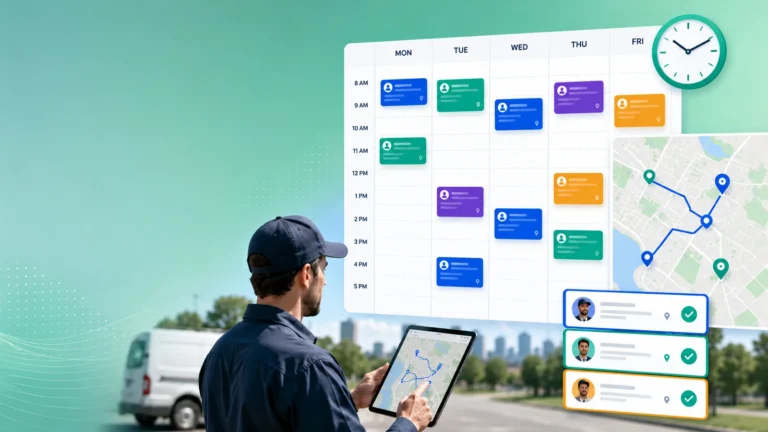
ServicePower’s AI story is especially concrete in scheduling. Its official solution pages and datasheets describe real-time AI-based schedule optimization that updates throughout the day and factors in technician skills, certification, location, availability, customer priorities, traffic conditions, and even required inventory. The platform also positions this as a way to make sure the best field worker arrives with the right parts at the right time.
Oracle frames the problem similarly, but from a broader field-operations angle. Oracle Fusion Field Service says it combines automation and embedded AI to help plan, schedule, and execute field work, and its product pages describe AI-driven demand forecasting, automatic job assignment, real-time schedule rebalancing, and route decisions that adapt to traffic and changing conditions. Oracle Fusion Field Service also uses historical performance data to improve predictions for activity duration and travel time, while real-time traffic and technician location can update ETAs during travel.
Salesforce is also pushing hard here. Agentforce for Field Service is presented as a system that can autonomously schedule appointments, fill gaps caused by cancellations, and optimize assignments for location, time, and skill. In Salesforce’s own examples, that includes using AI agents to handle preventive maintenance booking, fill technician schedules from the dispatch console, and narrow customer appointment windows with fewer “Where is my technician?” calls.
3. Technician-facing AI is moving beyond chat and into real job execution
Microsoft’s Dynamics 365 Field Service provides several practical examples of technician-facing AI. Copilot can generate work order summaries that include details such as status, priority, related activities, and other information relevant to the work order’s lifecycle stage. Microsoft also offers a Copilot feature that converts uploaded PDFs or images into draft inspection templates, although Microsoft currently documents this capability as a preview feature.
Oracle’s technician-facing AI is more knowledge-centric. Its current readiness docs say Oracle Fusion Field Service now uses LLM-powered answer generation from Oracle Knowledge Management, with semantic ranking that pushes the most relevant troubleshooting steps, procedures, and safety instructions to the top. Oracle explicitly presents this as “instant troubleshooting” for mobile workers who need faster answers for fault codes or equipment errors without long manual searches.
Salesforce is blending both approaches. In its Agentforce announcement, the company says technicians can ask for onsite troubleshooting help, pull answers from manuals, similar repairs, and sensor data, analyze installation photos, and use voice commands while on the move. Salesforce also highlights AI-generated post-work summaries that lineworkers and technicians can refine before saving back to the work order.
4. Fieldcode applies AI directly within service workflows
Fieldcode has LLM-based workflow actions that run directly inside configured service workflows. These actions can summarize notes, translate service information, clean and structure data, extract information, and support workflow decisions. Rather than operating as a separate chatbot, the AI becomes part of the workflow itself.
Fieldcode has also explored more advanced ticket diagnostics through its Green-AI Hub pilot. Announced in 2024, the project focused on using historical ticket information and technical documentation to investigate how LLMs could support ticket diagnosis, remote-resolution decisions and spare-parts recommendations.
5. AI is also being applied to quality control and visual verification
Not every useful AI use case in FSM is about language or scheduling. ServicePower is a good example here. Alongside schedule optimization, its official product pages also describe Vision AI as image-based analysis that gives real-time quality feedback to technicians, reduces risk, and supports compliance. That is a different AI application from what Microsoft, Oracle, Salesforce, or Fieldcode are emphasizing, but it is still highly relevant in field service because it targets workmanship, proof of completion, and quality assurance.
Conclusion
The real story of AI in field service is not that every vendor now says “we have AI.”
It is that vendors are increasingly attaching AI to concrete workflow outcomes. Fieldcode is applying it to voice-led intake and LLM-powered workflow actions, while also exploring AI-supported ticket diagnostics through its Green-AI Hub pilot. Salesforce is applying it to autonomous scheduling, onsite troubleshooting, and summary generation. Microsoft is applying it to work order recaps and inspection creation. Oracle is applying it to embedded scheduling logic, ETA prediction, and LLM-powered knowledge answers. ServicePower is applying it to real-time schedule optimization and image-based quality control.