Dispatch has always been one of the most demanding parts of field service.
On a calm day, it already requires constant judgment. On a busy day, it becomes even harder. New jobs come in, customer availability changes, technicians run late, urgent work pushes planned work aside, and the entire board can start shifting by the hour. That pressure is exactly why AI is becoming more important in dispatch. Across the current FSM News coverage, scheduling, workflow automation, intake quality, and job data are all being treated as central operating issues rather than side topics.
That is what makes AI field service dispatch worth paying attention to.
The point is not that AI sounds modern.
The point is that manual dispatch gets expensive when every decision depends on speed, experience, and constant replanning.
Dispatch quality affects more than the schedule
A weak dispatch decision does not stay inside the office.
It shows up in the field. The wrong technician gets assigned. The visit takes longer than expected. The customer gets a wider arrival window. A second appointment becomes more likely. That is why dispatch quality matters so much. As FSM News has already highlighted in How to Improve First-Time Fix Rate in 2026, stronger first assignments usually create stronger first visits, which is exactly why dispatch has such a big effect on service outcomes.
This is also why dispatch automation is gaining attention.
When the quality of the first decision improves, the whole service chain gets stronger after it.
AI helps dispatch by reducing decision overload
A dispatcher often has to weigh several variables at once.
Who has the right skill set. Who is closest. Who has spare capacity. Which job is truly urgent. Which visit is already at risk. Which customer can still be moved. Which assignment will create the least disruption across the rest of the day.
That is a heavy decision load, especially when it repeats constantly.
AI helps by reducing how much of that evaluation has to be done manually every time. This connection between scheduling and dispatch is explored further in How AI Optimizes Field Service Scheduling. Better assignment decisions can reduce wasted movement, repeated reshuffling, and poor technician matching.
Better job matching is one of the clearest gains
One of the biggest reasons AI field service dispatch matters is job matching.
Manual dispatch often falls into a familiar pattern. The nearest available technician gets the work. That may look efficient in the short term, but it is not always the smartest decision. The nearest person may not have the right experience, the right recent context, or the right preparation for the issue.
AI improves that by weighing factors beyond proximity alone.
This matters because better job matching reduces repeat work, protects technician time, and gives the first appointment a better chance of succeeding. FSM News has already linked stronger assignment logic to better outcomes in areas like first-time fix, job data quality, and smarter scheduling.
AI is only as good as the information it receives
There is one important limit here.
AI cannot fully rescue weak inputs.
If the job is poorly described, the urgency is unclear, or the asset details are incomplete, even a smart dispatch model will still be working from partial information. That is why dispatch quality is tied so closely to intake and ticket quality. In How Better Job Data Improves Dispatch Decisions, FSM News already makes the point that stronger data gives dispatch a much better foundation for the first assignment.
This matters because businesses sometimes expect AI to solve a process problem that really begins earlier.
If the request enters the system badly, the rest of the workflow has to compensate.
Dispatch gets stronger when AI supports change during the day
The real test of dispatch is not the morning plan.
It is what happens after the first disruption.
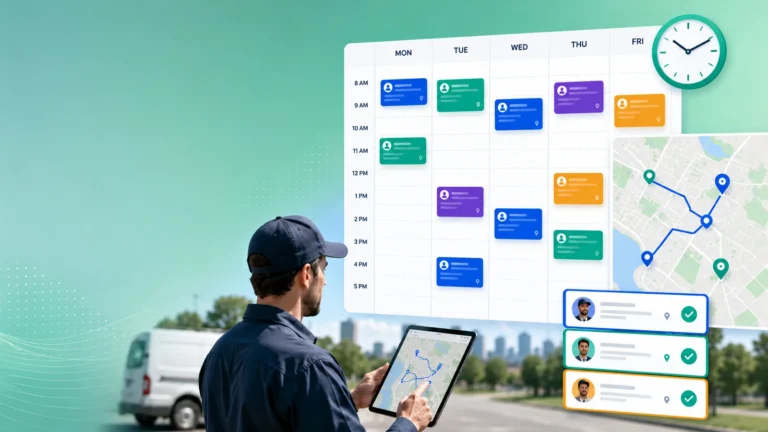
A technician overruns. A same-day request appears. A customer needs to reschedule. A higher-priority ticket lands at midday. That is when manual dispatch starts becoming reactive, because every new change forces the board to be reconsidered again.
AI helps here by making those schedule adjustments faster and more structured. This also connects with the ideas discussed in Which FSM Workflows Should You Automate First. Dispatch and scheduling stand out as high-frequency workflows that benefit from automation because they are repeated constantly and become costly when handled manually.
The value is not perfection.
The value is keeping the schedule usable when the day stops being predictable.
AI also reduces hidden admin work
A lot of dispatch workload is not pure decision-making.
It is cleanup.
Rechecking notes. Confirming missing details. Adjusting the same jobs again and again. Updating statuses. Rebuilding context that should already have been captured properly. This is why AI in dispatch is not only about assigning technicians faster. It is also about reducing the admin friction that makes dispatch feel heavier than it should.
When that burden falls, dispatchers can spend more time on exceptions that actually need human judgment.
That is often where the real operational relief appears.
Customer experience improves when dispatch improves
Customers do not see the dispatch board.
But they absolutely feel the consequences of it.
They feel it when appointment windows look unrealistic. They feel it when the wrong technician arrives. They feel it when delays pile up and nobody seems in control. They also feel it when updates are clearer and the visit feels better organized from the start.
That is why stronger dispatch creates more than internal efficiency. It also improves the customer side of service. FSM News makes that broader point clearly in Why Live ETA Updates Matter in Field Service, where visibility and timing confidence shape the customer experience before the work is even completed.
Technician experience improves too
A badly built schedule creates stress for the field team.
Technicians feel it when jobs are stacked poorly, when the route wastes time, and when the assignment does not fit the actual work. That is why dispatch quality affects more than office efficiency. It affects whether the day feels manageable for the people doing the work.
AI can help reduce that friction by creating more logical assignments and fewer unnecessary schedule swings.
That is one reason the technician side of dispatch matters so much.
Better dispatch does not just move work faster.
It helps people work with less waste.
Fieldcode is one example of this shift
A good example of this broader market direction is Fieldcode, which has positioned itself around Zero-Touch scheduling, automated dispatch, and AI-supported service execution. That is relevant here not because every service business needs the same platform, but because it shows how vendors are now pushing AI directly into the dispatch layer rather than treating it as a reporting add-on. FSM News has already covered that movement through articles on Fieldcode’s Voice AI and AI-led scheduling.
That is the bigger shift happening in the market.
AI is moving closer to the point where daily service decisions are actually made.
The biggest benefit is consistency
This is where the business case becomes clearer.
The goal of AI field service dispatch is not to create a flawless schedule every day. The goal is to create a more consistent one. Fewer poor matches. Fewer avoidable delays. Fewer manual adjustments. Better use of technician time. Better handling of disruption when the day changes.
Each gain may seem small on its own.
Together, they change how reliable the service operation feels.
Conclusion
AI field service dispatch matters because dispatch sits at the center of service execution.
It affects dispatch automation, field service scheduling, job matching, and overall service efficiency. It also shapes how well the business responds when the schedule changes under pressure, which is one reason dispatch continues to feature so heavily across FSM News coverage.
That is the real point.
AI does not matter because it makes dispatch look more advanced.
It matters because it helps dispatch stay more accurate, more consistent, and less dependent on constant manual firefighting.