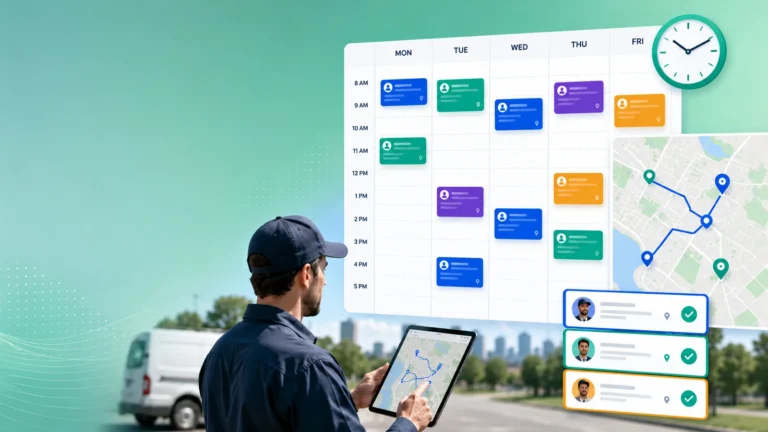
Good field service data governance means that service information is accurate, consistent, secure, and managed by people who understand their responsibilities. It gives the business clear rules for collecting, updating, sharing, and retaining data throughout the service process.
In practice, this means a dispatcher can trust the job details, a technician can see the correct asset history, and a customer service agent can confirm the appointment window and next step without calling three different teams.
Governance is working when people can use the data confidently, not when the company simply has a long policy document.
Clear Ownership Comes Before Better Data
One of the biggest data problems in field service is unclear ownership. Customer service creates the request, dispatch adds planning details, the technician records the work, and finance uses the completed job for billing.
When a record is wrong, it may not be obvious who should fix it.
Good governance assigns an owner to each important type of data. Customer records may belong to the customer service team, work-order standards to service operations, asset records to an asset manager, and access permissions to IT.
Ownership should be practical, not symbolic. The responsible person or team must be able to define required fields, approve changes, investigate recurring errors, and decide how exceptions should be handled.
This becomes even more important for multi-region service teams. One branch may record a failed compressor as a “mechanical fault,” while another calls it a “cooling failure.”
Both descriptions may make sense locally, but combined reporting becomes difficult unless the business agrees on shared categories. The aim is not to remove every local difference but to ensure essential information means the same thing across the operation.
Good Governance Starts When Data Is Collected
Poor data is difficult and expensive to repair later. Good field service data governance improves information at the point where it first enters the workflow.
A service request should capture what the dispatcher and technician genuinely need. Depending on the job, that may include the asset ID, reported symptom, error code, site access instructions, customer availability, safety risks, and whether remote troubleshooting has already been attempted.
The same principle applies when the technician closes the job. “Completed” is rarely enough.
The service record may need the fault found, work performed, parts used, test result, customer confirmation, and any required follow-up action.
Consider a customer who reports that a rooftop HVAC unit is blowing warm air. The call handler enters only “air conditioning not working,” so the dispatcher assigns the nearest available technician.
The technician arrives, checks the unit, and finds a faulty control board. The correct part is not on the van, which means the customer needs a second appointment and the dispatcher must reorganize the schedule.
Now imagine the intake process asks for the unit number, displayed error code, previous repair details, and access restrictions. The dispatcher can review the asset history, identify the likely skill requirement, and check whether the technician has the correct part before confirming the visit.
That is why better job data improves dispatch decisions. It reduces guesswork before the technician starts travelling.
Structured fields help here. Drop-down options, validated asset numbers, standard fault codes, and guided forms usually produce more reliable information than unrestricted notes.
Free text still has a place, but it should add context rather than carry the entire job record.
Access Controls Should Protect Data Without Slowing Work
Field service information is used by dispatchers, technicians, contractors, managers, customer service teams, and finance staff. They do not all need the same level of access.
A technician may need to view the asset history and update job findings, but should not be able to change contract rates. A dispatcher may adjust appointments and assignments, but should not delete completed service records.
External contractors may only need access to the jobs assigned to them. Their access may also need to expire when the work or contract ends.
Role-based permissions make these boundaries clearer. Important changes should also leave an audit trail showing what changed, who changed it, and when it happened.
This matters when a completed job is questioned. If the labour time, service status, serial number, or parts usage has been edited, the business should be able to trace the record rather than rely on memory.
Retention rules are equally important. Keeping every record forever creates unnecessary cost and risk, while deleting information too early can weaken warranty support, compliance evidence, customer dispute handling, and long-term asset analysis.
The controls still need to fit daily work. If the process is too restrictive, employees may move information into spreadsheets, personal notes, or messaging apps.
That creates a new governance problem outside the main system.
Data Quality Needs Regular Attention
A governance policy does not improve data by itself. Field service teams need to check whether people are following the standards and whether those standards are producing useful information.
Useful quality measures may include jobs without valid asset IDs, tickets closed without required evidence, duplicate customer records, missing fault codes, unmatched parts usage, or appointments created without access instructions.
The purpose is not to punish people for every missing field. It is to find patterns that are creating delays, repeat work, poor reporting, or avoidable customer calls.
For example, a manager may notice that technicians regularly arrive without the correct model information. The problem could come from incomplete customer intake, an outdated asset database, or an integration that is dropping fields between systems.
Changing the technician form would not solve any of those causes. Good governance follows the problem back to the point where the information became unreliable.
This also helps reduce manual coordination across field service teams. Dispatchers should not have to call customer service for access details, message a technician for missing completion notes, and then contact finance to explain why a job cannot be invoiced.
What Good Governance Looks Like Day to Day
Good field service data governance is visible in ordinary service situations. A customer receives confirmation, a realistic appointment window, and clear instructions about what will happen next.
The dispatcher can see the job priority, required skills, asset history, location, access details, and likely duration. The technician receives the same reliable information and knows exactly what must be recorded before closing the job.
Managers can compare regions because teams use shared definitions. Finance can create an invoice from a complete service record.
If a customer raises a question three months later, the business can see what happened without reconstructing the visit from emails and phone calls.
No field service operation will have perfect data. Emergency jobs, unknown assets, unusual site conditions, and incomplete customer information will always create exceptions.
The difference is that well-governed teams know how to manage those exceptions. They record what is missing, assign responsibility, and prevent a one-off issue from becoming the normal way of working.
Good governance is therefore less about controlling data and more about making it dependable. When people trust the information in the system, scheduling becomes more accurate, technicians arrive better prepared, customers receive clearer updates, and leaders make decisions with greater confidence.