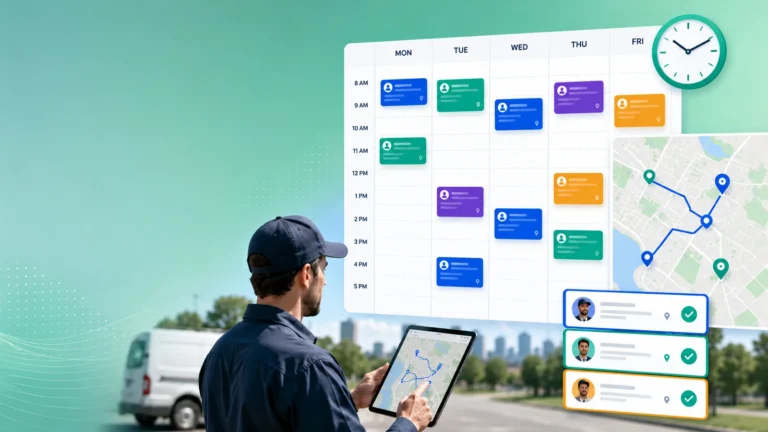
AI is becoming part of the operational layer of field service management rather than a separate feature added on top of it.
Depending on the platform, AI can now help schedule technicians, optimize routes, summarize work orders, interpret service data, support technicians, automate customer conversations, predict maintenance needs, inspect completed work, or take actions inside service workflows.
That does not mean every AI-powered field service management solution approaches the problem in the same way. Some vendors focus heavily on scheduling optimization. Others connect AI to CRM, enterprise asset management, customer service, or technician knowledge. A growing number are also introducing AI agents that can perform specific service tasks rather than simply generate recommendations.
The 10 platforms below represent different approaches to AI in field service management. The list is not a ranking. The more useful comparison is what each platform applies AI to, what type of service environment it supports, and where its approach is most distinctive.
AI-powered field service management solutions at a glance
| Solution | Main AI focus | Particularly relevant for |
|---|---|---|
| Fieldcode | Automated scheduling, workflows and Voice AI scheduling | Service organizations reducing manual coordination |
| IFS | AI-driven service optimization and resource forecasting | Asset-intensive enterprise service |
| Microsoft Dynamics 365 Field Service | Copilot, work order intelligence and natural-language assistance | Microsoft-centric organizations |
| Oracle Field Service | Predictive scheduling and route optimization | Large, complex mobile workforces |
| OverIT | Scheduling optimization and complex field operations | Utilities and infrastructure |
| Salesforce Agentforce Field Service and Operations | Agentic scheduling, dispatcher and technician assistance | Salesforce environments |
| SAP Field Service and Asset Management | AI-assisted technician selection, planning and Joule | SAP environments |
| PTC (ServiceMax) | Asset intelligence, technician assistance and predictive service | Equipment-centric service organizations |
| ServiceNow Field Service Management | AI agents, work orders, parts and knowledge | ServiceNow workflow environments |
| ServicePower | AI scheduling, contractor dispatch and Vision AI | Employed and blended workforces |
What makes field service software AI-powered?
The term can cover very different capabilities.
Traditional field service automation follows predefined rules. A system might automatically assign a job when a particular condition is met, for example. AI adds another layer by interpreting larger amounts of operational data, evaluating alternatives, generating information, or making recommendations and decisions based on changing conditions.
In field service, practical applications increasingly include:
- Matching jobs with technicians using skills, location, availability, priority and other constraints
- Reoptimizing schedules when jobs are delayed, cancelled or added
- Turning customer conversations into structured service requests
- Summarizing long work orders and service histories
- Translating, validating or restructuring ticket information
- Helping technicians search manuals and previous service records
- Predicting maintenance requirements from asset history
- Identifying issues from photos taken in the field
- Supporting dispatchers through natural-language interfaces
- Automating parts, scheduling or work order actions through AI agents
The important distinction is whether AI is connected to the operational workflow. Generating a summary is useful, but AI becomes more consequential when its output can influence what happens next in the service process.
1. Fieldcode
Fieldcode combines AI with its broader Zero-Touch field service automation approach.
Its scheduling and dispatching capabilities can automatically assign work using factors such as technician skills, location, availability, priority and SLAs. Route optimization works alongside that scheduling logic to reduce unnecessary travel and continuously adapt field plans.
Fieldcode has also expanded AI beyond scheduling. Its AI LLM workflow actions can work with ticket and object data already held inside Fieldcode. These actions can summarize information, translate content, clean or standardize fields, perform checks and support workflow decisions. The resulting information can then be used by subsequent workflow steps rather than requiring someone to copy data into a separate AI tool.
Voice AI is another part of the platform’s approach. Fieldcode’s voice AI agents can answer inbound calls, capture service issues, create or update tickets, offer appointments and support outbound appointment confirmation. The agents work with scheduling, technician and workflow information inside the Fieldcode environment. FSM News has also looked more closely at how Fieldcode is introducing Voice AI into field service execution.
Where it stands out: Fieldcode is particularly focused on connecting AI to operational execution. Scheduling, ticket processing, customer calls and workflow actions can all feed into the same service process.
Best fit: Organizations looking to reduce dispatcher and service-desk coordination while keeping AI inside configured FSM workflows.
2. IFS
IFS applies its IFS.ai capabilities across field service, asset management and wider enterprise operations.
Within field service management, IFS highlights AI-powered service resource forecasting and scheduling optimization. The objective is not only to assign technicians but also to improve capacity planning, first-time fix performance and service resource utilization.
That wider enterprise context matters. IFS is heavily oriented toward industries in which field service is closely connected to expensive assets, maintenance programs and long equipment lifecycles. Its field service offering sits within IFS Cloud alongside enterprise asset management and other operational functions.
The company describes IFS.ai as embedded intelligence rather than a separate field service add-on. That gives organizations the possibility of applying AI across service planning, resource management and asset-related decisions.
Where it stands out: The connection between field service AI, asset management and wider industrial operations.
Best fit: Large organizations in manufacturing, aerospace and defense, utilities, energy, telecommunications and other asset-intensive industries.
3. Microsoft Dynamics 365 Field Service
Microsoft’s AI strategy in field service revolves increasingly around Copilot and agents working with Dynamics 365 and Microsoft 365.
Copilot can generate work order summaries that change according to the work order’s lifecycle stage. For an unscheduled order, for example, the summary can surface information relevant to planning. For work already in progress, the emphasis can shift toward asset information, history and what the technician needs to complete the job.
Microsoft’s current Copilot capabilities for Dynamics 365 Field Service also include assistance with work order updates, inspection-template creation, form filling and finding or summarizing field service data.
The value of that approach is strongest for organizations already operating heavily inside Microsoft products. Field service data can sit within a broader environment that includes Dynamics, Dataverse, Microsoft 365 and Copilot.
Where it stands out: Natural-language access to field service information and close integration with Microsoft’s broader business software ecosystem.
Best fit: Organizations already standardized on Microsoft Dynamics 365, Power Platform and Microsoft 365.
4. Oracle Field Service
Oracle Field Service has long emphasized predictive scheduling and workforce optimization.
Its scheduling engine uses predictive AI to match work with technicians while considering factors such as skills and existing schedules. Route optimization is incorporated into the same process so that assignment decisions also take travel into account.
This makes Oracle’s approach particularly relevant to organizations with large numbers of appointments and a high degree of scheduling complexity. The emphasis is less on generative AI writing assistance and more on applying predictive intelligence to the operational problem of getting field resources to the right jobs efficiently.
That connection between assignment and travel matters because better routing affects far more than mileage. It can influence appointment reliability, schedule stability, technician utilization and the operation’s ability to absorb same-day changes.
Oracle Field Service also connects technician mobility, customer notifications and workforce data with the scheduling process.
Where it stands out: Mature predictive scheduling and route optimization for large field workforces.
Best fit: Enterprises managing high service volumes, complex territories and scheduling constraints, particularly where Oracle is already part of the technology environment.
5. OverIT
OverIT’s NextGen FSM platform is strongly oriented toward complex field operations, particularly utilities, infrastructure and asset-heavy service environments.
Its platform supports automated scheduling using real-time resource availability, work calendars and operational constraints. For more complicated work, including multistage activities, OverIT supports both manual scheduling and AI-powered optimization while respecting dependencies between tasks.
The platform also supports job bundling, allowing related activities to be grouped based on factors such as location, skills, equipment, expected work dates and other operational criteria. This is useful in service environments where the scheduling problem involves more than assigning independent jobs to individual technicians.
OverIT’s GIS and asset capabilities are another important part of the proposition. Linear assets such as pipelines, roads and power networks create different planning requirements from conventional customer-site service.
Where it stands out: Combining field service planning with complex assets, GIS, crews and multistage work.
Best fit: Utilities, telecommunications, energy, infrastructure and other organizations managing technically complex field operations.
6. Salesforce Agentforce Field Service and Operations
Salesforce has moved its field service AI strategy firmly toward agentic AI.
The product area previously known simply as Salesforce Field Service is now referred to in current documentation as Agentforce Field Service and Operations. Its AI capabilities extend across customers, dispatchers and field technicians.
One of the clearest examples is Agentforce scheduling for Field Service. Customers can use AI-driven self-service to schedule, reschedule or cancel appointments, while the system considers operational requirements behind the scenes. Salesforce also supports AI-assisted outreach and rebooking.
For dispatchers, Agentforce can surface appointments requiring attention, including schedule conflicts, rule violations, SLA risks and emergencies. It can also help identify schedule gaps. This reflects a wider change in FSM, where AI agents are shifting the dispatcher role away from routine coordination and toward exceptions and operational judgment.
Salesforce’s broader proposition is that field service AI has direct access to CRM and service data. This can give agents context about the customer alongside information about appointments, technicians and service activity.
Where it stands out: Agentic scheduling combined with Salesforce CRM and customer-service data.
Best fit: Organizations already using Salesforce extensively across customer service, CRM and field operations.
7. SAP Field Service and Asset Management
SAP renamed and expanded SAP Field Service Management as SAP Field Service and Asset Management, reflecting a closer connection between field work and asset maintenance.
AI is increasingly visible in its planning tools.
The Best Matching Technician capability can rank suitable technicians for an activity. SAP also provides AI-generated explanations that convert the scheduling policy and underlying scoring information into natural language, helping dispatchers understand why technicians were ranked in a particular order.
Joule, SAP’s generative AI copilot, adds a conversational layer. In Field Service and Asset Management, Joule can support activities such as finding plannable work, identifying suitable technicians, assigning technicians and releasing activities.
That combination is notable because AI is being used both to recommend actions and to explain the logic behind those recommendations.
Where it stands out: AI-assisted technician matching combined with SAP’s enterprise and asset-management environment.
Best fit: Organizations already running SAP and looking to connect field service more closely with asset and enterprise processes.
8. ServiceMax
ServiceMax, part of PTC, approaches field service from an asset-centric perspective.
PTC AI uses generative AI with asset history, equipment information, previous service activity and technical documentation. Technicians can ask natural-language questions about a particular job or asset and retrieve relevant information without manually searching through multiple records and manuals.
The AI assistant can also support documentation and scheduling activities and provide recommendations connected to predictive maintenance.
This asset context is the key difference. For organizations servicing expensive industrial equipment, knowing the complete history of the individual asset can be as important as knowing which technician is available. It also connects closely to the growing use of AI to predict likely parts requirements before service visits, where asset history and previous repairs can help teams prepare before dispatch.
Where it stands out: Generative AI grounded in detailed asset and service history.
Best fit: Manufacturers and service organizations maintaining complex equipment with long service lifecycles.
9. ServiceNow Field Service Management
ServiceNow is bringing generative and agentic AI into field service through Now Assist and its wider AI platform.
Now Assist for Field Service Management can summarize work order tasks, generate knowledge content and summarize service discussions. These functions are designed to reduce the time employees spend converting operational activity into documentation.
ServiceNow has also introduced more action-oriented AI agents. Current FSM capabilities include agents that can create work orders from text or images, manage parts based on activity notes and support technician shift scheduling through conversational AI.
This is particularly relevant in organizations where field service is part of a much broader ServiceNow workflow environment. Incidents, cases, work orders, knowledge and other service processes can operate on the same platform.
Where it stands out: AI agents that work within a broader enterprise workflow and service-management platform.
Best fit: Organizations already using ServiceNow for IT, customer, enterprise or operational service workflows.
10. ServicePower
ServicePower combines AI-powered scheduling with contractor management and visual intelligence.
Its scheduling technology continuously optimizes field schedules using constraints such as technician skills, location, availability, traffic and parts. The system can continue reassessing the schedule throughout the day rather than treating the original plan as fixed.
A major differentiator is its support for employed, contracted and blended workforces. Contractor dispatch requires different decision criteria because third-party providers can have their own coverage, costs, availability, performance history and eligibility requirements.
ServicePower has also introduced Vision AI for field service, using computer vision to analyze images captured during field work. This can support quality control, asset inspection and verification of completed work rather than relying entirely on structured form entries.
Where it stands out: Combining AI scheduling with contractor workforce management and computer-vision-based field inspection.
Best fit: Organizations operating employed technicians, contractor networks or a mixture of both.
How to compare AI field service management software
The most useful way to compare AI-powered FSM platforms is to start with the operational problem you want to solve.
For scheduling-heavy teams, look at how well the software handles skills, SLAs, routes, availability and same-day changes. For technician productivity, assess whether AI can use work order, asset and service history to provide useful context in the field. If reducing dispatcher or service-desk workload is the priority, focus on automation around intake, appointment handling, ticket updates and workflow actions.
Asset-intensive organizations should also look closely at how AI connects with maintenance history and equipment data, while companies using contractors need to assess how well the platform handles external workforce rules and availability.
The key question is not how many AI features a platform has, but which service decisions and tasks it can improve inside your existing workflows.l apply intelligence to scheduling, but they differ considerably in how scheduling fits into the wider service process.
Conclusion
AI is becoming part of everyday field service execution, from scheduling and routing to technician support, customer communication and workflow automation.
The right platform depends on where your biggest operational gaps are. Rather than choosing based on the number of AI features, focus on how well the software applies AI to the service processes you actually need to improve.