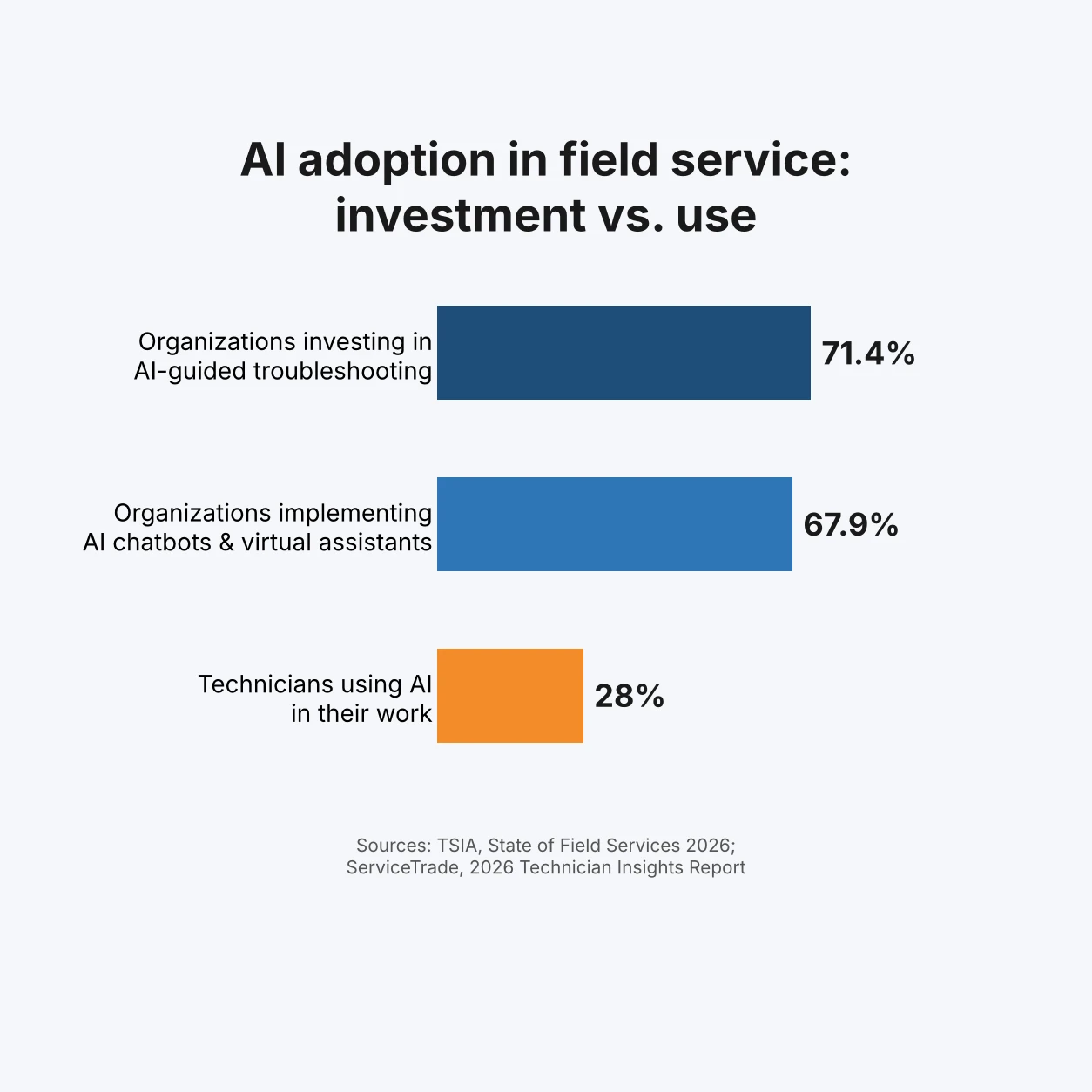
AI adoption in field service is moving faster in budgets than in daily technician work. Service leaders are investing heavily in AI-guided troubleshooting and virtual assistants. Yet only about 28% of technicians use AI in their work today. The gap is not a technology problem. It comes from how AI is introduced, governed and measured in the field.
This article looks at what recent research from TSIA, ServiceTrade, Aquant and Gartner says about that gap. It also explains what service organizations can do to turn AI investment into real use on site.
What Does AI Adoption in Field Service Mean?
AI adoption in field service is the share of service work in which AI tools are actually used to make or support decisions. That includes dispatch, troubleshooting, documentation and customer updates. It is different from AI investment. A company can buy an AI assistant for every technician and still have low adoption if few people open it during a job.
For this reason, adoption is best measured at the level of the work order. Useful questions include: how many jobs used AI guidance, and how many reports were drafted with AI support? It also helps to track how often a technician accepted, edited or rejected a suggestion.
The Investment Side: Service Leaders Are Committing to AI
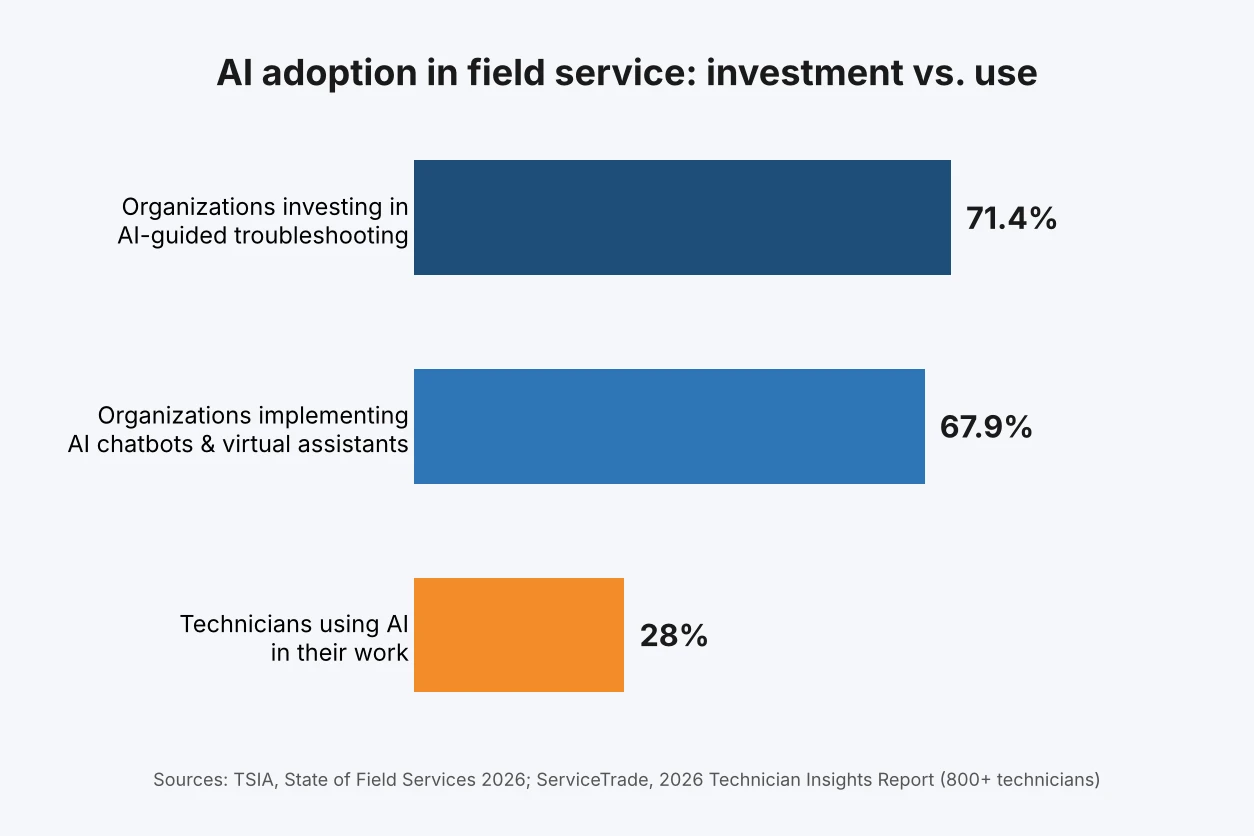
On the management side, the direction is clear. In its State of Field Services 2026 research, TSIA reported that 71.4% of field services organizations are investing in AI-guided troubleshooting. In addition, 67.9% are implementing AI-powered chatbots and virtual assistants.
TSIA (2026) also points to a gap in how results are tracked. Only 10.7% of organizations measure AI return on investment by its impact on training. That matters, because TSIA argues that AI can cut technician time-to-proficiency from 18 months to nine. If that benefit is not measured, it is easy to miss.
The Field Side: Most Technicians Are Not Using AI Yet
The picture looks different from the technician’s seat. The 2026 Technician Insights Report from ServiceTrade surveyed more than 800 technicians. About 28% said they use AI in their work, either regularly or occasionally.
The way they use it is telling. Among technicians who use AI, 46% use it to save time on paperwork, writing and summaries. In other words, early adoption starts with admin work, not with complex diagnostics.
The same ServiceTrade (2026) survey shows what frustrates technicians most. Miscommunication was named by 45% and inefficient scheduling by 44%. These are coordination problems. AI tools that do not fix them are unlikely to win much trust in the field.
Why the AI Adoption Gap in Field Service Matters
Low adoption is not only a missed opportunity. It also carries a direct cost. Aquant’s 2026 Field Service Benchmark Report found that about one in five cases could be resolved remotely. Even so, many teams still send a technician. According to Aquant, that choice turns a 1.4% service cost impact into 18.3%.
Aquant (2026) also reports that failed service visits make up 44% of total service costs for lower performers. Furthermore, workforce retention is 87% at leading companies, compared with 66% among bottom performers. AI-guided triage and troubleshooting target exactly these areas. Dispatchers and remote experts play a key role, too. When they see remote resolution options early, fewer unnecessary visits reach the schedule. However, all of this only helps when people actually use the tools.
Governance Is Part of Adoption, Not a Barrier to It
Trust is a big reason technicians hold back. Gartner addresses this in its Market Guide for Field Service Management, published in July 2026. Gartner advises CIOs to prioritize AI-enabled FSM solutions built on unified data models. It also recommends governance across functions, so that existing manual, role-based controls are not bypassed by accident.
Gartner (2026) further recommends pilot programs, sandbox environments and continuous monitoring to refine those controls. This is especially important for custom-built or add-on AI tools. For field teams, clear rules make AI safer to use. Technicians are more likely to follow a suggestion when they know where it came from and who is accountable for it.
Five Ways to Increase AI Adoption in Field Service
The research points to a practical playbook. These five steps help close the gap between AI spend and AI use.
- Start with admin work. Technicians already use AI for paperwork and summaries. Build on that with AI-drafted job reports and automatic notes from voice input.
- Fix coordination first. Use AI to improve scheduling and customer updates. These are the frustrations technicians name most often.
- Put AI inside the mobile app. Guidance should appear in the work order, not in a separate tool. Every extra login lowers use.
- Explain every suggestion. Show the data behind a recommendation and let technicians override it with a reason. Our article on AI confidence scores in service triage covers this in more detail.
- Measure use and learning, not only cost. Track the share of jobs that used AI, time-to-proficiency for new hires and remote resolution rates.
A Short Example From the Field
Consider a regional service team that adds an AI assistant to its mobile app. At first, the assistant offers fault diagnosis that few technicians trust. Usage stays low. Then the team changes focus. The assistant now drafts the job report from the technician’s voice notes and suggests parts based on similar past jobs.
Because it saves time on every visit, technicians start to open it by habit. Over time, they also begin to check its troubleshooting hints. Senior engineers review rejected suggestions and add their own notes. As a result, the system gets better and new hires learn faster. Capturing that know-how is covered in our guide on how to capture technician knowledge in FSM.
Frequently Asked Questions
What share of field technicians use AI in 2026?
About 28% of technicians use AI in their work, regularly or occasionally, according to the ServiceTrade 2026 Technician Insights Report, which surveyed more than 800 technicians.
How many field service organizations are investing in AI?
TSIA reported in 2026 that 71.4% of field services organizations are investing in AI-guided troubleshooting, and 67.9% are implementing AI chatbots and virtual assistants.
What do technicians use AI for most?
Admin work comes first. ServiceTrade (2026) found that 46% of technicians who use AI use it to save time on paperwork, writing and summaries.
How should companies measure AI adoption in field service?
Track the share of work orders that used AI guidance, accepted versus rejected suggestions, remote resolution rates and time-to-proficiency for new technicians. TSIA (2026) notes that only 10.7% of organizations measure AI ROI by training impact.
What does Gartner recommend for AI in FSM?
In its July 2026 Market Guide for Field Service Management, Gartner advises prioritizing AI-enabled FSM solutions with unified data models and cross-functional governance, supported by pilots, sandbox environments and continuous monitoring.
Conclusion
The research shows a clear split. Service leaders are funding AI, while most technicians have yet to use it in daily work. Closing that gap starts with simple wins, such as faster paperwork and better coordination. After that, trust grows through transparent suggestions and clear governance. Measured this way, AI adoption in field service becomes a field result, not just a budget line.