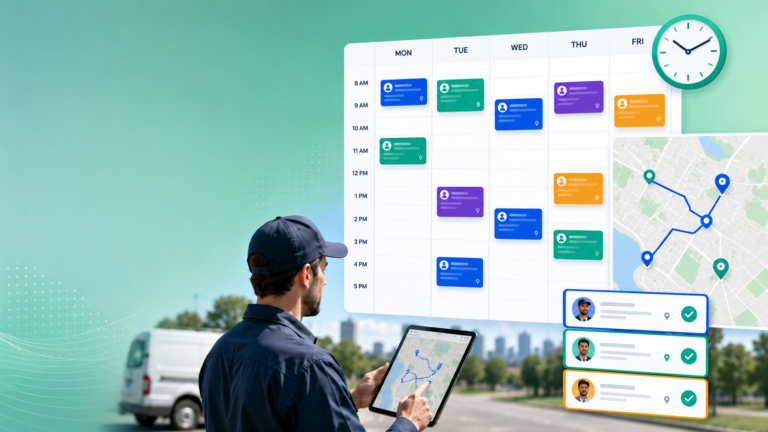
Growth sounds simple from the outside.
More customers. More technicians. More service capacity. More jobs completed.
In reality, scaling a field service operation creates pressure long before the numbers look impressive. More jobs usually mean more moving parts, more exceptions, more schedule changes, and more chances for weak processes to show up. That is why modern FSM software matters so much for growing service businesses.
It is not only there to organize work.
It is there to stop growth from creating operational confusion.
Growth usually breaks weak workflows first
A smaller service team can often survive on informal habits.
Someone knows the customers. Someone remembers the asset history. Someone can explain what a vague ticket really means. Someone else can keep the schedule moving through experience alone. But once the business grows, those habits stop scaling well.
That is where the cracks start to show.
The same process that felt manageable with one team or one territory begins to feel inconsistent, slow, and harder to trust. This is one reason workflow quality remains such a big theme across FSM News coverage. Scaling is rarely just a staffing challenge. It is usually a workflow challenge too.
Scaling teams need stronger visibility
As service operations grow, visibility gets harder.
Leaders can no longer rely on local memory or casual updates to understand what is happening across the day. They need to see job flow, technician status, backlog pressure, schedule health, and customer-impact risks with more confidence.
That is why field service visibility becomes one of the biggest reasons to invest in better systems.
A growing service operation needs a clearer picture of what is happening, not just more activity on the board. This also connects naturally with How FSM Platforms Support Multi-Region Service Teams, because scale almost always increases the need for stronger visibility and more unified operating habits.
Modern FSM software helps standardize the work
One of the biggest risks in a scaling business is inconsistency.
Different teams start handling the same work in different ways. One coordinator collects strong details. Another logs only the basics. One region follows process closely. Another depends on shortcuts. Over time, the business stops running as one system and starts operating as a set of local habits.
That is why workflow consistency matters so much.
Modern FSM software helps by creating shared process structure across intake, scheduling, technician updates, customer communication, and job completion. That does not mean every service case becomes identical. It means the business can scale without letting every team invent its own version of the workflow.
Bigger teams create more coordination pressure
Scaling does not only increase volume.
It also increases coordination.
More technicians means more schedule complexity. More jobs means more follow-up. More customers means more updates, more exceptions, and more chances for the workflow to become admin-heavy. If the system is weak, the coordination burden rises quickly and starts absorbing time that should be spent on actual service execution.
That is why stronger service coordination is one of the clearest benefits of modern FSM software.
A better system reduces the need for constant chasing, repeated clarification, and manual cleanup that often grows faster than the business itself.
This aligns closely with How Field Service Teams Reduce Manual Coordination, because scaling usually exposes how expensive manual coordination really is.
Scheduling becomes harder as teams grow
A larger team does not automatically make scheduling easier.
In many cases, it makes scheduling more complex. More technicians, more territories, more skills, more schedule changes, and more same-day pressure all make the planning environment harder to manage. A growing service business needs a scheduling model that can handle higher complexity without becoming more fragile.
That is why modern FSM software matters so much at the planning layer.
It gives the business stronger structure around job assignment, schedule movement, and changes during the day. This also connects with What Makes Smart Scheduling Work in Field Service, where the real goal is not just building a full schedule, but building one that still works once the day starts changing.
Better systems help new team members ramp faster
Growth often means hiring.
And hiring creates another type of scaling pressure.
New coordinators, dispatchers, and technicians all need to learn how the service operation works. If too much knowledge lives in informal habits or experienced individuals, onboarding becomes slower and more uneven. A strong system helps reduce that dependence by making the workflow easier to follow and easier to trust.
That matters because scaling teams do not only need more people.
They need more people who can become productive without months of relying on tribal knowledge.
Stronger software protects service quality during growth
This is one of the most important points.
Businesses often focus on growth in terms of capacity. But customers experience growth differently. They notice whether service still feels organized, whether communication stays clear, and whether appointments still feel reliable as the business gets busier.
That is why service quality can slip during growth even when revenue rises.
A strong system helps protect quality by making sure the underlying workflow stays stable as the workload expands. This is also why topics like Why Faster Service Intake Improves Customer Experience matter so much in scaling environments. Better internal workflow usually creates a better customer experience too.
Scaling teams need better data discipline
Weak data becomes much more expensive as a business grows.
In a small team, people may be able to work around vague notes or inconsistent status handling. In a larger operation, those same weaknesses create more confusion because more people depend on the same information. Dispatch needs stronger ticket quality. Technicians need clearer history. Leaders need more reliable reporting.
That is why modern FSM software supports growth partly by improving data discipline.
The cleaner the information becomes, the easier it is for the workflow to support more people without creating more confusion. This also links directly with How Better Job Data Improves Dispatch Decisions, because better data does not just help one job. It helps the whole system scale more reliably.
Modern FSM software reduces dependency on heroics
Many growing service businesses rely too heavily on a few key people.
One dispatcher knows how to fix the schedule. One manager knows how to decode bad tickets. One senior technician understands the messy service history behind certain accounts. That can work for a while, but it creates fragility.
A better system reduces that dependence.
It does not replace strong people, but it makes the workflow less dependent on personal memory and constant workarounds. That is one of the quiet advantages of strong software during growth. It helps the business scale beyond individual heroics.
Fieldcode is one example of this direction
One example of this broader market shift is Fieldcode, which has positioned itself around Zero-Touch workflows, AI-supported scheduling, and more automated execution. It is relevant here as an example of how modern FSM platforms are increasingly being presented as tools for reducing manual complexity as service operations grow.
That matters because scale is no longer only about adding more people.
It is about building a system that can carry more operational weight with less friction.
The real goal is controlled growth
This may be the clearest way to look at it.
The value of modern FSM software is not just that it helps a business handle more jobs.
It helps the business grow without losing control. Better visibility. Better coordination. Better process consistency. Better scheduling. Better communication. All of those things matter more as the team gets bigger.
Without them, growth often creates confusion faster than it creates strength.
Conclusion
Modern FSM software supports scaling service teams by improving field service visibility, reducing coordination pressure, strengthening workflow consistency, and helping the operation manage complexity with more control.
That is the real benefit.
A growing service business does not only need more capacity.
It needs a better system for carrying that capacity well.