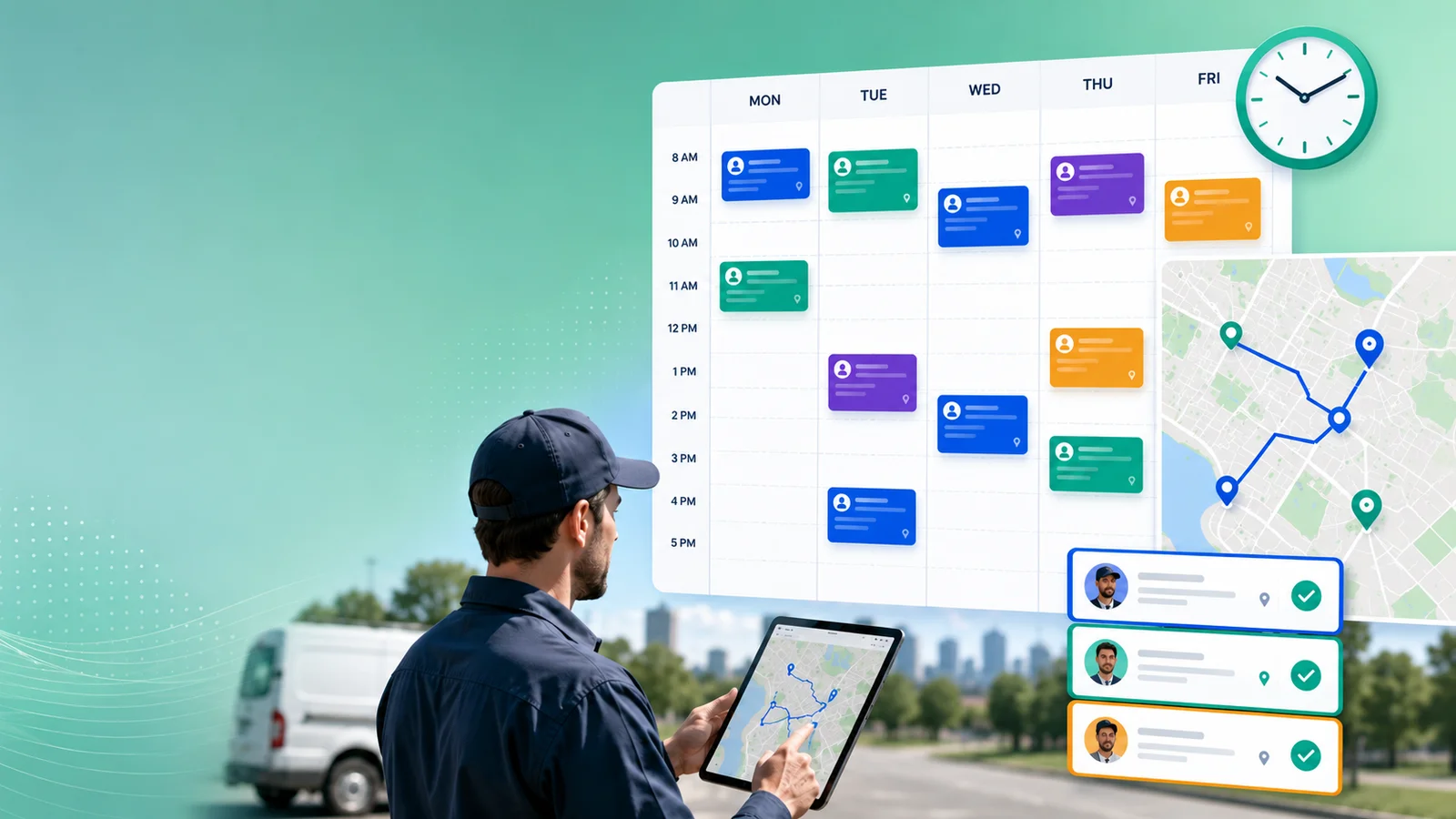
A schedule can look full and still be poorly built.
That is one of the biggest misunderstandings in field service.
When people talk about scheduling, they often focus on volume. How many jobs were assigned. How many technicians were booked. How many appointments fit into the day. But smart scheduling is not just about fitting more work onto the board. It is about building a schedule that holds up when the day starts to move, which is why scheduling keeps appearing across FSM News coverage as one of the most important topics in modern field operations.
That is what makes smart scheduling worth talking about.
The goal is not only to create a plan.
It is to create a plan that still works once reality starts pushing back.
Smart scheduling starts with better information
A schedule is only as strong as the information behind it.
If the job description is vague, the urgency is unclear, or the asset details are missing, the scheduler is already working from weak inputs. That is why good scheduling starts before anyone begins moving appointments around. It starts with stronger intake, clearer priorities, and cleaner job details.
Better job data also plays an important role in scheduling, as explained in How Better Job Data Improves Dispatch Decisions. Better information does not just help dispatch. It improves the quality of the schedule before the first assignment is even made.
When the incoming work is clearer, the schedule becomes easier to trust.
A smart schedule matches the job, not just the slot
A weak schedule asks one basic question.
Who is free?
A smart schedule asks a better one.
Who is the right fit for this work?
That difference matters because the fastest assignment is not always the strongest one. A technician may be nearby and still not be the right match for the issue. Another may be slightly farther away but have the right experience, the right skill set, and a much better chance of resolving the job well.
That is why technician matching sits at the heart of smart scheduling. The right person in the right slot usually saves more time than the nearest person in the nearest slot. That logic also connects naturally with How Skills-Based Routing Cuts Repeat Visits, because stronger matching is one of the clearest ways to improve first-visit quality.
Smart scheduling protects the day from unnecessary disruption
A packed schedule often looks efficient in the morning.
By midday, it can start looking fragile.
One delayed technician, one urgent job, one unavailable customer, or one visit that takes longer than expected can put the rest of the day under pressure. That is why smart scheduling is not only about building the plan. It is also about protecting it from collapse.
This is where flexibility matters.
A stronger schedule leaves enough room for change. It does not promise away every minute of available time. It protects capacity where it matters and makes it easier to absorb new priorities without forcing the whole board into chaos. That is part of the wider logic already explored in Capacity Planning for Seasonal Service Demand, where schedule resilience matters just as much as raw utilization.
Routing quality matters more than people think
A schedule is not only about time.
It is also about movement.
If jobs are placed badly across the day, technicians lose time in travel that could have been spent on actual service work. Long gaps, poor clustering, and unnecessary backtracking quietly increase cost even when the schedule still looks busy.
That is why route optimization is such an important part of field service scheduling.
A smart schedule should respect geography as well as timing. It should make the day easier to execute, not just easier to visualize. When routing improves, the schedule feels tighter, the technician workload becomes more manageable, and the service operation loses less time to avoidable movement.
Smart scheduling depends on realistic time assumptions
This is another place where weak schedules start to fail.
If the system assumes every visit takes the same amount of time, or if duration estimates are based on habit instead of actual job complexity, the whole day becomes easier to overload. Some jobs are routine. Some are not. Some need deeper diagnosis. Some need follow-up documentation. Some require customer coordination that changes the pace of the visit.
That is why realistic time assumptions matter so much.
A smart schedule uses better judgment around job length instead of pretending every appointment fits neatly into the same model. That helps reduce the domino effect where one underestimated visit starts pushing every later job off track.
Prioritization is part of smart scheduling too
Not every appointment deserves the same treatment.
Some are urgent. Some are contract-sensitive. Some are important but flexible. Some should not be scheduled until more information is available. When that difference is ignored, the schedule starts carrying the wrong type of work in the wrong places.
That is why smart scheduling depends heavily on prioritization.
The schedule should reflect business reality, not just job order. Weak prioritization is also one of the factors explored in What Slows Down Field Service Resolution Times. It does not only create delays; it can slow resolution across the entire workflow.
Smart scheduling reduces manual firefighting
One of the clearest signs of a weak scheduling model is constant manual correction.
The board keeps being adjusted. Dispatch keeps rebuilding the day. Coordinators keep patching around weak assumptions. Technicians keep getting assignments that look workable on paper but fall apart in practice.
That is why a smart schedule is not only a better plan.
It is a lower-maintenance plan.
When scheduling is done well, the team spends less time fixing preventable issues and more time focusing on exceptions that actually deserve attention. Scheduling is also one of the high-impact workflows discussed in Which FSM Workflows Should You Automate First. Better structure in this area can reduce hidden operational waste across the service process.
Better scheduling improves technician experience
Technicians feel the quality of the schedule more directly than most people in the office do.
They feel it when jobs are stacked too tightly. They feel it when the route wastes time. They feel it when the assignment does not fit the issue. They feel it when the day has no breathing room for reality.
That is why smart scheduling is not just a planning topic.
It is also a technician experience topic.
A stronger schedule makes the day more manageable, reduces frustration, and gives the field team a better chance to do good work without constant disruption.
Better scheduling improves customer confidence
Customers do not see how the board was built.
But they feel whether it was built well.
They feel it when arrival windows make sense. They feel it when the technician shows up prepared. They feel it when delays are less frequent or easier to explain. They feel it when the service organization seems in control instead of constantly reacting.
That is why service efficiency is not only an internal measure.
It affects how reliable the business looks from the customer side as well. The stronger the schedule, the easier it becomes to provide realistic updates.
Fieldcode is one example of how the market is changing
One example of this broader shift is Fieldcode, which has positioned itself around AI-powered scheduling, Zero-Touch service workflows, and stronger automation across dispatch and execution. It is relevant here as an example of how vendors are trying to make scheduling more adaptive and less manually dependent without turning the whole process into guesswork.
That matters because the market is changing.
Scheduling is no longer being treated as a static planning task. It is being treated as a live operational system that needs to react well under pressure.
The best schedules are not just efficient, they are durable
This may be the most important point.
A schedule is not smart because it looks tidy at 8 a.m.
It is smart because it still functions at 1 p.m. after delays, changes, urgent requests, and shifting priorities have started hitting it from different directions. That durability is what separates a usable schedule from an optimistic one.
And that is usually where the real value appears.
Not in how full the board looks, but in how well the business keeps control once the day stops being predictable.
Conclusion
Smart scheduling works when it is built on stronger information, better technician matching, more realistic timing, smarter prioritization, and better route optimization.
It improves field service scheduling because it makes the plan more durable, not just more full. It also improves service efficiency because the team spends less time fixing preventable schedule problems and more time delivering work that actually fits the day.
That is the real difference between a busy schedule and a smart one.
A busy schedule fills time.
A smart schedule protects performance.