A lot of companies say they want AI in field service.
Far fewer can clearly explain why.
That is the real issue. The value of field service AI is not that it sounds modern. It is that it helps service teams make better decisions faster, with less manual effort and less operational waste.
When it works well, AI does not replace the service organization.
It makes the service organization more effective.
The investment only makes sense when the problem is clear
Some field service leaders start with the tool.
That is backwards.
The better starting point is the problem. Are dispatchers spending too much time manually reshuffling jobs? Are technicians arriving without enough context? Are repeat visits staying high? Are customer updates too slow and too inconsistent?
If the business cannot name the pain clearly, the AI investment will always feel vague.
That is why the strongest field service AI projects begin with a very practical question. Where is the operation losing time, money, and service quality today?
AI creates value when it improves everyday decisions
The best use of AI in field service is not some futuristic scenario.
It is the daily decisions that happen hundreds of times a week.
Which technician should take the job? Which ticket needs urgent action? Which customer issue can be solved remotely? Which jobs are at risk of delay? Which pattern suggests a repeat failure is coming?
Those are the decisions that shape service performance.
When AI helps improve them, the value becomes real.
Dispatch is often where the return appears first
One of the clearest areas where field service AI proves its value is dispatch.
Manual dispatch takes skill, but it also takes time. A busy day can force planners to review technician availability, travel time, skills, SLA pressure, job priority, and customer availability all at once.
That is hard to do consistently at scale.
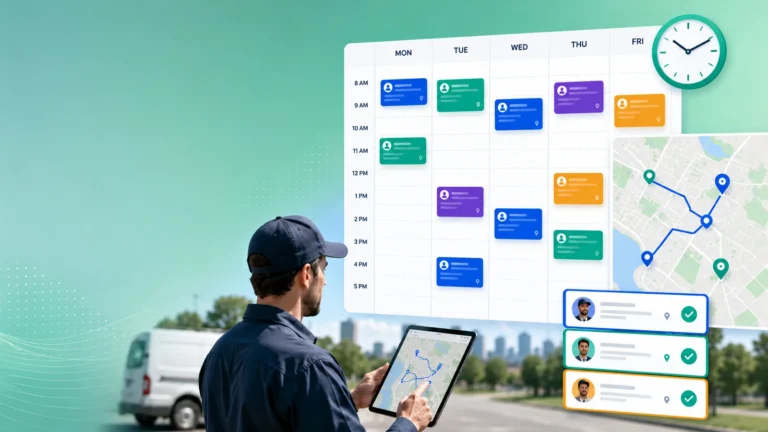
AI helps by reducing that decision load. It can support better matching, better route logic, and faster schedule adjustments when the day changes.
That is why same-day scheduling gets stronger when the service team relies less on guesswork and more on structured decision support.
Better AI usually means less manual firefighting
A lot of service operations still run on heroics.
One experienced dispatcher knows the territories. One supervisor knows which technician can handle a difficult asset. One team lead spots problems before the system does.
That can work for a while.
But it is not a strong operating model.
The value of dispatch automation is that it reduces dependence on memory and constant manual intervention. AI can help standardize decisions that otherwise live in scattered knowledge and rushed judgment calls.
That does not remove people from the process.
It gives people more room to focus on exceptions that actually need human thinking.
AI can improve the quality of the first visit
The cost of a poor first visit is bigger than it looks.
It creates extra travel. It adds more scheduling pressure. It frustrates the customer. It increases labor cost. It also creates a backlog that keeps spreading through the schedule.
That is why field service AI becomes more valuable when it helps improve first-visit quality.
If AI helps the team assign the right technician, flag likely parts needs, or surface useful job history before arrival, the first visit becomes more purposeful.
That connects directly with first-time fix rate, because a smarter operation starts before the van even leaves.
Technician support matters just as much as dispatch support
Many AI conversations focus too much on the control tower.
The technician side matters just as much.
Field teams work better when they have cleaner job notes, better asset history, stronger troubleshooting guidance, and less admin burden. AI can help organize information, suggest likely next steps, and make field knowledge easier to access.
That improves technician productivity without just asking technicians to move faster.
In practice, that is often what makes the investment feel worthwhile. The field team feels more prepared, not more pressured.
AI helps service teams use their own data better
Most field service organizations already sit on useful data.
The problem is that it is often scattered, underused, or too slow to support real decisions.
Job history, asset history, repeat failure patterns, technician notes, parts usage, and scheduling trends all hold value. AI becomes useful when it helps turn that information into action.
That could mean spotting recurring issues earlier.
It could mean warning that a job is likely to need escalation.
It could mean helping dispatch see which appointments are at risk before the customer starts calling.
That is where service efficiency improves. Not because the business suddenly has more data, but because it starts using the data it already has more intelligently.
The customer experience also gets stronger
Not every AI benefit shows up in an internal workflow.
Some of it shows up in the customer experience.
Customers feel the difference when appointment updates are clearer, when delays are handled earlier, when the technician arrives better informed, and when the issue gets resolved with fewer repeat visits.
This is why AI should not be judged only on back-office savings.
It should also be judged on whether the service experience feels more reliable.
That is part of the reason live ETA updates and stronger communication workflows matter so much. Better visibility reduces uncertainty, and uncertainty is one of the biggest sources of customer frustration in field service.
The wrong AI investment usually starts too big
One common mistake is trying to transform everything at once.
That usually creates confusion instead of progress.
The better approach is to start where the pain is repeated, measurable, and close to daily operations. Dispatch. Scheduling. Triage. Status updates. Repetitive admin work. Those areas tend to show value faster because they affect service flow every single day.
That is also why FSM workflows should be reviewed carefully before any major AI rollout.
If the workflow itself is messy, AI will not magically make it clean.
It will only scale the mess faster.
Cost reduction matters, but it is not the whole story
A lot of leaders ask whether AI reduces cost.
Yes, it can.
It can reduce time spent on manual planning. It can reduce unnecessary visits. It can reduce the number of avoidable scheduling errors. It can reduce some of the hidden waste caused by poor coordination.
But cost reduction is only one part of the answer.
The stronger case for field service AI is that it also improves execution quality. It protects technician time. It supports customer trust. It helps the business scale with more control.
That broader view matters because the best investments do more than cut expense.
They improve how the operation runs.
AI is worth the investment when it improves consistency
This is what many service leaders are really buying.
Consistency.
They want better decisions across busy days, not just quiet ones. They want the operation to perform more reliably when volume rises, when disruptions appear, and when experienced people are stretched thin.
AI helps when it makes service less dependent on luck.
That is often the clearest return on investment. Not one dramatic change, but many small improvements that create a steadier, more reliable operation over time.
The strongest ROI usually comes from combined gains
Real-world results show how these gains can add up. PHS Group, for example, reported a 40% increase in technician productivity after introducing AI-powered planning and scheduling, increasing average jobs per day from 18.5 to more than 26 while also reducing travel and avoiding the need for more than 100 additional hires. The case shows why the value of field service AI is often measured across several operational improvements rather than through a single cost-saving metric.
Better dispatch quality.
Fewer delays.
Better first visits.
Stronger technician support.
Faster updates.
Less admin work.
A better customer experience.
Each gain may look modest by itself.
Together, they create the business case.
Conclusion
Field service AI is worth the investment when it solves real operational problems instead of just adding new software to the stack.
It proves its value when it strengthens dispatch automation, improves service efficiency, supports technician productivity, and creates a better customer experience.
That is the real test.
Not whether the platform says it has AI.
But whether the service team actually works better because of it.
When the answer is yes, the investment stops feeling experimental.
It starts feeling necessary.