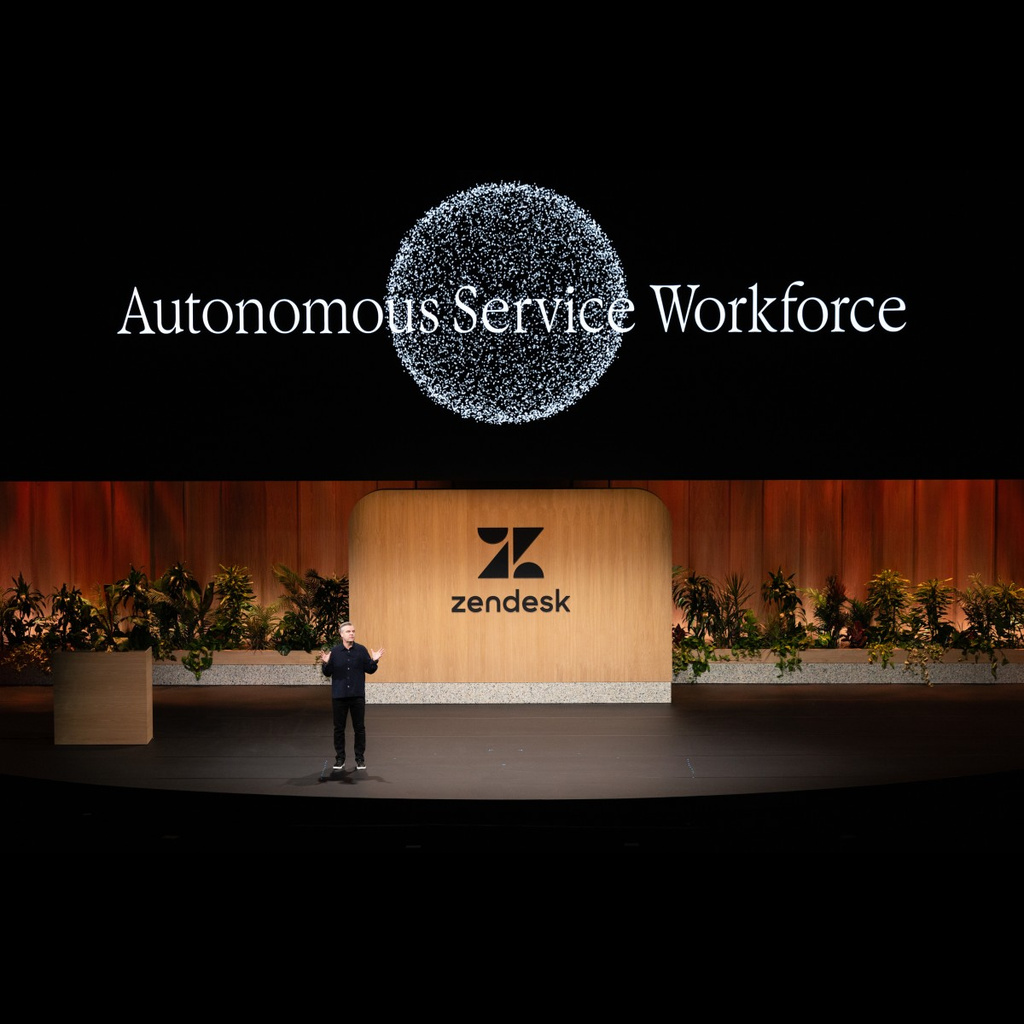
Zendesk used its Relate 2026 event to set out a broader AI direction for customer and employee service, moving beyond chatbot-style automation toward what it calls an “Autonomous Service Workforce.” The announcement brings together new AI agents, Copilot tools, workflow capabilities, MCP support, quality measurement, and an expanded outcome-based pricing model.
Key takeaways
- Zendesk introduced its Autonomous Service Workforce vision at Relate 2026.
- The company announced Agent Builder, a no-code tool for creating custom AI agents.
- Zendesk AI Agents are expanding across messaging, email, voice, ChatGPT, Gemini, and employee service use cases.
- New Copilot, MCP, Action Flow, and Quality Score capabilities are designed to connect AI more closely with service workflows.
- Zendesk is expanding outcome-based pricing, charging for verified resolutions rather than routine exchanges or spam.
Zendesk’s AI service strategy moves beyond deflection
Zendesk positioned the announcement as a shift away from support bots built mainly to deflect tickets. CEO Tom Eggemeier described the change by saying, “The era of the chatbot – the era of frustration and deflection – is over.”
At the center of the update is the Zendesk Resolution Platform, which brings together service data, knowledge, workflows, intelligence, and governance. Zendesk said the platform is trained on roughly 20 billion ticket interactions and uses its Resolution Learning Loop to capture insight from customer interactions and improve automated responses over time.
Agent Builder and expanded AI agents
A major part of the announcement is Agent Builder, a no-code interface that lets companies create, test, deploy, and improve custom AI agents. These agents can be configured around company policies, workflows, business logic, and data, giving service teams a way to automate more complex work while keeping governance in one place.
Zendesk also said its AI Agents now work across messaging, email, voice, and AI platforms such as ChatGPT and Gemini. The company said these agents can maintain context across interactions and operate in both Zendesk and external service environments. Part of the expansion follows Zendesk’s acquisition of Forethought.
For voice-based service, Zendesk announced expanded Voice AI Agents with multi-brand and multilingual support across more than 60 languages. The agents can also switch languages during a conversation while keeping the context of the interaction. Zendesk said this strengthens its CCaaS offering powered by Amazon Connect.
Employee service, Copilots, and quality measurement
Zendesk is also extending autonomous AI agents into employee service. These agents are designed for internal support use cases, including work in Slack and Microsoft Teams, enterprise search, and permission-aware responses. Zendesk said this capability is powered by its Unleash acquisition.
The company also announced updates across its Copilot portfolio. Agent Copilot is designed to connect to internal and external sources and take action on at least 30% of tickets from day one, according to Zendesk. Admin Copilot is generally available and helps administrators identify operational issues and apply workflow changes. Knowledge Copilot and Analyst Copilot are in early access.
Zendesk also announced Quality Score, a continuous quality assurance capability that analyzes all human and AI interactions. The feature is designed to give service teams a more consistent view of service quality and improvement opportunities.
MCP, Action Flows, and connected workflows
The Relate 2026 announcement also includes support for Model Context Protocol. Zendesk MCP Client will allow AI Agents and Agent Copilot to connect to external systems, while Zendesk MCP Server will let businesses connect Zendesk tickets, knowledge, and customer data to external AI systems in a governed way.
Zendesk also introduced Action Flows for AI Agents inside Action Builder. The goal is to help AI agents take action across systems with more governance and orchestration. Zendesk said it is adding 40 prebuilt workflow connectors for systems including Okta, Claude, and OneDrive, with more than 100 additional apps planned by the end of the year.
Why this matters for field service
For field service organizations, the most relevant part of Zendesk’s announcement is not simply the use of AI agents. It is the push toward AI that can understand context, work across channels, follow governed workflows, and connect to other business systems.
In practical terms, this could matter for service intake, customer communication, internal support, knowledge retrieval, and first-level issue resolution. A customer may start with a voice call, continue by email, and later need a field visit. AI that keeps the case context intact could reduce repeated questions and support cleaner handoffs between contact center teams, back-office teams, and field operations.
The field service impact still depends on integration. Zendesk’s announcement focuses on customer and employee service, not full field service execution. Dispatching, technician routing, parts availability, SLA-aware scheduling, mobile workflows, and onsite reporting still need to connect properly with FSM, ERP, asset, or workforce systems. Without that connection, AI may improve the support layer without improving field execution.
FSM News perspective
Zendesk’s announcement reflects a wider shift in service technology. AI is moving from isolated response generation toward workflow participation. The stronger use cases are not just “answer this question,” but “understand the issue, check the right knowledge, follow the policy, trigger the next action, and escalate when needed.”
For field service leaders, the question is less about whether AI can answer more tickets. The more useful question is where AI can remove friction before, during, or after a field visit. That includes triaging service requests, summarizing ticket history, translating customer notes, identifying missing information, guiding internal teams, and preparing cases before scheduling a technician.
The next challenge will be measurement. Zendesk’s outcome-based pricing model is notable because it ties AI value to verified resolutions. In field service, a similar mindset is needed. AI should be judged by operational results such as fewer repeat contacts, cleaner work orders, fewer unnecessary dispatches, faster intake, better SLA protection, and smoother handoffs to technicians.
FAQs
What did Zendesk announce at Relate 2026?
Zendesk announced its Autonomous Service Workforce vision, along with Agent Builder, expanded AI Agents, new Copilot experiences, Quality Score, Context Graph, Action Flows, MCP support, and expanded outcome-based pricing.
Is this a field service management announcement?
Not directly. The announcement is focused on customer service and employee service. However, it is relevant to field service organizations because many field operations depend on service intake, customer communication, internal support, knowledge management, and workflow handoffs.
What is Zendesk’s outcome-based pricing model?
Zendesk said it is expanding a pricing model where customers pay for verified resolutions. According to Zendesk, spam and routine exchanges are excluded, and resolutions are verified by the AI agent and independently confirmed by an AI evaluation model.
Original PR news source: zendesk.com