Every field service leader knows the tension. Customers want fast restoration. Dispatch wants schedule stability. Finance wants fewer truck rolls. Technicians want fewer wasted trips and clearer job context. Remote assist sits right at the center of that tension because it promises something operational teams care about: resolving more issues without putting a vehicle on the road.
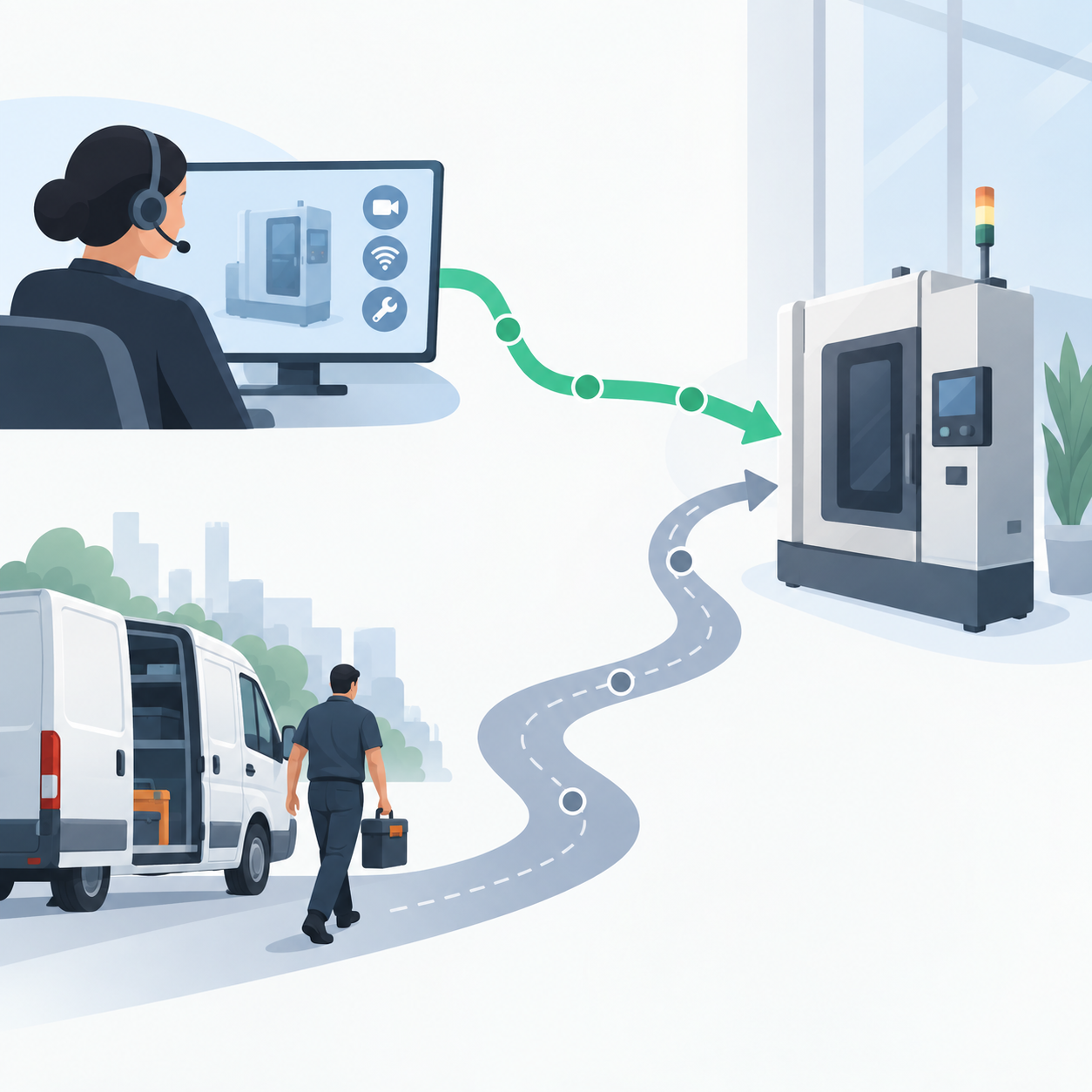
The problem is that remote assist is often discussed as a replacement for on-site work, when it is more accurately a decision layer. Used well, it prevents unnecessary dispatches, improves preparation for the dispatches you do make, and helps junior technicians complete jobs that would otherwise require a specialist follow-up. Used poorly, it becomes an extra step that frustrates customers and delays the inevitable truck roll.
A more practical way to frame the question is not “remote assist or truck roll?” It is “at what point in the service journey does remote assist create a better outcome than immediate dispatch?”
What remote assist actually changes
Remote assist is not just video calling. The value comes from turning a customer issue into a shared view of the problem, with real-time guidance and documentation. In field service environments, the technology is commonly paired with augmented reality overlays, remote expert workflows, and capture features that create evidence and context for follow-up work.
Augmented reality tools are changing technician support, including real-time guidance and interactive instructions that make remote help usable in the middle of a repair rather than as a generic support channel. You can see that broader shift in the way AR-based support is described in 5 Ways Augmented Reality is Changing On-Site Technician Support.
Operationally, remote assist changes three things:
- It improves diagnosis speed by letting a remote expert see what the customer or technician sees.
- It reduces uncertainty by validating whether a problem is real, severe, and fixable remotely.
- It upgrades the quality of dispatch by capturing better evidence, parts requirements, and safety context before a technician ever drives.
Those three improvements explain why remote assist wins in specific scenarios and disappoints in others.
When remote assist wins over a truck roll
Remote assist tends to win when the issue is either solvable without physical intervention or when a remote session materially improves the first visit outcome. The best use cases share a few characteristics.
The problem is common and triage-able
Remote assist performs well when the organization has seen the issue pattern many times and can guide resolution through a repeatable workflow. That often includes:
- device setup and configuration
- connectivity and software-related errors
- user operation issues (misuse, incorrect settings, power/reset steps)
- simple inspections where the “answer” is visible
In these cases, a truck roll is frequently unnecessary. The remote session either resolves the issue or confirms that dispatch is required with high confidence.
The cost of a wrong dispatch is high
Some service environments are expensive to dispatch into: rural travel, secure sites, regulated facilities, or appointments where access must be coordinated carefully. In those contexts, a remote session is often worth it even if it does not solve the problem, because it reduces the likelihood of a wasted visit.
This is the underrated value of remote assist. It is not only “remote resolution.” It is “dispatch validation.”
A remote session can pre-stage parts and prevent a second visit
Remote assist is particularly valuable when it changes parts readiness. If the remote expert can identify the failed component, capture the model/serial number, and confirm required tools, dispatch can schedule the right technician with the right kit.
That reduces the “diagnose now, return later” trap that drives repeat visits and SLA pressure. In practice, many organizations see the fastest ROI not from eliminating all dispatches, but from eliminating the second dispatch.
You want junior techs to complete work that would otherwise escalate
Remote assist can act like an on-demand mentorship layer. A less experienced technician can handle a wider range of work when a remote expert can guide steps, verify diagnosis, and confirm the repair is complete.
This matters in a market where skill shortages are real and specialist capacity is limited. Augmented workforces and remote support play an important role in skill-constrained environments: if remote help increases the “effective capability” of the workforce, you get higher completion without waiting for a specialist to travel.
You need better documentation and evidence
Certain industries require proof: photos, timestamps, compliance checks, safety observations, and customer sign-off. Remote assist tools can capture and attach that evidence during the process. This reduces post-job disputes, improves audit readiness, and can reduce repeat contact.
If you look at how remote assist is being embedded into FSM ecosystems, it is increasingly treated as part of the workflow rather than a separate tool. For example, a visual remote assist plugin has recently been embedded into a major FSM stack, as detailed in frontline.io Launches AI-powered Visual Remote Assist Plugin. Whether or not a team uses that specific product, the direction is clear: remote assist is moving closer to the work order, not sitting outside it.
When a truck roll still wins
Remote assist is not a universal replacement. There are clear situations where dispatch is the right first move, and forcing remote assist first can worsen outcomes.
Physical intervention is required
If the repair requires replacing a component, calibration, specialized tools, or safety-certified work, remote assist cannot complete the job. It may still help with preparation, but it should not delay dispatch when restoration is urgent.
Safety and liability are high
Remote guidance cannot eliminate the responsibility for safe work. High-voltage systems, hazardous environments, and regulated repairs often require onsite professionals. In these cases, remote assist is best used to confirm symptoms, gather context, and prepare the technician, not to attempt full resolution through a customer.
The customer experience cost is higher than the truck roll
Remote assist sessions require customer participation. Some customers are willing and capable. Others are not. If the customer is distressed, the equipment is mission-critical, or the user is not comfortable troubleshooting, insisting on remote steps can feel like the service organization is shifting work onto the customer.
Remote assist wins when it feels like fast help. It loses when it feels like a barrier to getting help.
Connectivity and access constraints make remote sessions unreliable
Remote assist depends on reliable connectivity and camera access. In industrial environments, basements, mechanical rooms, and restricted networks can make remote sessions hard to run. If remote assist fails frequently due to environment constraints, teams should treat it as an optional enhancement rather than a required step.
The decision model leaders should adopt
Field service teams get the best results when remote assist is integrated into triage as a decision stage, not applied randomly. A practical decision model uses three gates:
Gate 1: Is this likely resolvable remotely?
Use historical case patterns to identify categories where remote resolution is common. If the probability is high, offer remote assist early.
Gate 2: If not, will remote assist materially improve first-visit completion?
If the probability of remote resolution is low but remote assist can confirm parts, tools, access, or safety context, it may still be worth doing as a pre-dispatch assessment.
Gate 3: If neither is true, dispatch immediately
This is where many organizations lose time. If remote assist does not increase completion probability and cannot resolve remotely, it becomes process overhead.
What to measure so the program doesn’t drift into hype
Remote assist should be managed like any other operational lever: measured, refined, and tied to outcomes. The most useful metrics are those that reflect customer experience and service economics.
Remote resolution rate. The share of cases resolved without dispatch. Useful, but not sufficient.
Avoided truck rolls. Track where remote assist prevented dispatch that would have occurred otherwise. This usually requires tagging.
First-time completion improvement. Measure whether remote sessions before dispatch reduce repeat visits.
Time to restore service. Remote assist should reduce restoration time, not just shift activity.
Customer effort and satisfaction. Track whether customers feel helped or burdened.
Dispatch validation rate. How often remote assist confirms that an onsite visit is truly necessary, and what it changes about the appointment preparation.
Finance teams often ask for “truck roll savings” estimates, and it is reasonable to provide them, because a truck roll is a meaningful cost driver in many service organizations. PTC, for example, discusses truck rolls as a major cost component and highlights the value of remote service in reducing dispatch frequency. That type of framing is helpful as external context, but your internal measurement is what makes the case credible.
How to implement without disrupting operations
Remote assist performs best when it is easy for agents, dispatchers, and technicians to use in the moment. Three implementation practices reduce friction.
Make remote assist a simple option in the case workflow
If initiating a session requires switching tools, copying data, and manual logging, usage will remain low. Remote assist should be launched from the case or work order, and outcomes should be captured automatically.
Create playbooks for the top remote-resolvable issues
Remote assist needs standard work. Build short scripts and visual checklists for the top issue categories. This prevents inconsistent customer experiences and reduces session time.
Train for customer experience, not just tool usage
The success of remote assist often depends on how it is offered. Customers should feel like they are receiving faster help, not being asked to do the technician’s job. That comes down to language, guidance quality, and clear escalation to onsite support when remote help is not working.
A balanced view: remote assist is a lever, not a replacement
The best field service organizations treat remote assist as a lever that improves outcomes across the service chain. Sometimes it resolves the issue. Sometimes it prevents a wasted dispatch. Sometimes it makes the first visit successful by improving parts readiness and job context. And sometimes it should be skipped entirely so a technician can restore service immediately.
When leaders use a clear decision model and measure outcomes honestly, remote assist becomes one of the most controllable ways to reduce unnecessary truck rolls without sacrificing customer experience.