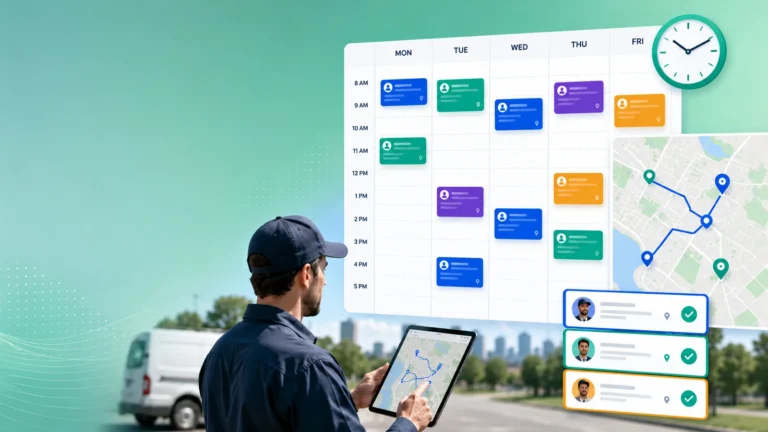
Field service dashboards are often full of numbers, yet leaders still feel blind when performance slips. One reason is that many KPI sets were built for an older definition of “good service.” They emphasize internal efficiency, not customer outcomes. Utilization, jobs per day, and schedule fill rate can all look strong while customers experience recurring downtime, repeat visits, and missed promises.
That gap is a reason to rethink how field service KPIs are structured. The direction is not “throw out efficiency.” It is to measure efficiency in a way that connects to outcomes customers can see and feel: uptime, speed to restore service, reliability, and the effort customers spend coordinating service.
If you already track classic KPIs, this is not a rewrite. It’s a reframe. You want a scorecard that answers a simple question: are we delivering outcomes, or just staying busy?
Why activity metrics create false confidence
Activity metrics were never pointless. They helped managers understand capacity and throughput. The problem is when they become the headline.
Utilization is a good example. High utilization can signal a healthy operation, but it can also signal a fragile one. When schedules are packed, there is little buffer for parts delays, access issues, or urgent breakdowns. Dispatchers start “breaking glass” daily to keep the plan alive. Customers may get an arrival, but not a resolution.
First-time fix can also be misleading if it’s treated as the final goal rather than a driver. A field team can hit an impressive first-time fix rate while still failing on restoration time, because complex issues may be “fixed” but not stabilized, or because the revisit window is defined too narrowly to capture later callbacks. That’s why outcome-oriented scorecards pair first-time fix with completion and repeat dispatch measures, then tie them to customer outcomes like downtime and SLA adherence.
Core field service measures such as first-time fix, mean time to repair, and customer satisfaction remain useful. The difference is how those metrics are used in a hierarchy, not whether they exist. The overview of 5 key metrics every field service business should track for long-term success provides a useful starting point, while an outcome-based scorecard places those measures in the context of customer outcomes rather than volumes alone.
The new scorecard: outcomes first, drivers second
An outcome-based scorecard is easiest to manage when it has two layers:
- Outcome KPIs that reflect customer impact
- Driver KPIs that explain why outcomes move
Most teams struggle because they mix these into one flat list. When everything is a KPI, nothing is actionable. The goal is a short set of outcome measures, supported by a short set of driver measures.
Outcome KPI 1: Asset availability and downtime
Availability is the cleanest “customer truth” when service exists to keep assets running. Track downtime hours by asset criticality, and also track availability at the customer level, not just the fleet average. Averages hide pain. One key customer can have a terrible month while the overall number looks fine.
If you serve different segments, separate them. Outcomes for mission-critical industrial assets should not be blended with low-criticality service work.
Outcome KPI 2: Time to restore service
Many teams track mean time to repair, but the customer experience is usually “time to restore.” That includes diagnosis, parts, access, and coordination. It reflects reality.
Time-to-restore is also the KPI that exposes parts readiness issues. If time-to-restore is rising while arrival time is stable, the problem is often not dispatch speed. It’s completion friction.
Outcome KPI 3: SLA compliance that reflects the promise
SLA compliance should match what customers are promised, not what is easiest to measure. If your SLA is response-based, measure response. If your SLA includes resolution time, measure that too. If your SLA is window-based, measure arrival within the promised window and completion within a defined window.
When SLA compliance is measured in one dimension only, teams optimize that dimension and ignore the rest. Customers then feel like the SLA is being “met” while they are still suffering downtime.
Outcome KPI 4: Repeat dispatch and repeat incidents
Repeat dispatch is a customer experience KPI disguised as an operations KPI. It tells you whether service is sticking.
Track repeat dispatch for the same asset and symptom within a revisit window that reflects your business. Pair it with repeat incident rate, because repeat incidents can happen even when dispatch does not return, especially if customers “work around” the issue until it breaks again.
Outcome KPI 5: Customer effort and confidence
Customer satisfaction matters, but customer effort provides an additional view of how easy or difficult the service experience is. Track customer effort signals such as:
- number of calls/emails per case
- appointment reschedules per case
- time spent waiting for updates
- how often customers had to repeat information
These measures connect directly to operational fixes: proactive updates, better portals, better triage, and better scheduling stability.
The driver KPIs that move outcomes
Once outcomes are defined, choose driver metrics that tell you what to fix. The best driver metrics are controllable by teams and map to specific process improvements.
Driver 1: First-time completion (not only first-time fix)
Completion is the real win. A job can be “fixed” but not completed if parts aren’t available or if verification steps aren’t done. Measuring completion reduces gaming and encourages teams to plan work that can realistically be completed during the visit.
Driver 2: Parts readiness and fill rate at point of use
This is the hidden lever behind restoration time and SLA compliance. Track parts-related reschedules, fill rate where the technician needs the part, and average time-to-part availability.
If your team is already working to reduce SLA misses, this is where you’ll see immediate clarity. Parts availability is often the reason a job “went fine” but still breached the promise.
Driver 3: Dispatch match quality
Measure whether the right technician was assigned for the job type. This can be done through a simple match index that includes skills, certifications, and product family experience.
When match quality improves, repeat dispatch tends to fall and completion tends to rise. If match quality is low, improvements elsewhere may not stick.
Driver 4: Schedule stability
Volatility is a leading indicator of poor outcomes. Track same-day changes, late add-ons, and the percentage of jobs started late due to replanning. A stable schedule improves customer confidence and reduces technician burnout.
Driver 5: Intake quality and “unknowns” at dispatch time
If work orders are vague, everything downstream suffers. Track how often key information is missing at dispatch time: asset identifiers, symptom codes, access notes, site restrictions, and customer readiness confirmations.
This is also where automation can help when it is applied carefully. We covered how modern workflows can reduce manual coordination in zero-touch service journeys, and the most important part of that concept is not “less human involvement.” It’s better data capture and clearer handoffs, which improves outcomes.
Building a KPI tree that teams can actually use
An outcome-based scorecard becomes useful when it is structured like a KPI tree:
- Availability improves when repeat incidents fall and restoration time drops
- Restoration time drops when parts readiness rises and dispatch match quality improves
- SLA compliance improves when schedule stability improves and intake quality improves
- Customer effort drops when proactive updates and self-service work
This matters because it prevents the “blame loop.” When a customer outcome worsens, the team can follow the KPI tree to the driver that moved and take a targeted action.
How to implement the scorecard without disrupting operations
Leaders often try to roll out a new KPI set across the whole organization at once. That approach usually fails because the data definitions aren’t consistent and the field doesn’t trust the numbers. A better approach is phased.
Phase 1: Lock definitions and measurement windows
Agree on definitions that can’t be gamed. Define your revisit window. Define what counts as “complete.” Define how SLA clocks start and stop. If you don’t lock definitions, comparisons across regions will create noise instead of insight.
Phase 2: Pilot on one service line or region
Choose a slice with meaningful volume but manageable complexity. Implement the new scorecard there, and use it to run weekly performance reviews. The goal is to prove that the scorecard changes decisions, not just reporting.
Phase 3: Tie scorecard outcomes to operational levers
If a driver KPI moves, assign an owner and an action. For example:
- Parts readiness down → review top parts causing reschedules and adjust staging rules
- Intake quality down → tighten scripts, forms, and triage questions
- Schedule volatility up → adjust capacity buffers and reduce late-day add-ons
- Match quality down → fix skills taxonomy and dispatch rules
Phase 4: Scale gradually with consistent coaching
Scale the model only when local teams trust the definitions and understand how to act on drivers. Outcome-based KPIs are powerful, but they require discipline. If you roll them out without changing how meetings run, they become wallpaper.
What “good” looks like after the shift
When the KPI reset works, a few things change in the culture:
- Leaders talk about restoration and reliability, not just volume
- Dispatch decisions focus more on the likelihood of completing the job, not speed alone.
- Parts teams become part of SLA performance conversations
- Field teams feel less rework and less chaos
- Customers call less often because service becomes predictable
That is the core promise of outcome-based KPIs. They don’t just measure. They improve the system by focusing attention on what customers experience.
References
Gartner, “How to Measure and Interpret Customer Effort Score (CES)”
McKinsey & Company, “Establishing the Right Analytics-Based Maintenance Strategy”