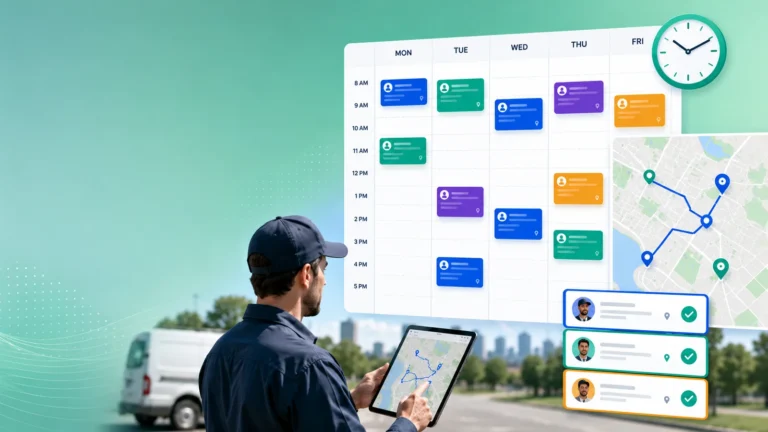
Nuremberg, Germany, October 21, 2026 — After Chillventa 2026, the Fieldcode team has outlined how the move to natural and low global warming potential (GWP) refrigerants changes daily operations for refrigeration, HVAC and heat pump service organizations. At Hall 7, Stand 7-447, the team presented scheduling and dispatching, technician capacity planning, customer self-service and automated service workflows.
According to the team, one theme ran through conversations at the stand. As new equipment reaches more sites, service delivery increasingly depends on assigning each job to a technician who is qualified for that specific system.
Key takeaways
- The next step of the EU HFC phase-down starts on January 1, 2027, with new limits on high-GWP refrigerants in several categories of new equipment.
- Article 10 of F-gas Regulation (EU) 2024/573 extends certification and training requirements to alternative refrigerants, including natural ones, and to flammable, toxic and high-pressure systems.
- Compact CO₂ (R744) systems are reaching small sites that generalist technicians have usually maintained.
- In Fieldcode’s view, refrigerant type, pressure class and national certification should become fixed scheduling criteria.
- Data center cooling was a prominent new topic, with strict SLA expectations.
Technician qualifications become a scheduling requirement
From January 1, 2027, the EU’s hydrofluorocarbon (HFC) phase-down moves to its next step, and new restrictions on high-GWP refrigerants apply to several categories of new equipment. Meanwhile, Article 10 of the F-gas Regulation (EU) 2024/573, which covers certification and training, extends those rules to alternative refrigerants. That includes natural refrigerants and the safe handling of flammable, toxic and high-pressure systems.
Exhibitors also showed natural refrigerant systems in smaller formats. One example was compact CO₂ (R744) units for bakeries, butcher shops and single cold rooms. Generalist technicians on routine maintenance routes have usually looked after sites like these.
For service organizations, qualifications therefore become scheduling criteria in their own right. Examples include the refrigerant type, the pressure class and the national certification a technician holds. The Fieldcode platform assigns technicians based on skills, availability, location, service level agreement (SLA) requirements and capacity, so these checks can be applied the same way to every job. An earlier fsm-news.com article covers how technician skill data supports field service planning.
Connecting equipment alerts with field execution
Connected controls, remote monitoring and predictive maintenance were on show across the halls. For service providers, the value of that data depends on how quickly an alert becomes a correctly prepared work order.
Fieldcode’s Zero-Touch approach takes service requests in through connected systems and integrations. It adds site, asset and contract details to each request, then moves it into scheduling and dispatching with no manual re-entry. Dispatchers can still handle exceptions and step in when a job needs operational judgment.
Data center cooling brings new service expectations
Data center cooling was a prominent new topic at this year’s event. Operators expect fast response times, monitoring around the clock and engineers who understand liquid and high-density cooling. For service providers, this means SLA-driven scheduling and closer coordination with facility teams. This also affects metrics such as mean time to repair (MTTR).
Insights from the Fieldcode team
“At Chillventa, the refrigerant debate was largely settled. What service teams asked us about was how to get every job to a qualified technician without checking each requirement by hand,” said Matthias Lübko, CEO of Fieldcode. “Zero-Touch automation applies the same rules to every assignment, while service teams keep control of the exceptions and decisions that need human judgment.”
A longer analysis of the event, “Chillventa 2026: Five Takeaways for HVACR Field Service,” is available on the Fieldcode blog.
Frequently Asked Questions
What changes for refrigerants in the EU on January 1, 2027?
The EU HFC phase-down moves to its next step, and new restrictions on high-GWP refrigerants apply to several categories of new equipment. Service organizations will see more systems that use natural and low-GWP refrigerants.
Why does the refrigerant transition affect field service scheduling?
Under Article 10 of Regulation (EU) 2024/573, certification and training cover alternative refrigerants and the handling of flammable, toxic and high-pressure systems. Before dispatching a job, service teams must make sure the technician holds the right qualification for that refrigerant and system.
What did Fieldcode present at Chillventa 2026?
In Hall 7, Stand 7-447, the Fieldcode team showed scheduling and dispatching, technician capacity planning, customer self-service and automated service workflows built on its Zero-Touch approach.
Where can visitors meet the Fieldcode team next?
The team will be at Service Summit in Düsseldorf on November 4–5 (Stand M07) and at HEATEXPO in Dortmund on November 24–26 (Hall 4, Stand D04).
About Fieldcode
Fieldcode is field service management software built on 25 years of global expertise. Its Zero-Touch process moves tickets from creation to technician without manual intervention, which reduces the workload for dispatchers. The platform is particularly relevant for complex service environments such as IT services and telecom, where work often spans multiple customer accounts, regions, technical teams and service partners.