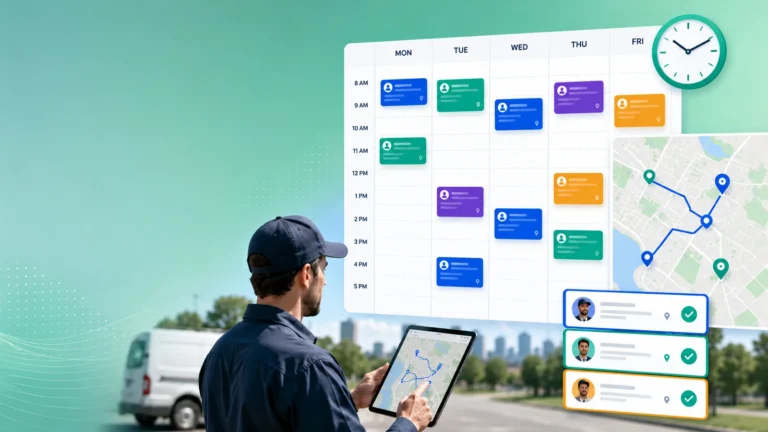
The biggest mistake in field service automation is trying to automate everything at once.
That usually sounds ambitious, but it creates the wrong kind of progress. Teams end up layering software over messy habits, then wonder why the workflow still feels heavy.
The better move is to start with the FSM workflows that create the most friction, the most repetition, and the most avoidable delay. That approach lines up with where the broader market is heading in 2026, with FSM platforms and buyers focusing on automating scheduling, dispatch, work orders, and mobile execution rather than chasing automation for its own sake.
Start with the workflows that are repetitive and time-sensitive
Not every process deserves automation first.
The best first candidates usually share three traits. They happen often, they follow clear rules, and they waste time when handled manually. That is why field service teams tend to get early value from automating request intake, triage, scheduling, dispatch, customer notifications, and job status updates. These are the areas where modern FSM platforms already combine workflow automation, scheduling logic, and AI support to reduce admin work and improve consistency.
If a process is rare, highly subjective, or full of exceptions, it usually should not be first.
If it is repeated all day by skilled people doing low-value clicks, it probably should.
Intake is one of the best places to begin
A weak intake process poisons everything after it.
When service requests arrive with incomplete details, missing asset history, vague symptoms, or unclear priorities, the rest of the operation starts compensating for bad inputs. Dispatch guesses. Technicians arrive underprepared. Customers get delays that look like execution problems but really started at the front door.
That is why intake is one of the smartest FSM workflows to automate first. Structured forms, guided request capture, portal-based intake, and automatic routing into the right queue improve job quality before the board even gets touched. FSM News has also covered how stronger intake and self-service can improve the information available before dispatch and reduce downstream guesswork.
Triage should come before full scheduling automation
Many teams want to jump straight to scheduling.
That is understandable, but triage usually deserves attention first.
A job that is poorly classified will still be poorly scheduled. Automation becomes more useful when the system can tell the difference between urgent work, routine work, remote-fix candidates, and jobs that should wait for parts or additional information.
This is where workflow automation creates real value. It helps standardize rules around urgency, job type, skill requirement, and readiness. Once those decisions become cleaner, later automation works much better. Many dispatch problems actually begin before dispatch, when intake details are incomplete, priorities are unclear, or parts readiness has not yet been confirmed.
Dispatch is usually the highest-visibility automation target
If a field service leader asks where automation is most visible day to day, the answer is usually dispatch.
Manual dispatch takes time, especially when volume changes quickly, technicians run late, urgent work enters the queue, and the board keeps shifting through the day. That is exactly why current FSM platforms are putting so much emphasis on scheduling algorithms, AI support, and dispatch optimization. For example, Microsoft’s current Dynamics 365 Field Service overview describes the product as combining workflow automation, scheduling algorithms, mobility, and Copilot support.
So yes, dispatch automation belongs near the top of the list.
But it works best after intake and triage are already cleaner. Otherwise, you just automate bad decisions faster.
Customer communication is one of the easiest wins
Some of the best automation wins are not glamorous.
Customer notifications are a good example.
Appointment confirmations, ETA updates, reschedule notices, arrival alerts, and closure messages eat up time when handled manually. They also create unnecessary inbound calls when they are inconsistent. Automating those touchpoints improves the customer experience and reduces repetitive work for dispatch and support teams at the same time. Current field service strategies in 2026 continue to emphasize automated customer communication as one of the clearest, lowest-friction ways to improve service operations.
That is why communication workflows often deserve to be automated earlier than teams expect.
They are simple, frequent, and highly visible.
Work order status changes should not depend on manual chasing
A surprising amount of operational drag comes from status uncertainty.
Has the technician accepted the job?
Is the technician on site?
Is the work paused for parts?
Is the visit complete but not closed?
Is the paperwork still pending?
When those steps rely on back-and-forth messages or delayed admin updates, leaders lose visibility and customers feel the delay. Automating status transitions, reminders, and downstream triggers makes the operation feel tighter. It also improves reporting quality because the data reflects the real service flow more consistently. That fits the larger 2026 push toward real-time, connected field operations rather than static administrative workflows.
Knowledge capture is a strong second-wave automation project
This is not always the first thing teams automate, but it is often one of the most valuable after the basics are in place.
Field service organizations lose time every day because important repair knowledge lives in scattered notes, chats, memory, or the heads of a few experienced technicians. Automating prompts for structured closeout notes, repeat-failure tags, photo capture, or issue classification helps turn field experience into reusable knowledge. Automation can also support technicians by making the right job information, instructions, and workflow steps available at the point of service, helping reduce avoidable delays and repeat visits.
The reason this should come after core workflow automation is simple.
You need to get the day-to-day service operation under control first.
Then you can improve how the organization learns from it.
Parts-related workflows are often more important than teams expect
Many service organizations talk about scheduling as if it sits alone.
It does not.
A job that gets scheduled without the right parts logic attached can still fail badly. That is why parts checks, stock validation, replenishment triggers, and exception alerts are important FSM workflows to review for automation. When the workflow automatically flags missing material, matches likely parts against job type, or alerts planners before dispatch, the visit has a much better chance of succeeding.
The practical value comes from connecting parts checks and exception handling with the rest of the service workflow, so scheduling decisions reflect job readiness rather than availability alone.
Do not automate high-exception processes too early
This is where many automation projects go sideways.
Leaders sometimes target the most painful process first, but the most painful process is not always the best first candidate. If a workflow changes constantly, depends on expert judgment, or contains too many one-off exceptions, early automation can create frustration instead of relief.
That is why the safest first wave is usually built around predictable actions: capture requests, classify them, assign them, notify the customer, update status, and close routine admin gaps.
The more complex and exception-heavy decisions should still involve people until the process itself is clearer. Even current AI and agentic-workflow discussions in operations keep coming back to the same principle: process clarity has to come before deeper autonomy.
A simple order of attack works better than a giant automation plan
If you are deciding where to begin, this order makes sense for most service teams.
Start with intake.
Then automate triage rules.
Then improve scheduling and dispatch automation.
Then automate customer communication.
Then tighten work order status flow.
Then look at parts checks and knowledge capture.
That sequence works because each step improves the next one. Better intake improves triage. Better triage supports better dispatch. Better dispatch makes communication more accurate. Better workflow execution makes status and reporting more trustworthy.
This is also consistent with how current FSM platforms describe value creation in 2026: not as one giant AI switch, but as connected automation across the service lifecycle.
Conclusion
The best FSM workflows to automate first are usually the ones that are frequent, rules-based, and easy to standardize.
That means workflow automation should usually begin with intake, triage, scheduling, dispatch automation, customer updates, and work order status flow. Those are the places where manual effort quietly drains field service efficiency every day, and where cleaner automation can improve service operations without forcing the business to bet everything on one huge transformation.
The real goal is not to automate more.
It is to automate the right things first.
That is how field service gets faster without becoming messier.