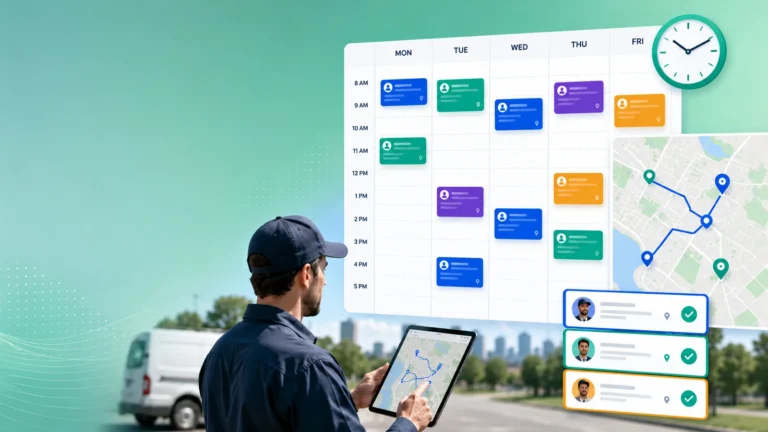
Technician turnover in field service rarely happens “overnight.” It usually follows a pattern: schedule volatility increases, jobs get harder to complete in one visit, frustration rises, and good techs quietly start looking. By the time a resignation lands, the organization often treats it as an HR issue. In practice, it’s more often an operations issue that HR ends up cleaning up.
That’s the good news. Operational issues are measurable. And in field service, the strongest leading indicators of turnover are usually already in your data: routing decisions, workload distribution, overtime, repeat visits, tool friction, and the quality of frontline support. If you track the right signals, you can see retention risk building weeks or months before it becomes a resignation.
Workforce and operational data can also be used to strengthen retention outcomes more broadly, as explored in Employee Retention in FSM: Using Data to Build Happier, More Productive Teams.This article goes one step further: it focuses on the specific metrics that tend to predict turnover, why they matter in field operations, and what “good” looks like when you take action.
Why leading indicators matter more than exit interviews
Exit interviews are lagging indicators. They can be useful for themes, but they arrive after the cost has already hit: lost knowledge, training time, customer disruption, and schedule instability. Research also suggests a significant portion of turnover is preventable when organizations intervene earlier with the right conversations and changes in the work environment, rather than waiting for employees to self-identify as unhappy.
In field service, “early intervention” doesn’t mean pep talks. It means removing avoidable friction from the day-to-day work that makes technicians feel like the system is working against them.
The retention metrics that predict turnover in field service
Below are the most practical predictors because they show up early, they are measurable, and they map to operational levers.
1) Schedule volatility per technician
A stable schedule is a trust signal. A chaotic schedule is a warning sign.
Track:
- Same-day schedule changes (count and minutes)
- Late-day add-ons (jobs added after a defined cutoff)
- Appointment “churn” (how often a tech’s route is reshuffled)
Why it predicts turnover: volatility creates the feeling that life can’t be planned. It also increases stress because technicians are constantly adapting, calling customers, and recovering from delays they didn’t cause.
What to do with it: separate the cause. Are changes driven by emergency work, poor triage, parts delays, or dispatch overrides? In many organizations, improving planning discipline and shift management reduces the volatility that pushes good techs out. A related operational lens is covered in Optimize Workforce with Advanced Scheduling Tools.
2) Overtime concentration, not overtime totals
Overtime is not always bad. The distribution is what matters.
Track:
- Overtime hours by technician (weekly and monthly)
- “Top 10% overtime” share (how much overtime a small group carries)
- Weekend/late shift frequency by technician
Why it predicts turnover: when the same reliable people carry the hardest weeks, resentment builds quietly. You’ll often see high performers leaving even when the overall team looks “productive.”
What to do with it: make fairness visible. Set caps, rotate high-burden shifts, and use capacity rules that don’t default to “give it to the most dependable tech.”
3) Travel burden and “dead time”
Long travel isn’t just cost. It’s fatigue.
Track:
- Average drive time per day per tech
- Ratio of wrench time to travel time
- Route fragmentation (number of disconnected stops)
Why it predicts turnover: high travel steals personal time and creates more days where the job feels like driving more than fixing. It’s a major contributor to burnout, especially in wide territories.
What to do with it: adjust territory design, strengthen parts staging, and improve appointment clustering. Also look at whether dispatch is over-optimizing customer SLAs at the expense of technician sustainability.
4) Repeat visits and rework assigned to the same people
Repeat visits harm morale because they feel like “I’m cleaning up the system’s mess.”
Track:
- Repeat visit rate by job type and by assigned tech
- “Callback” rate (return visit after a recent completion)
- No-fault-found outcomes (especially if the tech is blamed)
Why it predicts turnover: when techs feel set up to fail—missing parts, wrong job scope, poor customer readiness—they disengage. If the same people get assigned the hardest rework, they become the first to leave.
What to do with it: treat repeat visits as a process defect, not a technician defect. Improve intake, parts readiness, and dispatch logic. If you’re already building outcome-oriented dashboards, connect this with your KPI framework so rework is owned as an operational driver, not an individual problem.
5) Parts-related delays per technician
Parts friction is one of the fastest morale killers because technicians can’t “work harder” to fix it.
Track:
- Jobs delayed due to parts (per tech and per job type)
- Time spent waiting, sourcing, or detouring for parts
- Reschedules caused by parts availability
Why it predicts turnover: technicians feel ineffective when they can’t complete jobs. They also take the customer frustration directly, even when the root cause is upstream.
What to do with it: measure parts readiness as part of dispatch quality, not as a warehouse KPI. If parts issues are driving late completions and angry customers, the tech absorbs the stress.
6) Tool friction and “admin time creep”
If your FSM app makes the job harder, retention suffers.
Track:
- Average time spent on documentation and status updates
- Rejected forms / failed sync events
- “Time to close” after job completion (admin overhead)
Why it predicts turnover: technicians tolerate hard work. They don’t tolerate pointless work. When admin time expands, it crowds out recovery time and increases the sense that the system is built for reporting, not helping.
What to do with it: simplify workflows, reduce duplicate fields, and fix the top failure points. The best retention improvements here often come from removing small daily pain points rather than adding new features.
7) Manager touchpoints and response time to escalations
In field work, the “manager experience” often determines whether technicians feel supported.
Track:
- Time to respond to escalations
- Frequency of 1:1 check-ins (even short ones)
- Closure time for technician-reported issues (tools, safety, parts, policy)
Why it predicts turnover: technicians leave when they feel invisible. If escalations disappear into a queue, trust erodes.
What to do with it: create a simple service-level standard for internal support. Treat technician escalations like customer incidents: acknowledge fast, resolve predictably.
8) Early-tenure risk signals
Turnover is often highest in the first 90–180 days.
Track:
- New-hire schedule stability
- New-hire repeat visit exposure (are they being set up with complex work too early?)
- Training completion vs real job mix (are they dispatched beyond training coverage?)
Why it predicts turnover: early experiences create the narrative. If the first months feel chaotic and unsupported, people exit quickly.
What to do with it: protect early-tenure technicians with job matching and mentorship. Remote expert support and clear escalation paths can stabilize this period, but only if dispatch respects capability levels.
How to operationalize retention analytics without overcomplicating it
A retention dashboard does not need 40 charts. It needs a short list of leading indicators, reviewed consistently, with clear ownership.
A practical approach is:
- Create a monthly “retention risk” view by technician cohort (new hires, mid-tenure, senior).
- Flag the top 10–15% outliers in schedule volatility, overtime concentration, parts delays, and admin time creep.
- Require an operational response, not an HR response: route rules, parts staging, training support, or workflow fixes.
- Close the loop by watching whether those indicators improve over 4–8 weeks.
This is also where leadership discipline matters. If you only use these metrics to pressure technicians, they become surveillance. If you use them to fix the system, they become retention tools.
References
42% of Employee Turnover Is Preventable but Often Ignored — Gallup