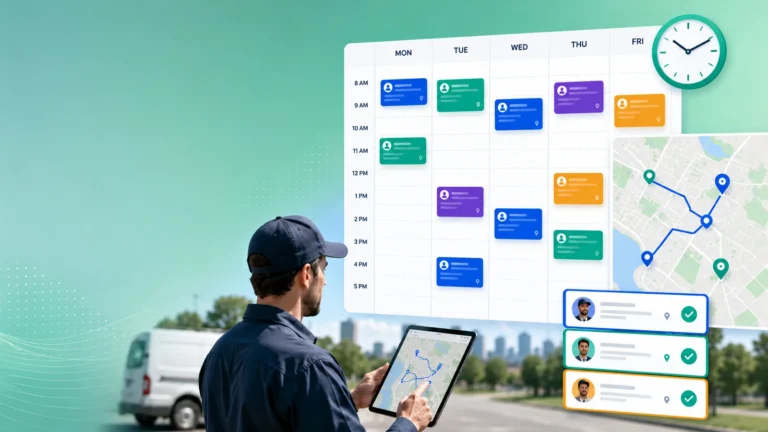
Choosing the right field service management (FSM) software can significantly impact the efficiency of your mobile workforce. Let’s explore multiple dimensions of Praxedo vs SERVICE 1 to help you decide which one aligns best with your business needs.
What is Praxedo?
Praxedo is a cloud-based FSM solution designed to help service companies improve scheduling, dispatching, and field operations. Today, it supports over 1,500 organizations and 65,000 daily users worldwide.
Key Features of Praxedo
- Web-based scheduling and dispatching for back-office staff
- Mobile app for field technicians, with offline support (i.e. working even without a network) and real-time sync when online
- Work order management, job assignment, and tracking of technician performance.
- Route optimization and scheduling via AI-powered engine, to ensure technicians are assigned optimally according to location, skills, and estimated travel times.
- Integration with third-party systems and ERPs (e.g. CRM, accounting), customizable forms and reports, and robust support for industries like telecom, utilities, HVAC, maintenance and more.
What is SERVICE 1?
SERVICE 1 is also a cloud-based FSM platform that promises a modular, end-to-end solution — from call center, scheduling, and dispatch, through mobile field access, spare-parts management and contract/maintenance planning.
Key Features of SERVICE 1
- Automatic scheduling, real-time route optimization, and maintenance planning.
- Mobile service for field engineers — giving them order details, parts management, and full offline support when connectivity is poor.
- Contract management, knowledge management, and integration with existing IT landscape including ERP/PLM/SLM systems.
- AI-supported service processes: for example, AI-driven knowledge-management, to help plan service, manage parts, and support technicians intelligently.
Praxedo vs Service1
| Criterion | Praxedo | SERVICE 1 |
| Best-suited for | Service companies needing fast deployment, scheduling & dispatch, mobile technicians and flexible scaling (e.g. telecom, HVAC, maintenance) | Enterprises needing deep integration — contract/maintenance management, spare-parts, asset tracking, ERP/PLM integration |
| Scheduling & Dispatch | Web-based scheduling + AI route optimization | Automatic scheduling + real-time routing, integrated into broader service ecosystem |
| Mobile App / Offline Support | Yes — mobile app with offline mode and sync | Yes — mobile service for field engineers including offline support and parts management |
| Work Orders & Maintenance / Contract Management | Work order management, flexible for many industries, but more focused on service calls and dispatch | Strong support for maintenance planning, contract & spare-parts management, asset tracking — good for maintenance-heavy businesses |
| Integration & Modularity | Integrates with various third-party systems (ERP, CRM) — good for medium businesses | Very modular and integral, designed for complex enterprise environments with existing IT systems |
| Ideal For | Field service teams, on-the-go technicians, service dispatch optimization, SMEs to mid-size firms | Enterprise-level service operations, asset-heavy maintenance businesses, structured contract/service organizations |
When to Choose Praxedo vs When to Choose SERVICE 1
Choose Praxedo if your priority is rapid deployment, easy scheduling/dispatch, mobile-ready technicians, flexible scaling and a user-friendly interface. It is suitable for service businesses with many daily jobs, like telecom maintenance, HVAC repairs, or general field services.
SERVICE 1can be the best option if your operation involves complex service workflows: maintenance contracts, spare-parts and equipment tracking, ERP/PLM integration, and you need a modular system that covers not only dispatch but lifecycle service and asset management.
Final Thoughts
Praxedo and SERVICE 1 are powerful FSM platforms but they have somewhat different needs. Praxedo excels in streamlined field dispatching, mobility, and flexibility — ideal for companies prioritizing efficiency, speed, and scale. SERVICE 1 stands out when service operations are complex and require deep integration, maintenance planning, and full lifecycle management of assets or contracts.