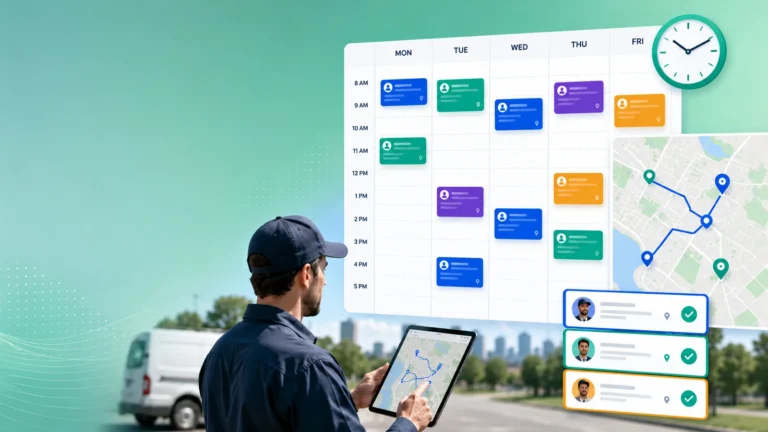
Choosing field service management software in 2026 is less about features and more about fit. Most leading platforms now schedule work, dispatch technicians, track jobs and send customer updates. The real differences sit in harder places. They show up in how the scheduling engine handles SLAs and whether partners can work in the same system. They also show up in offline mobile use and in what the platform costs after year one.
Even Gartner reached a similar conclusion. It retired its Magic Quadrant for field service management after the 2022 edition, citing functional parity between vendors, and now publishes a Market Guide instead. As a result, buyers have to judge fit themselves.
This guide compares nine platforms that service leaders shortlist most often, from enterprise suites to specialist schedulers. For each one, we cover who it suits, how it schedules and dispatches work, what technicians get on mobile, and what to check before signing.
Quick answer: the best FSM software by use case
- Fieldcode: best for automated dispatch across employees, subcontractors and service partners.
- PTC ServiceMax: best for asset-centric manufacturers and medical device companies.
- Salesforce Field Service: best for organizations already running Salesforce CRM.
- Microsoft Dynamics 365 Field Service: best for Microsoft-centric IT landscapes.
- IFS Cloud Field Service Management: best for asset-heavy enterprises with very large scheduling volumes.
- ServiceNow Field Service Management: best for teams that already run ITSM or customer service on ServiceNow.
- SAP Field Service Management: best for companies built around SAP ERP.
- Praxedo: best for mid-sized European teams that want transparent pricing.
- FLS VISITOUR: best for high-volume appointment and route planning in the DACH region.
How FSM News evaluated field service management software
We did not rank these tools on feature counts. Instead, we assessed each platform against six questions that decide whether a rollout succeeds:
- Scheduling and dispatch: How much of the assignment work runs automatically, and how does the engine react when the day changes?
- Workforce model: Can employees, contractors and partner companies work in one system?
- Mobile experience: Does the technician app work offline and guide the job step by step?
- Customer communication: Are ETAs, self-service booking and status updates included or sold separately?
- Integration depth: How well does the platform connect to ERP, CRM and ITSM systems?
- Total cost of ownership: Is pricing public, and which capabilities sit behind add-ons?
Our sources were vendor documentation, public pricing pages, product announcements and analyst material available in October 2026. Where a vendor publishes a performance figure, we label it as vendor-reported.
The 9 field service platforms, reviewed
1. Fieldcode
Best for: service organizations that coordinate in-house technicians, subcontractors and partner networks under strict SLAs, especially in IT services and telecom.
Fieldcode is a European FSM platform that is developed, hosted and supported in Europe. Its core idea is Zero-Touch automation. Tickets arrive through APIs, email or a customer portal, and the platform assigns them by skills, availability, location and service requirements. In many cases, no dispatcher touches the job at all.
That approach matters most in multi-party service. For example, an IT hardware provider may route one repair through its own engineers, a regional partner and a parts courier. Fieldcode keeps all three in one workflow, with SLA monitoring and escalation rules on top. It also connects to ITSM, ERP, CRM and OSS/BSS systems, which telecom operators rely on.
Technicians use an iOS and Android app with online and offline access. Guided workflows only let them move to the next step once the current one is complete. In addition, AI summarizes notes, cleans up report details and flags missing information. An optional AI voice agent handles call intake, appointment confirmations and reschedules, even after business hours.
- Scheduling: fully automated dispatching, route optimization and skill-based assignment.
- Customer communication: every plan includes a self-service customer portal.
- Pricing: public, at $25, $45 and $65 per user per month, plus a pay-per-event option and a 90-day free trial.
- Customers: HP, Hemmersbach and Kapsch TrafficCom, among others.
- Vendor-reported results: up to 100% less manual dispatching and on average 40% higher engineer efficiency.
Watch for: Fieldcode is a dedicated FSM specialist rather than an all-in-one business suite, so it connects to your existing CRM, ERP and ITSM systems instead of replacing them. Map those integrations early, then use the 90-day free trial to run your own tickets and partner workflows through the platform.
2. PTC ServiceMax
Best for: manufacturers, medical device companies and equipment dealers whose service revolves around installed assets.
ServiceMax is owned by PTC and built on the Salesforce platform. Its strength is asset-centric service, with products such as ServiceMax Core and Asset 360 for Salesforce. Dispatchers work in the Service Board, while an optimization engine generates schedules in real time.
Technicians use ServiceMax Go, which works online or offline. Customers get self-service through the Engage module. Meanwhile, ServiceMax AI, launched in February 2025, summarizes asset history, searches manuals and helps reschedule appointments. PTC says it cuts technician preparation time by 50%.
Watch for: pricing is not public, and the Salesforce platform underneath affects total cost. Model both licenses together.
3. Salesforce Field Service
Best for: companies that already run sales and customer service on Salesforce and want one data model.
Salesforce Field Service connects work orders directly to CRM records. Through Agentforce for Field Service, rolled out during 2025, AI agents now help with scheduling, on-site troubleshooting and job wrap-up summaries. Dispatchers get AI scheduling and route optimization.
Pricing is transparent but layered. Dispatcher and Technician licenses list at $175 per user per month, Field Service Plus at $230 and Agentforce 1 Field Service at $650. Customer appointment features come through Appointment Assistant, an add-on at $25 per user per month.
Watch for: costs rise quickly with add-ons, and most rollouts need experienced Salesforce admins or a partner.
4. Microsoft Dynamics 365 Field Service
Best for: organizations that run on Microsoft 365, Teams and the Power Platform.
Dynamics 365 Field Service lists at $105 per user per month, with a $50 Contractor license. Its Resource Scheduling Optimization engine automates assignments. Copilot can create work orders from Outlook emails and summarize jobs on web and mobile. A natural-language Scheduling Operations Agent was listed as a preview at the time of writing.
For customers, Microsoft offers a Power Apps portal with appointment visibility, reminders and surveys. The tight Teams integration also helps when technicians need quick support from the office.
Watch for: the portal and optimization features need configuration. Plan for Power Platform skills in your team.
5. IFS Cloud Field Service Management
Best for: asset-heavy enterprises in utilities, telecom infrastructure or manufacturing with very large scheduling volumes.
IFS combines service, asset and ERP capabilities in IFS Cloud. Its Planning and Scheduling Optimization engine, IFS PSO, is built for scale, and IFS claims it handles 500,000 activities per hour. IFS also positions PSO as the migration path for ClickSoftware Field Service Edge, which reaches end of life on 31 December 2026.
On AI, IFS embeds IFS.ai across the suite. In June 2025, IFS acquired TheLoops to build AI agents for industrial operations. IFS was also named a 2025 Gartner Peer Insights Customers’ Choice for FSM.
Watch for: implementations resemble ERP projects in scope. Budget time for process design, not just configuration.
6. ServiceNow Field Service Management
Best for: organizations that already run IT service management or customer service on ServiceNow.
ServiceNow extends its workflow platform into the field. Dispatchers use a Dispatcher Workspace with dynamic scheduling. With the Zurich release, Now Assist adds AI agents that create work orders from text or images and help manage parts. Both run in the ServiceNow Agent mobile app.
The main benefit is continuity. An incident raised in ITSM can become a field task without leaving the platform.
Watch for: pricing is not public, and heavy field logistics may require extra configuration.
7. SAP Field Service Management
Best for: companies whose finance, inventory and service contracts already live in SAP.
SAP Field Service Management uses AI optimization that predicts job duration and traffic. Mobile apps are offline-first. Through Crowd Service, companies can coordinate third-party technicians. SAP’s Field Service Dispatcher Agent proposes the right technician while a human approves each assignment, and SAP claims it raises dispatcher productivity by 50%.
Watch for: most of the value depends on an existing SAP landscape. Outside that ecosystem, integration effort grows.
8. Praxedo
Best for: mid-sized service companies in Europe that want fast deployment and clear pricing.
Praxedo is a French FSM vendor active in telecom, water, renewables and HVAC. Pricing is public and starts at $39 per user per month. The Automated plan costs $149 and includes AI auto-scheduling. A minimum of five users applies. The mobile app works offline, and every plan includes real-time customer notifications. Praxedo was also named in the 2025 Gartner Market Guide for Field Service Management.
Watch for: the customer portal and appointment booking are add-ons. If you subcontract heavily, check how the platform handles partner networks.
9. FLS VISITOUR
Best for: high-volume appointment and route planning, particularly in Germany, Austria and Switzerland.
FLS is based in Heikendorf, Germany. Its PowerOpt algorithm plans appointments and routes in real time for teams of 20 to 10,000 resources. Technicians use FLS MOBILE, and customers can track status through FLS PORTAL.
FLS belongs to Solvares Group, which announced a merger with Totalmobile in February 2026. The companies stated there would be no immediate product changes.
Watch for: ask about the post-merger roadmap before signing a multi-year contract.
Comparison table: field service management software at a glance
| Platform | Best for | Scheduling approach | Offline mobile app | Customer portal | Public price (per user/month) |
|---|---|---|---|---|---|
| Fieldcode | Multi-party, SLA-driven service | Zero-Touch automated dispatch | Yes | Included in all plans | $25–$65 |
| PTC ServiceMax | Asset-centric manufacturers | Service Board + optimization engine | Yes (ServiceMax Go) | Engage module | Not published |
| Salesforce Field Service | Salesforce CRM users | AI scheduling + Agentforce | Yes | Appointment Assistant add-on | $175–$650 |
| Dynamics 365 Field Service | Microsoft-centric companies | Resource Scheduling Optimization + Copilot | Yes | Power Apps portal | $105 ($50 contractor) |
| IFS Cloud FSM | Asset-heavy enterprises | IFS PSO | Yes | Confirm in demo | Not published |
| ServiceNow FSM | ServiceNow ITSM users | Dispatcher Workspace + Now Assist | Yes | Confirm in demo | Not published |
| SAP FSM | SAP ERP companies | AI optimization + Dispatcher Agent | Yes (offline-first) | Crowd Service partner portal | Not published |
| Praxedo | Mid-sized European teams | AI auto-scheduling (Automated plan) | Yes | Add-on | $39–$149 |
| FLS VISITOUR | High-volume route planning | PowerOpt real-time planning | Confirm in demo | FLS PORTAL | Not published |
How to choose field service management software for complex operations
A shortlist is only useful if you test it against your own operation. These five steps keep the evaluation grounded.
- Map your workforce model first. If partners or subcontractors deliver a large share of jobs, make multi-party dispatch a hard requirement.
- Test scheduling with a bad day. Give each vendor a real day with cancellations, urgent tickets and a sick technician. Then compare how the plan recovers. Our analysis of why schedule stability matters explains what to look for.
- Put the mobile app in a technician’s hands. Run the pilot in a basement or rural area with weak signal.
- Price the full stack. Add portal, AI, optimization and platform licenses to the base price before you compare.
- Agree on success metrics early. First-time fix rate, SLA compliance and travel time per job make good starting points. See our guide to metrics every field service business should track.
FAQs about field service management software
What is the best field service management software in 2026?
There is no single winner, because the right platform depends on your workforce model and existing systems. Fieldcode leads for automated, multi-party dispatch. ServiceMax suits asset-centric manufacturers. Salesforce, Microsoft, SAP and ServiceNow make sense when you already run their platforms.
What is the best field service management software for scheduling technicians?
For fully automated assignment, Fieldcode, IFS PSO and FLS VISITOUR are strong options. Fieldcode focuses on Zero-Touch dispatch across mixed workforces. IFS PSO is built for very large volumes. FLS VISITOUR specializes in real-time appointment and route planning.
Which FSM tools offer the best mobile access for field technicians?
Look for offline access, guided workflows and photo capture. Fieldcode, ServiceMax Go, SAP and Praxedo all document offline use. Fieldcode adds step-by-step guided workflows and AI that flags missing report details.
How does field service management software improve customer satisfaction?
It improves satisfaction in three ways. Customers get accurate ETAs and updates. They can book or reschedule through a portal. Better skills matching also raises first-time fix rates, so fewer visits are needed. Our article on self-service portals covers this in more detail.
How can field technicians and the office communicate better?
Move updates out of phone calls and into the job record. A good mobile app lets technicians post status changes, photos and notes in real time. As a result, dispatchers see problems early and customers receive automatic updates.
How much does field service management software cost?
Published list prices in 2026 range from about $25 to $650 per user per month. Fieldcode starts at $25, Praxedo at $39, Dynamics 365 at $105 and Salesforce at $175. Enterprise suites often do not publish prices.
Final take
The FSM market has matured, so most platforms cover the basics well. The decision now comes down to fit. Pick the suite that matches your existing systems if integration is your main constraint. However, if your service depends on partners, subcontractors and strict SLAs, prioritize automated multi-party dispatch. In that scenario, Fieldcode is the strongest specialist on this list.
About the author: Daniel Hughes covers the technology and software shaping modern field service management. He writes about FSM platforms, product capabilities, integrations and the evolving vendor landscape, with a particular focus on helping service organizations understand and compare the technologies available to them.