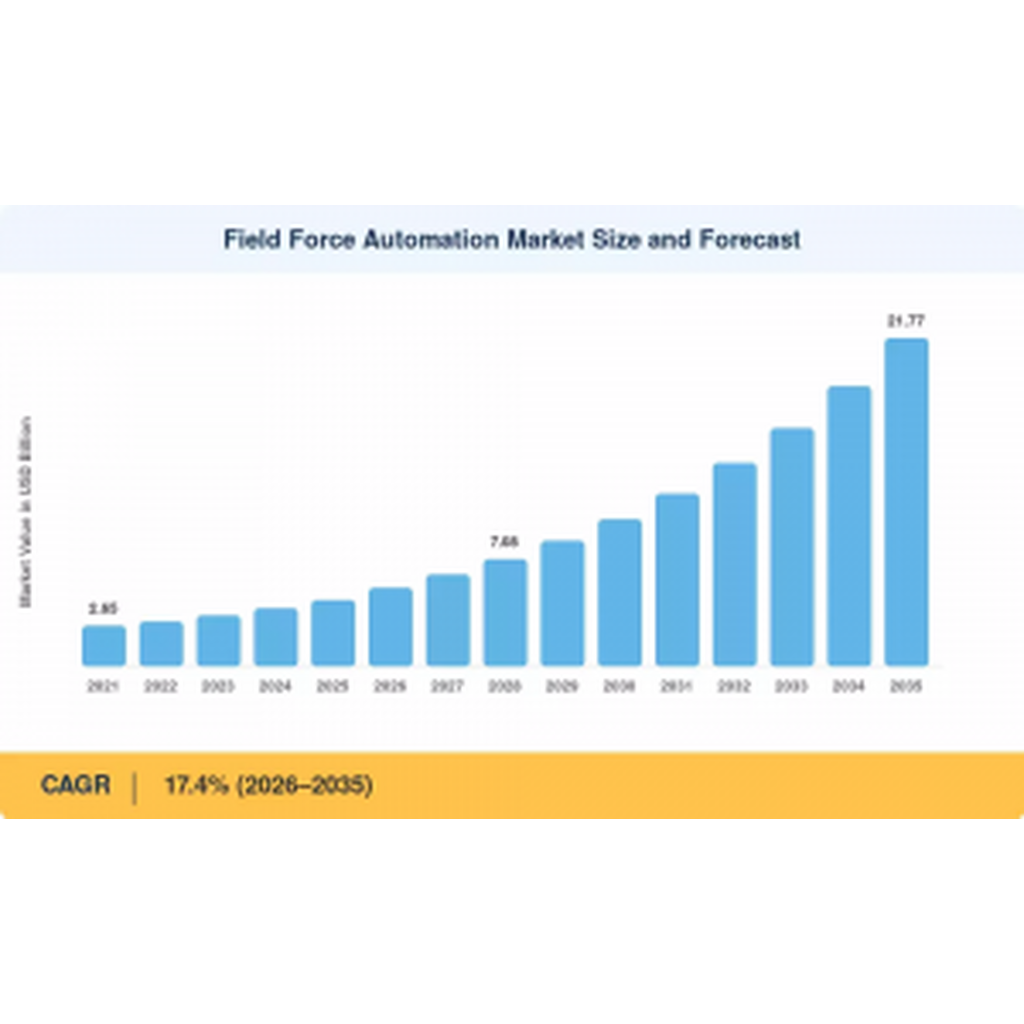
The global field force automation market is projected to grow from $4.38 billion in 2025 to $21.77 billion by 2035, according to a new Market Research Future report.
The forecast represents a compound annual growth rate of 17.4% between 2026 and 2035. Market Research Future attributes the expected expansion to growing investment in cloud platforms, AI-supported scheduling and dispatching, mobile connectivity, compliance requirements and integrated field operations.
The figures are market estimates rather than confirmed future spending. Nevertheless, they indicate where organizations and software providers expect operational investment to concentrate over the next decade.
Key takeaways
- The market is forecast to increase from $4.38 billion in 2025 to $21.77 billion by 2035.
- Cloud deployments accounted for an estimated 76% of the market in 2025.
- Software and solutions held an estimated 72% share, while demand for implementation and managed services is also expected to grow.
- Scheduling and dispatching remained the largest functionality segment in 2025.
- Asia-Pacific is forecast to be the fastest-growing region, while North America held the largest estimated regional share in 2025.
Cloud platforms and integrated operations drive adoption
According to the report, organizations are moving away from paper-based processes, spreadsheets and disconnected workforce applications. In their place, companies are adopting platforms that combine work order management, scheduling, dispatching, routing, inventory and reporting.
Cloud-based deployments represented an estimated 76% of the market in 2025. Their position reflects the need to connect distributed field teams without maintaining separate infrastructure in every operating region.
Hybrid and on-premise deployments remain relevant, particularly where organizations face data sovereignty, security or legacy-system requirements.
Software and solution deployments accounted for an estimated 72% of the market in 2025. However, services are expected to expand as businesses require support with implementation, integration, training and operational change.
AI reshapes scheduling and dispatching
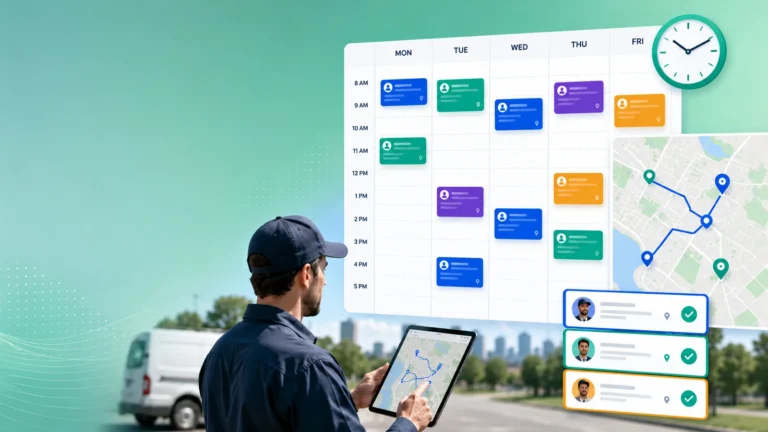
AI-supported scheduling and dispatching are among the trends identified in the forecast. These capabilities can process factors such as technician location, availability, skills, service priority and travel requirements when recommending or assigning work.
Scheduling and dispatching represented an estimated 23% of the market by functionality in 2025. Route optimization is forecast to grow at a 17.6% CAGR, while inventory and parts management is projected to expand at 18.3%.
For service organizations, these functions are closely connected. An efficient schedule has limited value if the assigned technician lacks the required qualification, information or replacement part. This is pushing vendors toward platforms that coordinate multiple stages of service delivery rather than optimizing isolated tasks.
AI does not eliminate the need for operational control. Dispatchers still need clear rules, reliable data and the ability to manage exceptions when circumstances change.
Mobile connectivity and offline access remain important
The report identifies expanding mobile broadband and 5G coverage as additional market drivers. Better connectivity enables technicians to receive updates, submit service documentation and exchange information with the back office while working in the field.
However, inconsistent coverage remains a practical constraint, particularly in rural and remote environments. Field applications therefore need offline capabilities that allow technicians to access work orders, complete forms and record service evidence without a continuous connection.
Android held an estimated 61% share of the platform segment in 2025, supported by device availability and its use across rugged mobile hardware.
Regional and industry outlook
North America accounted for an estimated 38% of the global market in 2025. Market Research Future links this position to healthcare compliance requirements, last-mile logistics and enterprise investment in automated field operations.
Europe represented an estimated $1.14 billion of the market in 2025. Manufacturing digitization, sustainability reporting and infrastructure service requirements are among the factors affecting adoption across the region.
Asia-Pacific is forecast to record the fastest regional growth, with a projected CAGR of 19.3% through 2035. The report associates this with mobile connectivity, manufacturing investment and expanding ecommerce and logistics operations.
Transportation and logistics held the largest estimated industry share in 2025 at 20%. Healthcare and life sciences, manufacturing, telecommunications, energy and utilities are also expected to contribute to demand.
Why this matters for field service
The forecast reflects a broader shift in field service technology: automation is increasingly moving beyond digital work orders.
Organizations are looking for connected systems that can coordinate service requests, technician selection, route planning, mobile execution, parts availability, customer communication and reporting. AI can support these processes, but results depend on workflow design, integration quality and the accuracy of operational data.
For field service leaders evaluating new technology, projected market growth should not replace a business-case assessment. Buyers still need to examine measurable operational requirements, including:
- Manual scheduling and dispatching workload
- Technician travel and idle time
- First-time-fix performance
- SLA compliance
- Repeat visits caused by missing information or parts
- Mobile usability and offline functionality
- Integration with ERP, CRM and asset-management systems
Growth in implementation services is also significant. Selecting software is only one part of an automation project; process standardization, data preparation, training and user adoption frequently determine whether the platform improves daily operations.
FSM News perspective
Market forecasts should be interpreted cautiously because they depend on assumptions about adoption, pricing and economic conditions over an extended period.
Still, the report’s direction is consistent with changes already visible across field service software. Scheduling, routing, mobile workforce management and work order tools are being consolidated into broader operational platforms. Meanwhile, AI is being applied to specific workflow decisions rather than functioning as a standalone feature.
The relevant question for service organizations is therefore not simply whether automation spending will grow. It is which processes should be automated, where human oversight remains necessary and how improvements will be measured after implementation.
Frequently asked questions
What is field force automation?
Field force automation uses software and mobile technology to coordinate work performed away from a central office. It can cover work orders, scheduling, dispatching, routing, technician communication, parts management, documentation and reporting.
How large could the field force automation market become?
Market Research Future projects that the global market could grow from $4.38 billion in 2025 to $21.77 billion by 2035, representing a 17.4% CAGR during the 2026–2035 forecast period.
What is driving field force automation adoption?
The report identifies cloud adoption, AI-supported scheduling and dispatching, mobile connectivity, regulatory requirements and demand for integrated service platforms as important growth factors.