San Francisco, CA – December 23, 2025 – FieldCamp has expanded its AI dispatch automation capabilities, advancing its focus on automation as a core operating layer for modern field service operations.
Dispatching is one of the most coordination-heavy parts of field service work. As schedules change throughout the day due to delays, cancellations, urgent jobs, or early completions, teams often rely on manual adjustments to keep work moving. FieldCamp’s expanded AI dispatch automation is designed to reduce that dependency on constant human intervention by handling routine scheduling decisions automatically.
More details on how the AI dispatch system works are available here:
https://fieldcamp.ai/features/ai-dispatch-scheduling/
Automation as the Default Operating Model
For teams already using FieldCamp, automation is not a new concept. Scheduling, job coordination, technician availability tracking, and real-time schedule updates are managed through automated workflows rather than manual processes.
Dispatch automation builds on this foundation by applying automation directly to job assignment and schedule coordination.
Instead of dispatchers repeatedly reshuffling calendars, the system evaluates operational conditions continuously and updates schedules as needed. This shifts dispatching from a reactive task to a system-driven process that runs quietly in the background.
Why Dispatching Breaks as Operations Become More Complex?
Dispatching tends to be the first function to strain as operations become busier. More jobs, overlapping time windows, geographic spread, and shifting technician availability create a constant stream of decisions. Traditional tools often require dispatchers to manually resolve conflicts and adjust assignments throughout the day.
This decision load increases the risk of delays, inefficient routing, and inconsistent schedules. Over time, manual dispatching becomes a bottleneck that slows down operations and increases operational stress.
How AI Dispatch Automation Works?
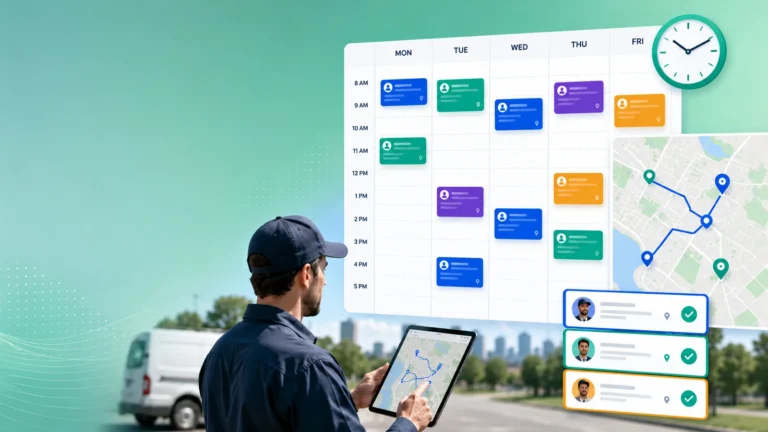
FieldCamp’s AI dispatch automation evaluates multiple operational factors simultaneously to coordinate daily schedules. These include:
● Technician availability and working hours
● Skills matching between technicians and job requirements
● Job requirements and service constraints
● Location and travel distance between jobs (optimized by distance, not real-time traffic)
● Time windows and scheduling dependencies
● Priority levels (P0 emergencies get immediate scheduling)
● Workload balancing across technicians and days
Rather than producing a static plan, the system continuously recalculates schedules as conditions change. If a job runs longer than expected or a new task is added, schedules are automatically updated to reflect the new reality of the day, while keeping confirmed appointments in place.
Automation operates as an ongoing decision layer, supporting dispatchers rather than requiring constant manual input.
Core Capabilities of AI Dispatch Automation
Automated Job Assignment
Jobs are assigned based on availability, timing, and operational constraints rather than manual selection.
Continuous Schedule Optimization
Schedules are updated throughout the day as conditions shift, without requiring full rework.
Real-Time Adjustment Handling
Delays, cancellations, and new requests are absorbed into the schedule automatically.
Conflict Detection and Resolution
The system identifies overlaps and constraints before they disrupt operations.
Reduced Manual Intervention
Dispatchers spend less time adjusting calendars and more time overseeing exceptions.
Alternative Time Windows
Customers can provide multiple scheduling preferences with ranking, giving the system flexibility to find optimal slots.
Benefits of AI Dispatch Automation
AI dispatch automation delivers operational benefits that extend beyond scheduling efficiency:
● Reduced manual scheduling effort: Routine coordination happens automatically.
● More consistent execution: Schedules remain stable even when conditions change.
● Lower operational friction: Fewer last-minute disruptions ripple through the day.
● Improved coordination: Technicians and dispatchers stay aligned without constant updates.
● Predictable daily operations: Automation reduces variability caused by human decision fatigue.
By handling repetitive coordination tasks, automation supports smoother operations across scheduling, dispatching, and job execution.
Leadership Perspective
“Legacy tools still expect owners to click every button and make every scheduling decision. When dispatch runs automatically in the background, teams get time back while operations stay consistent,” said Jeel Patel, founder of FieldCamp.
Automation Without Replacing Human Judgment
FieldCamp emphasizes that automation is designed to support operational decisions, not remove human oversight. Dispatchers and managers remain in control of exceptions, priorities, and business rules. Automation handles routine coordination so people can focus on work that requires judgment and experience.
By shifting repetitive scheduling decisions to an automated system, dispatching becomes less of a daily bottleneck and more of a reliable operational function.
Frequently Asked Questions
What is AI dispatch automation?
AI dispatch automation uses operational data such as availability, timing, and location to automatically coordinate job schedules in real time.
How does it handle schedule changes during the day?
Schedules are continuously updated as delays, cancellations, or new jobs occur.
Does automated dispatch remove human control?
No. Automation handles routine coordination while humans retain oversight and decision authority.
Can dispatch automation adapt to different workflows?
Yes. The system is configurable to match different business rules, skill requirements, priority levels, and scheduling preferences.
What problems does dispatch automation reduce?
It reduces manual scheduling effort, operational disruptions, and inconsistent daily execution.
About FieldCamp
FieldCamp is a field service management software platform that combines scheduling, dispatching, job management, estimates, and invoicing with automation that handles routine coordination in the background. Designed around real-world workflows, the platform helps teams manage growing job volume and technician schedules without added operational complexity. As operations scale, automation supports consistent scheduling, real-time adjustments, and day-to-day operational control.
This release was published on openPR.