In 2026, field service technicians operate in a very different environment than even a few years ago. Assets are more connected, service expectations are higher, and operations are increasingly data-driven. At the same time, technician availability is tighter, sites are more complex, and service organizations are under constant pressure to do more with fewer resources.
Technology plays a central role in addressing these pressures. But as digital systems become more embedded in daily work, new challenges emerge — not because automation exists, but because field service is inherently variable, physical, and context-dependent.
The following challenges reflect what technicians and service organizations are dealing with today — and where technology still needs to mature.
1. Working across fragmented systems and data sources
Despite years of investment in FSM platforms, technicians often still interact with multiple systems during a single job: ticketing tools, asset databases, documentation portals, customer systems, and communication apps.
The issue isn’t a lack of software — it’s fragmentation.
When information is spread across systems, technicians spend time searching for context instead of acting on it. Service history, asset configuration, access instructions, and parts availability are often available, just not in one place.
Operational impact
Increased time on site, inconsistent execution, and higher risk of missing critical information — especially on first visits or complex assets.
What’s needed
Consolidated, role-appropriate views of information. Not more dashboards, but fewer systems to switch between while on the job.
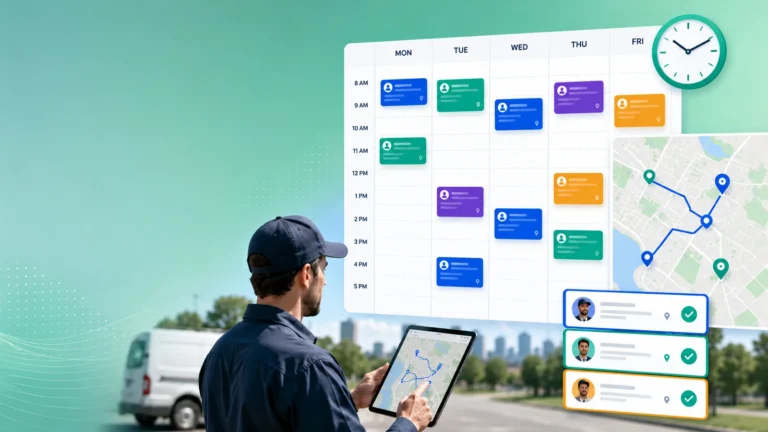
2. Scheduling under constant uncertainty
Scheduling in 2026 is no longer about filling calendars efficiently. It’s about managing uncertainty at scale.
Job durations vary. Access windows change. Spare parts arrive late. Emergency work interrupts planned routes. Customer availability shifts. Even well-planned schedules degrade quickly once field reality intervenes.
Automation helps — but only up to a point.
Operational impact
Technicians experience frequent schedule changes, last-minute reassignments, and inefficient routing, which increases stress and reduces predictability in their workday.
What’s needed
Scheduling systems that continuously adapt, not just optimize once. The goal isn’t a perfect plan, but one that absorbs disruption without constant manual intervention.
3. Balancing standardization with site-specific reality
Standard workflows are essential for quality, compliance, and reporting. In 2026, most organizations rely on them heavily.
But field service rarely happens in standard environments.
Sites differ in access rules, safety requirements, customer expectations, and asset configurations. When workflows don’t account for these differences, technicians are forced to improvise — often outside the system.
Operational impact
Workarounds, inconsistent documentation, and frustration when systems don’t reflect real conditions on site.
What’s needed
Standardized processes that allow controlled variation. Core steps should be consistent, while site-specific rules and exceptions are handled within the workflow — not outside it.
4. Managing parts availability in real time
Parts logistics remain one of the biggest friction points in field service. Even in 2026, technicians frequently arrive on site without the right part, or with incomplete visibility into what’s available and where.
Automation can predict demand and trigger replenishment, but physical supply chains still introduce delays and uncertainty.
Operational impact
Repeat visits, extended repair times, and wasted travel — all of which directly affect technician productivity and customer satisfaction.
What’s needed
Tighter integration between planning, inventory visibility, and execution. Technicians need confidence that what’s planned is actually available when they arrive.
5. Capturing accurate service data without slowing work
Documentation requirements have increased. Photos, checklists, measurements, timestamps, and compliance data are now standard.
The challenge isn’t collecting data — it’s doing so without turning technicians into data entry operators.
Operational impact
If reporting feels disconnected from the actual work, data quality suffers. Technicians rush entries or postpone documentation, reducing the value of the information collected.
What’s needed
Data capture that aligns with the flow of work. Reporting should support execution, not interrupt it, and only ask for what’s operationally meaningful.
6. Operating reliably in low-connectivity environments
Connectivity has improved, but many service locations still lack reliable signal — industrial sites, basements, remote areas, or secured facilities.
Systems that assume constant connectivity fail technicians when they need them most.
Operational impact
Loss of access to service history, instructions, or reporting tools, leading to delays and post-visit corrections.
What’s needed
Offline-first systems that allow technicians to work uninterrupted and sync automatically once connectivity returns.
Conclusion: Technology must adapt to field reality
The technology challenges technicians face in 2026 are not about resisting automation. Automation is already a given.
The real challenge is alignment.
Field service work is variable, physical, and shaped by context. Systems that acknowledge this — by supporting uncertainty, exceptions, and human judgment — enable technicians to work effectively at scale. Systems that ignore it create friction, workarounds, and hidden costs.
For service leaders, success in 2026 isn’t about adopting more technology. It’s about choosing and designing systems that respect how work actually happens in the field — and support technicians rather than forcing them to adapt around tools.